MCP vs OpenAPI: What's the Real Difference?
MCP vs OpenAPI: MCP lets AI agents call tools at runtime, while OpenAPI describes an HTTP API ahead of time. Here is how they differ and work together.
7 min read
AI releases in October 2026, checked against vendor pages: GPT-6.1 Terra, Kimi K3.1 Pro, Gemini 4 Argon, Claude Haiku 5.5 and the open-weight drops.
Six labs shipped new frontier models between 6 and 26 October 2026: OpenAI, Google, Anthropic, Meta, Mistral and Moonshot AI. In the same weeks Meta, Reflection AI, NVIDIA, Recursive and MiniMax put large open-weight models on Hugging Face, and OpenAI halved the input price of its high-volume model. We read the vendor page for every release below, checked the numbers against the model cards, and flagged the places where a popular roundup of the month got a detail wrong.
The main AI releases of October 2026 are GPT-6.1 Terra (OpenAI, 26 October), Kimi K3.1 Pro (Moonshot AI, 23 October), Gemini 4 Argon (Google, generally available 13 October), Muse Wonder (Meta, 12 October), Claude Haiku 5.5 (Anthropic, 7 October) and Mistral Large 4 (6 October), plus open-weight models from Meta, Reflection AI, NVIDIA, Recursive and MiniMax, and Anthropic's Claude Duet agent.
This page is written for people who build agents, so each entry ends on what the release changes for the agent you run. Dates are 2026 throughout, and prices are per million tokens, input then output, as the vendor publishes them.
| Model | Lab | Released | Weights | Price per 1M tokens (in / out) |
|---|---|---|---|---|
| GPT-6.1 Terra | OpenAI | 26 Oct | Closed | $1 / $5 |
| Kimi K3.1 Pro | Moonshot AI | 23 Oct | Promised by 4 Nov | Not shown on Moonshot's page when we checked |
| Gemini 4 Argon | 13 Oct (GA) | Closed | $2 / $10 until 30 Nov, then $4 / $20 | |
| Muse Wonder | Meta | 12 Oct | Closed | Not on Meta's page |
| Claude Haiku 5.5 | Anthropic | 7 Oct | Closed | $0.10 / $0.50 (prompts up to 100k tokens) |
| Mistral Large 4 | Mistral AI | 6 Oct (preview) | Promised by end of October | $1.36 / $4.18 |
| DeepSeek V4.1-Flash-1017 | DeepSeek | 17 Oct | MIT | Served as deepseek-flash |
| Muse Spark Open | Meta | 15 Oct | Muse Model License (gated) | $1.25 / $4.25 on OpenRouter |
| Beam | Reflection AI | 16 Oct (weights) | Apache 2.0 | $0.25 / $1.00 on OpenRouter |
| Nemotron 3.5 Super VL | NVIDIA | 15 Oct | OpenMDW-1.1 | Self-hosted |
| Flint | Recursive | 21 Oct | Apache 2.0 | Free tier on OpenRouter |
| MiniMax M3.1 Flash | MiniMax | 19 Oct | minimax-community | $0.15 / $0.60 |
| Mercury 3 | Inception | 19 Oct | API only | $0.10 / $0.35 (launch price) |
Two of those prices come from OpenRouter's listing, not from the lab, and we say so in each section. Where a vendor publishes no price, the table says that instead of borrowing a number from a blog.
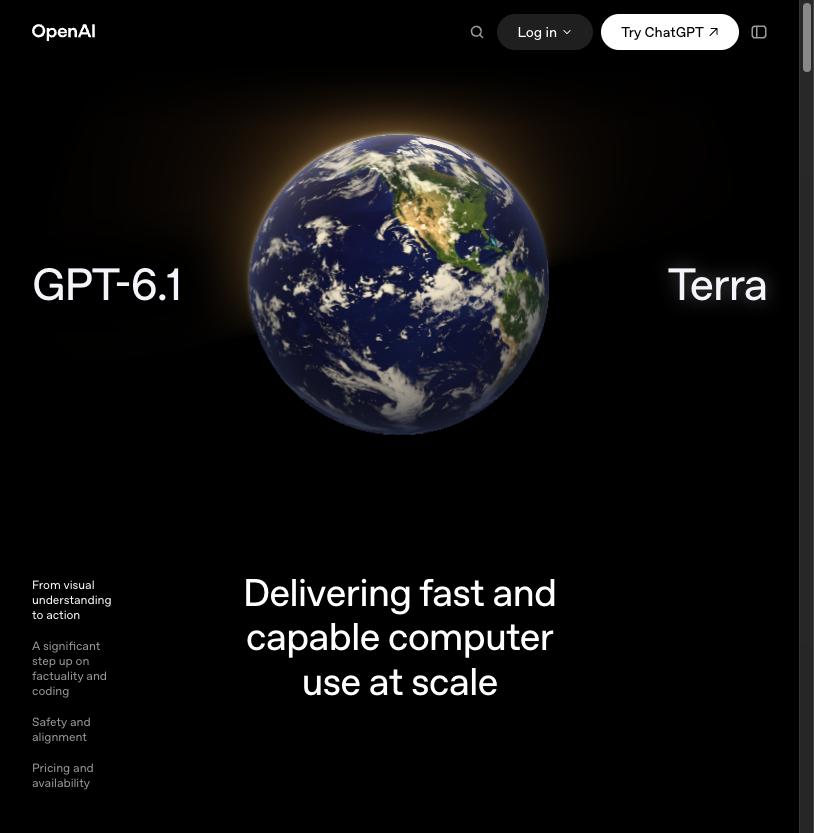
OpenAI's GPT-6.1 Terra announcement, captured 26 October 2026.
GPT-6.1 Terra is OpenAI's fast, high-volume model, and its launch page leads with computer use rather than chat. The model page in OpenAI's API docs lists it as gpt-6.1-terra at $1 per million input tokens, $0.05 cached and $5 output, with a 1,050,000-token context window and up to 128,000 output tokens. It takes text and images, and the computer_use tool works through the Responses API.
The price is the story. The previous model in the line, GPT-5.6 Terra, costs $2 in and $12 out, so input halved and output fell by more than half. A computer-use agent spends most of its tokens reading screenshots and writing short actions, which makes the cheaper input the part you will notice on the invoice. If you run one, our explainer on computer use agents covers the loop these prices apply to.
OpenAI's system card, dated 26 October, rates Terra Critical for cybersecurity capability and High for biological and chemical capability. On prompt injection it gives no Terra-specific figure and says the model behaves like GPT-6 Astra and GPT-6.1 Sol. Read the announcement for availability across ChatGPT and Codex.
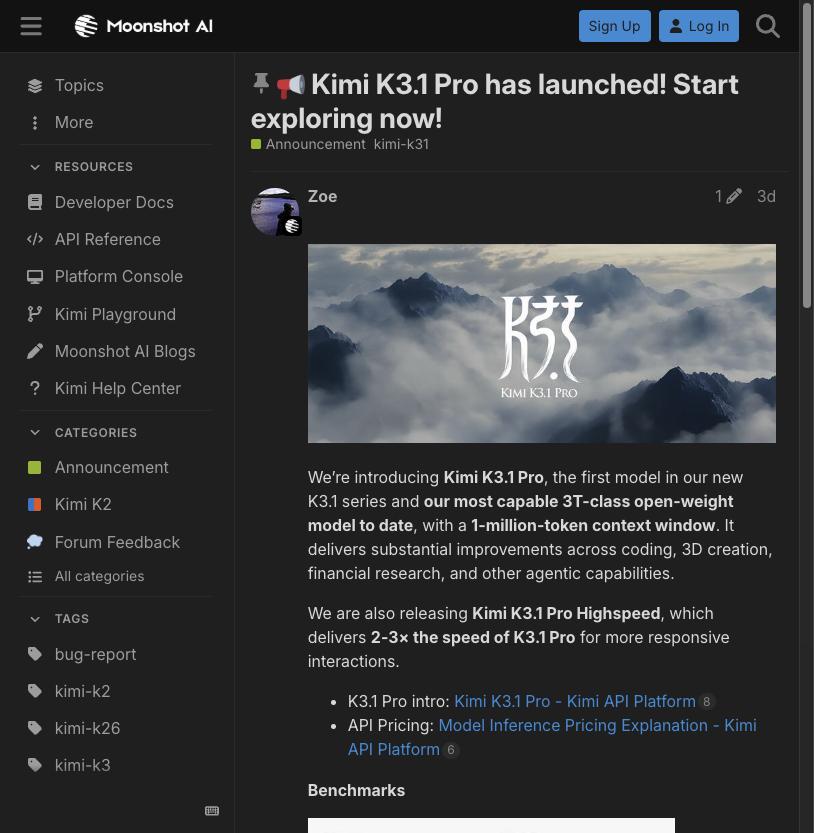
Moonshot AI's launch post for Kimi K3.1 Pro on its developer forum.
Moonshot announced Kimi K3.1 Pro on its developer forum as its strongest 3T-class open-weight model so far, with a 1-million-token context window. A second model, K3.1 Pro Highspeed, runs two to three times faster. The quickstart gives the API ids kimi-k3.1-pro and kimi-k3.1-pro-highspeed, accepts image and video input, and keeps thinking on at all times, with effort set to low, high or max. Moonshot reports 81.0% pass@3 on xdev-bench-hard.
Two cautions before you plan around it. Weights are promised by 4 November and are not out yet, and the quickstart does not state a licence. And the "2.8T total, 104B active" figure doing the rounds belongs to the earlier Kimi K3; for K3.1, Moonshot only says "3T-class". Moonshot's pricing page rendered empty tables when we checked, so we have left the price out.
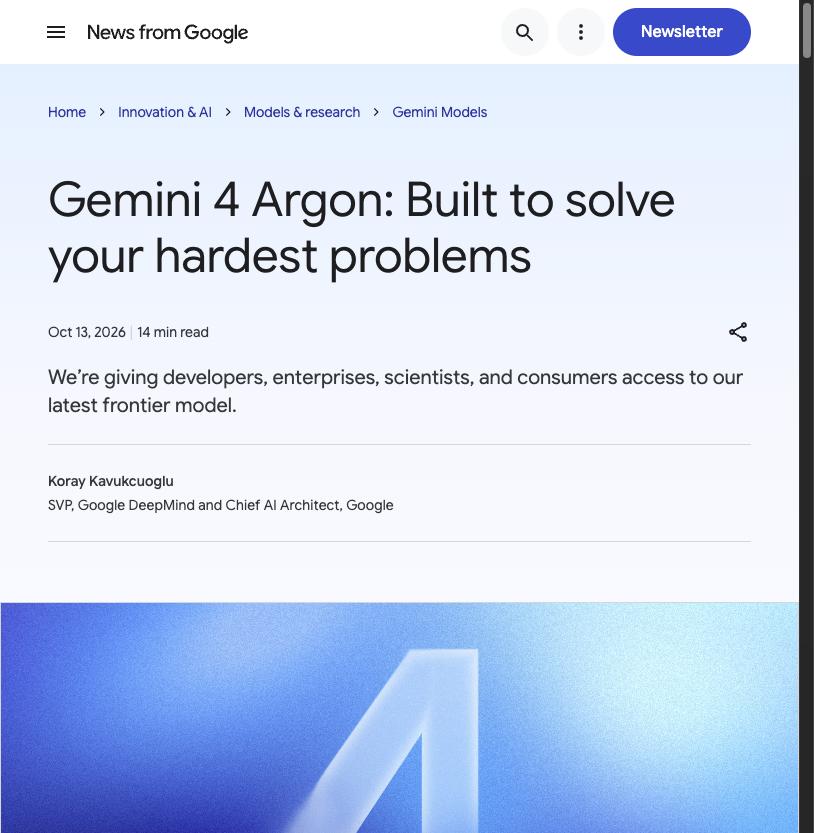
Google's Gemini 4 Argon launch post on the Keyword blog.
The Gemini API changelog marks gemini-4-argon as generally available on 13 October. Pricing is $2 in and $10 out until 30 November 2026, then $4 and $20 from 1 December, and the model is not on the free tier. Budget at the December price if your agent will still be running in December.
Google's launch post puts Argon in the API, AI Studio, the Gemini app, AI Mode in Search, and Antigravity for Ultra subscribers. It quotes a 1M-token limit shared between input and output, 87% on ERQA, and a 0.7% attack success rate on Gray Swan's indirect prompt injection test. Google cites first place on the Vals Index; the Arena ranking quoted in some roundups is not on Google's page.
Meta's Muse Wonder research page.
Meta's Muse Wonder post introduces two models aimed at agent work for individuals and businesses. Muse Wonder is in the Meta Model API and Muse Code; Muse Wonder Full is limited to Muse Code subscribers. The model card lists text, image, video and audio input, text output and a 1M-token context. Meta offers no weights download for either, and its pages publish no price.
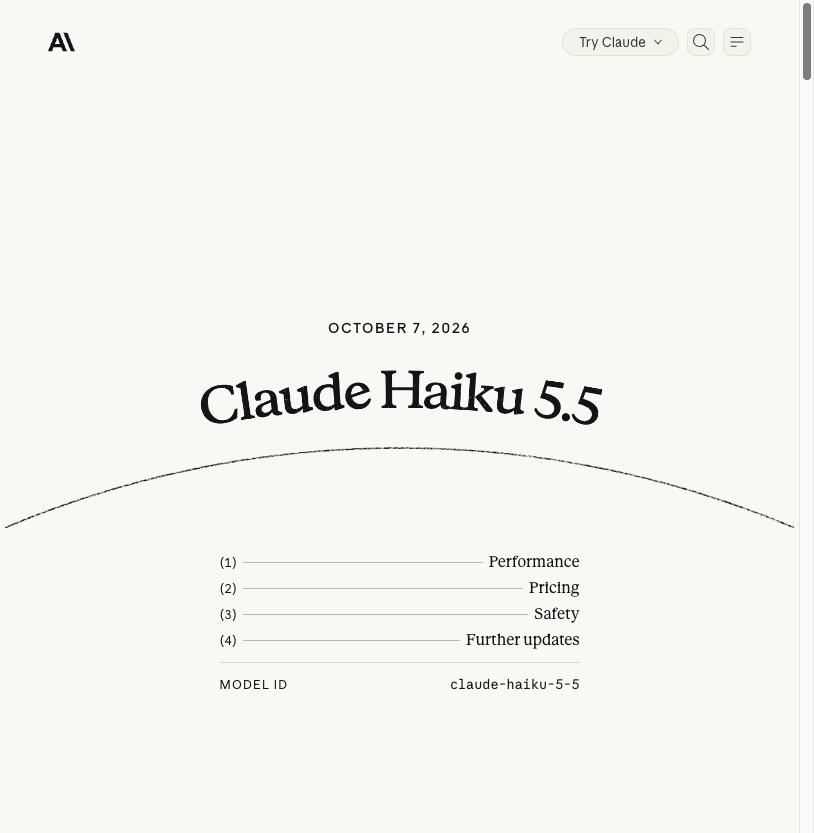
Anthropic's Claude Haiku 5.5 page, with the model id claude-haiku-5-5.
Claude Haiku 5.5 is Anthropic's small, fast model, and the only current Claude model priced in two tiers. Prompts up to 100k tokens cost $0.10 in and $0.50 out; prompts over 100k cost $0.50 and $2.50. Most summaries quote only the first tier. The models overview lists a 1M context window, 128K max output and a default effort of medium.
Anthropic positions it as a subagent for Opus 5.5 and Sonnet 5.5, and reports 72.4% on the offline subset of OSWorld 2.1 and 39.2% on Terminal-Bench 4.0. If your orchestrator fans out short tasks, keep each subagent's prompt under 100k tokens and you stay on the cheap tier. Our guide to Claude subagents shows how Claude Code splits work that way, and our news desk tracked how OpenAI and Anthropic cut agent model prices between June and September.
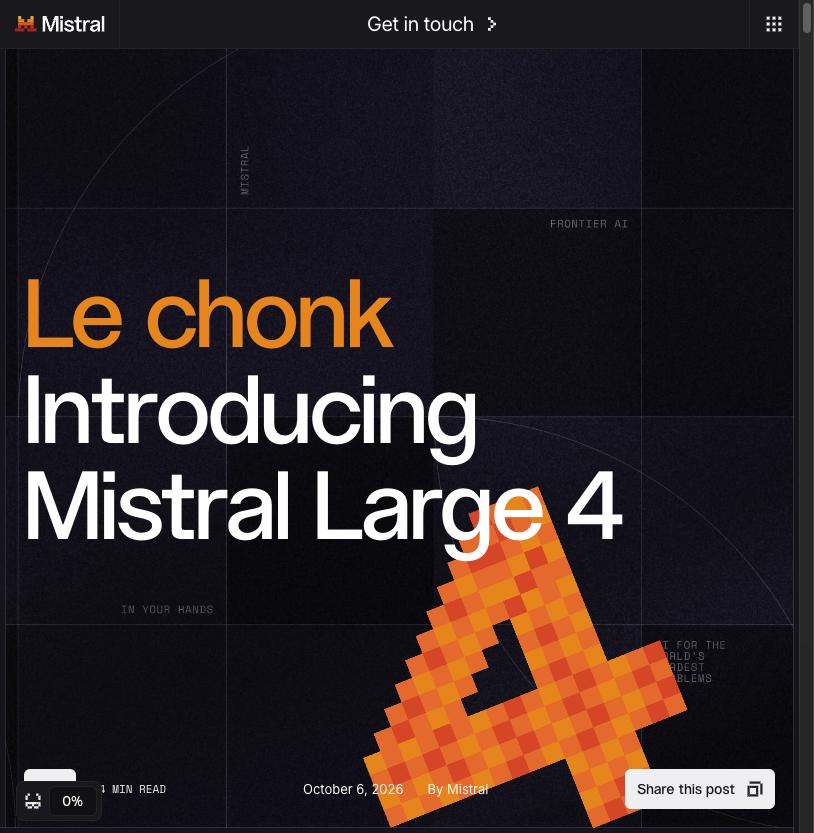
Mistral AI's Large 4 announcement, dated 6 October 2026.
Mistral Large 4 is a natively multimodal mixture-of-experts model in public preview. The model docs give 1.05T total parameters, 52B active, a 1.6B vision encoder and a 1M context. The API costs $1.36 in and $4.18 out, and Mistral reports 28.3% on Terminal-Bench 4 and 61.7% on DeepSWE v1.1. Mistral's own words on weights: "We will release the weights by the end of the month." That is a promise for 31 October, not a release; the docs page states no licence yet.
DeepSeek shipped an updated checkpoint on 17 October, announced in its API news. The Hugging Face card lists an MIT licence, 763B parameters, a 1M context and image input, with 42.3 on Terminal-Bench 4.0 (run in the Claude Code harness) and 77.0 on DeepSWE v1.1. The deepseek-flash API endpoint now serves it. We covered the vLLM speedup for the earlier V4.1-Flash build on 9 October.
xAI released Grok Voice 3.0 on 14 October at $0.08 a minute ($4.80 an hour), with latency under a second. xAI reports a score of 86.9 and first place on the Artificial Analysis Speech-to-Speech Index, and 74% on EVA-Bench. Sessions on grok-voice-latest moved to the new model automatically, so pin grok-voice-3.0 if your voice agent needs stable behaviour.
| Model | Total / active parameters | Context | Licence |
|---|---|---|---|
| Muse Spark Open (Meta) | 816B / 42B | 1M | Muse Model License, gated |
| Beam (Reflection AI) | 501B / 23B | 1M | Apache 2.0 |
| Nemotron 3.5 Super VL (NVIDIA) | 120B / 12B | Up to 1M | OpenMDW-1.1 |
| MiniMax M3.1 Flash | About 428B / 23B (per its card) | 1,000,000 | minimax-community |
| Flint (Recursive) | 39.8B / about 2.5B | 262,144 | Apache 2.0 |
| Nemotron 3.5 Bolt E4B (NVIDIA) | 8B / 4B effective | 64K | See model card |
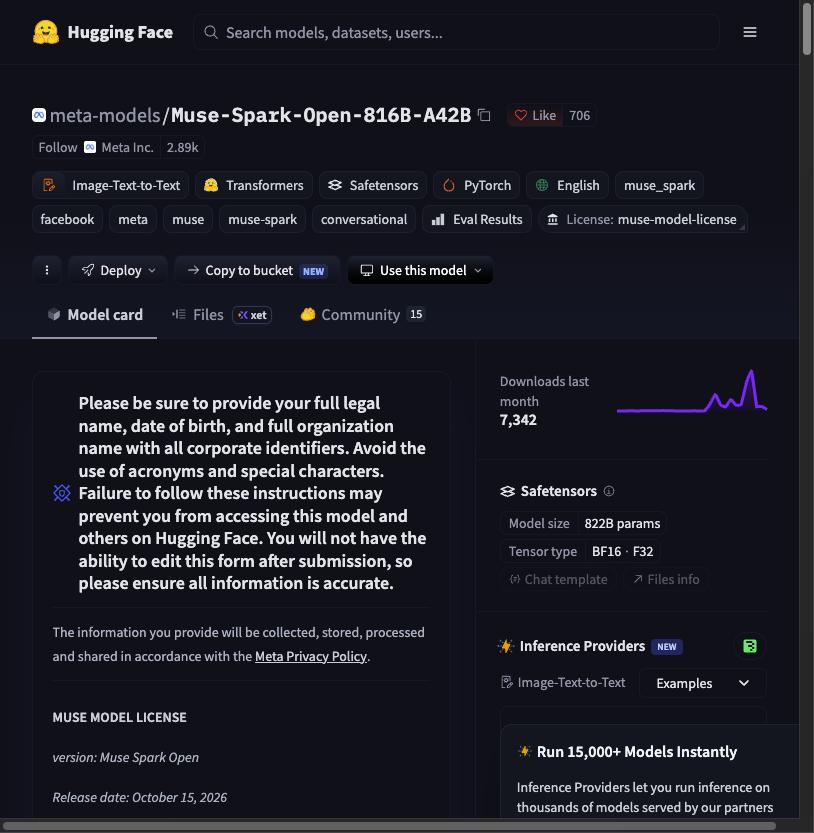
The gated Hugging Face repository for Muse Spark Open.
Muse Spark Open is the largest open-weight release of the month. The Hugging Face card gives 816B total parameters with 42B active (256 experts, 8 per token), a 1M context, and native text, image, video and audio input. Meta tuned it to run on two Mac Studios with M5 Ultra chips through MLX. On a server, self-hosting needs at least 700GB of VRAM in NVFP4 or 2TB in BF16.
Read the licence before you build on it. The Muse Model License gates downloads behind your legal name and date of birth, requires a separate agreement with Meta for any service that made more than $20M in the previous 12 months, and requires "Built with Muse Spark Open" attribution. Meta's developer post calls it the most capable US open-weight model that runs on a desktop. That qualifier matters: Meta's own model card puts it at 39 on the Artificial Analysis Intelligence Index, behind Kimi K3 at 45 and GLM 5.3 at 44.
OpenRouter lists it at $1.25 in and $4.25 out. Meta names Baseten, Fireworks, Groq (in preview), Modal, Nebius, OpenRouter and Together as hosts.
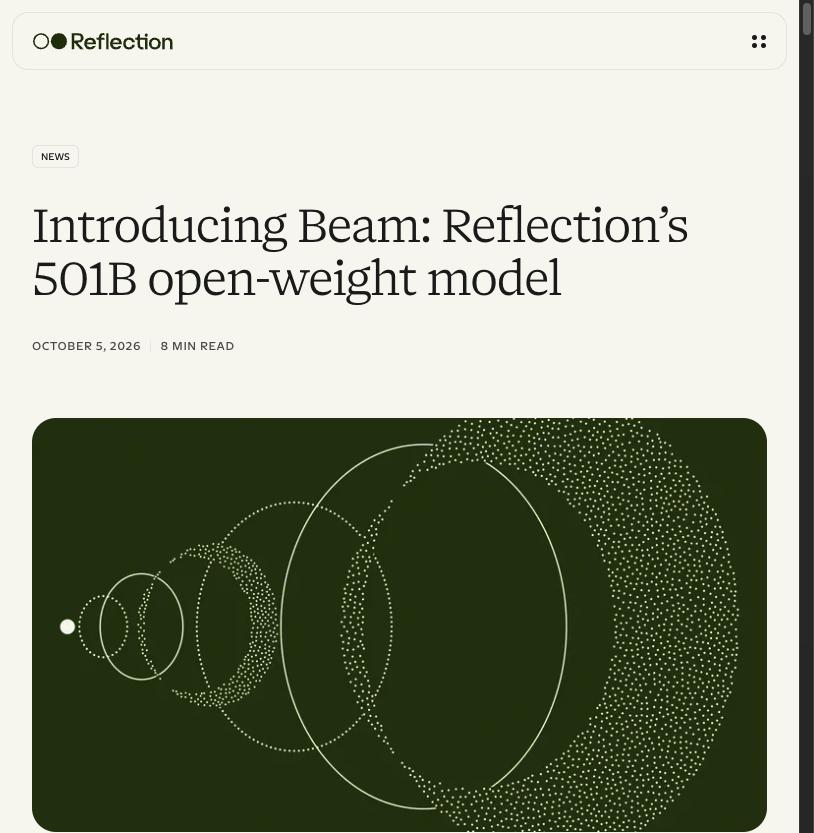
Reflection AI's Beam announcement, dated 5 October 2026.
Reflection AI announced Beam on 5 October and pushed the weights to Hugging Face on 16 October: 501B total, 23B active, text only, a 1M context, BF16, FP8 and NVFP4 builds, and an Apache 2.0 licence. Reflection reports 81.6% on SWE-bench Verified and aims it at enterprise coding and agent work. OpenRouter lists it at $0.25 in and $1.00 out.
Of the large October models, Beam has the simplest licence. If your legal team reads the Muse Model License and says no, Beam is the model in this size class with no revenue cap. Reuters relayed a Financial Times report on 11 October that NVIDIA was in talks to deepen its investment in Reflection or acquire it; Reuters said it could not verify the report.
NVIDIA's Nemotron 3.5 announcement.
NVIDIA's Nemotron 3.5 post covers two families. Super VL is the server model: the Hugging Face card lists 120B total and 12B active, text, image and video input, up to 1M tokens of context and the OpenMDW-1.1 licence, and BF16 inference needs four H100s or two GB200s. Bolt is the local family. Bolt 74B-A9B uses native 2-bit quantisation to fit in 24GB, and Bolt E4B, released 23 October, is an 8B model with 4B effective parameters built on Gemma 4 E4B, with a 64K context and text only. NVIDIA's measurements put it at 3.1 to 5.0 GB of VRAM, which is why NVIDIA targets GeForce RTX cards and Jetson boards.
On 21 October NVIDIA added open retrieval models: Embed-8B, Embed-1B, Rerank-8B and a 631M parsing model. For an agent that searches its own documents, these are the October release you can use this week without changing your main model.
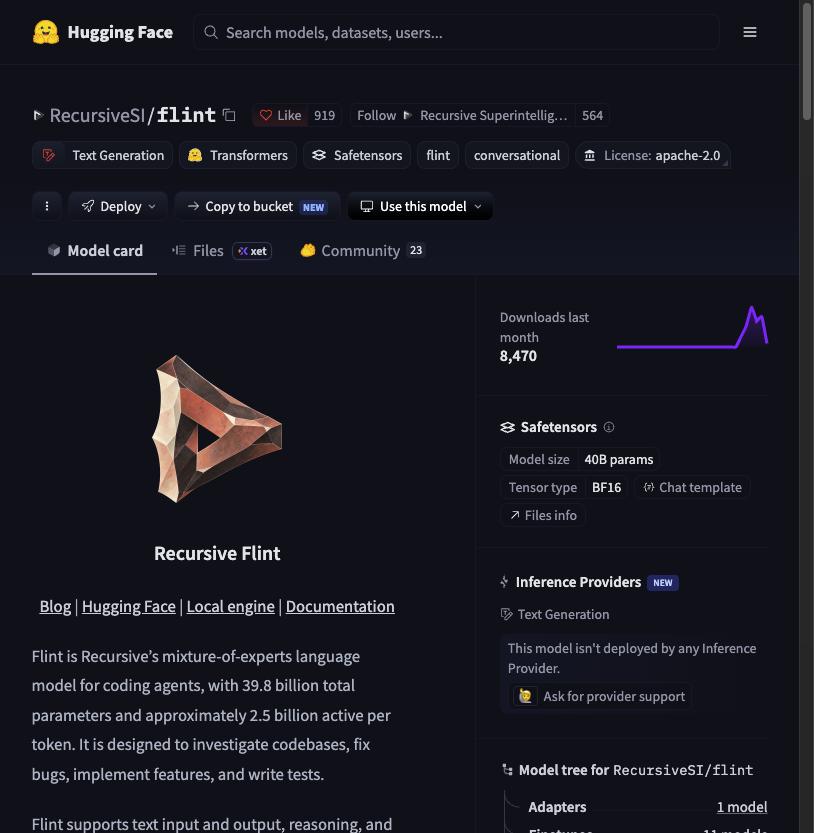
Recursive's Flint model card on Hugging Face.
Flint is a 39.8B mixture-of-experts coding model with about 2.5B active parameters, Apache 2.0, and a 262,144-token context on its card (Recursive's blog says 512k; the card is what ships). Recursive reports 54.9% on Terminal-Bench 2.1 and 74.2% on SWE-bench Verified. Its launch post measures more than 125 tokens per second on an M4 Pro MacBook Pro.
That speed on a laptop is why Flint matters for agent builders. A local coding agent that edits, runs tests and edits again calls the model dozens of times per task, and at 125 tokens per second the loop stays interactive with no API bill. Pair it with an open agent like OpenHands or Cline and you have a fully local coding setup.
MiniMax's M3.1 Flash post prices the model at $0.15 in, $0.60 out and $0.015 for cached input. The Hugging Face repository appeared on 23 October under the minimax-community licence, with text, image and video input and up to 1,000,000 tokens of context. The card says about 428B total and 23B active, while the Hub's own metadata says 220B, so treat the size as unresolved until MiniMax corrects one of them.
Mercury 3 from Inception is a diffusion language model. Inception measures 1,068 tokens per second on NVIDIA GPUs, raises the context to 1M from 260K, and charges $0.10 in and $0.35 out at launch, half its list price of $0.20 and $0.70. It is API only.
Base Labs released two decision models on 21 October, described on Baseten's blog. Mammoth-1 (27B) and Elephant-1 (9B) are post-trained from Qwen3.5 and return a probability for each possible answer, with the probabilities summing to one. An agent can branch on that number instead of parsing a yes or no. Mammoth-1 is MIT-licensed, scores 71.24 on the Jev Decision Index (first of 208), and its free week ends on 27 October. We wrote about running open decision models locally with Ollaya in September.
Hugging Face also published Carbon-X on 21 October, a 14.8B DNA language model built on Qwen3-14B under Apache 2.0.
Anthropic's Claude Duet announcement.
Claude Duet is Anthropic's proactive agent for professionals and small business owners. It runs on Claude Opus 5.5 in a virtual machine with its own browser, so it keeps working when your laptop is closed, and it sends a short brief every morning. It reaches your tools through more than 6,000 connectors and plugins in the Claude Marketplace. The research preview opens by waitlist to US Pro and Max subscribers on iOS, Android and claude.ai, under the same usage limits as the rest of Claude.
The approval design is the part to study if you build agents yourself. Duet waits for a yes before it sends a message, makes a payment, signs a document or deletes anything, and it will not trade securities or move money between accounts even if you approve. That is a human-in-the-loop policy written as a product rule, and our guide to human-in-the-loop AI agents explains how to build the same gate. Anthropic does not name competitors, but the obvious comparison is OpenAI's always-on Dots agents, which shipped on 30 September.
OpenAI's developer changelog shows the Decisions API in beta with gpt-6-luna on 6 October, a native Decisions integration in GPT-Live (gpt-live-1) on 15 October, and general availability on 22 October. The GA version takes up to 400 questions per request, up from 200 in beta. If an article you read calls it a beta, it predates 22 October.
The Linux Foundation's press release on the four new AAIF projects.
Anthropic donated the Agent Skills standard to the Agentic AI Foundation, including the name, logo, GitHub organisation and agentskills.io. The Linux Foundation's release the same day added four projects to the foundation: Agent Skills from Anthropic, Open Responses from OpenAI, OpenEnv from Hugging Face and OpenSandbox from Alibaba. The foundation now hosts ten projects.
For skill authors, nothing changes in the file format today; versioned releases are on the proposed roadmap, not shipped. If you are new to the format, our explainer on how SKILL.md files teach an agent a job covers it, and the skills directory lists the ones already published.
Some roundups describe October as a month of MCP standard updates. The latest Model Context Protocol specification is still 2026-07-28, the version our post on MCP sampling and the 2026-07-28 spec covers. Two things did happen: SEP-2127, MCP Server Cards, merged on 6 October, and a Tasks and Events Working Group formed on 20 October.
| Framework | Latest release | What changed |
|---|---|---|
| LangGraph | 1.2.18, 26 Oct | Delta snapshots every 100 updates instead of every 1,000 |
| CrewAI | 1.15.30, 24 Oct | Bug fixes; seven point releases during October |
| OpenHands | v1.33.0, 23 Oct | Masks secret values in Settings forms; repo now at OpenHands/OpenHands |
| Cline | v4.1.26, 26 Oct | Local or Cloud toggle for tasks; default model back to Claude Sonnet 5.5 |
| Hermes Agent | v0.22.0, 13 Oct | Guided setup on a free trial model, one-click llama.cpp, signed desktop packages, a 600-plugin catalog |
If you are choosing between the first two, our LangGraph vs CrewAI comparison goes through the trade-offs, and CrewAI has its own listing in the directory. On GitHub's weekly trending page on 26 October, the top agent repositories were cloudflare/security-audit-skill, stablyai/orca, anomalyco/opencode, Graphify-Labs/graphify and anthropics/knowledge-work-plugins. That list changes daily.
Voice had a busy month. Mistral's Voxtral 3 (20 October) adds an agent SDK built on LiveKit and a voice agent API at $0.04 a minute. The "50+ languages" figure applies to the Small and Mini Transcribe 3 models; the text-to-speech model covers 35+ languages and 50+ dialects. Block's Dessa is a full-duplex speech-to-speech model that runs locally on a MacBook Pro with an M4 Max, open by waitlist with early access for a small group of AI safety researchers. Our voice AI agents explainer and the voice category cover the products built on models like these.
On video, Kuaishou's press release says Kling 4.0 officially launched on 15 October. Kling's own post lists 30-second clips in a single pass, up to 15 reference assets, up to 10 keyframes, and 720p, 1080p and 4K output. Black Forest Labs lists FLUX 3 Max under FLUX 3 Video and says it renders 10 seconds of video in 12 seconds, served through fal.
Canva Craft (22 October) plans a layout first and renders the image second, at up to 2K across more than 30 aspect ratios. It is in Canva's Dream Lab for every user and in the Public API, with a Canva MCP server listed as coming soon. For robotics, NVIDIA's Flora labels robot video for roughly 1/125th of what GPT-6 Astra would cost, by NVIDIA's estimate, and its weights ship under the NVIDIA OneWay Noncommercial License.
We started this post from a roundup of the month built from release trackers and news coverage, then checked each line against the vendor's own page. Most of it held. These lines did not:
This is our read from the vendor numbers above, not a benchmark verdict. Test on your own tasks before you switch.
| Agent job | Start with | Why |
|---|---|---|
| Cheap subagents and fan-out | Claude Haiku 5.5, MiniMax M3.1 Flash, Mercury 3 | All at or under $0.15 per million input tokens at launch prices |
| Computer use at volume | GPT-6.1 Terra | Built and priced for it, $1 input, 1,050,000-token context |
| Self-hosted frontier model | Beam, then Muse Spark Open | Beam is Apache 2.0; Muse Spark Open has a revenue cap and gating |
| Local coding loop on a laptop | Flint, Nemotron 3.5 Bolt | Flint runs over 125 tokens per second on an M4 Pro; Bolt E4B needs 3.1 to 5.0 GB of VRAM |
| Yes or no decisions with a confidence | Mammoth-1, OpenAI Decisions API | Probabilities you can branch on |
| Retrieval over your own documents | Nemotron Embed and Rerank | Open, and no change to your main model |
| Voice agents | Grok Voice 3.0, Voxtral 3 | Per-minute pricing at $0.08 and $0.04 |
The model is half the decision. The other half is the tools it can reach: a cheap subagent with no browser and no file access does nothing useful. Browse the MCP servers that connect these models to real systems, such as the Playwright MCP server for browser control or the Hugging Face MCP server for pulling model cards into a session.
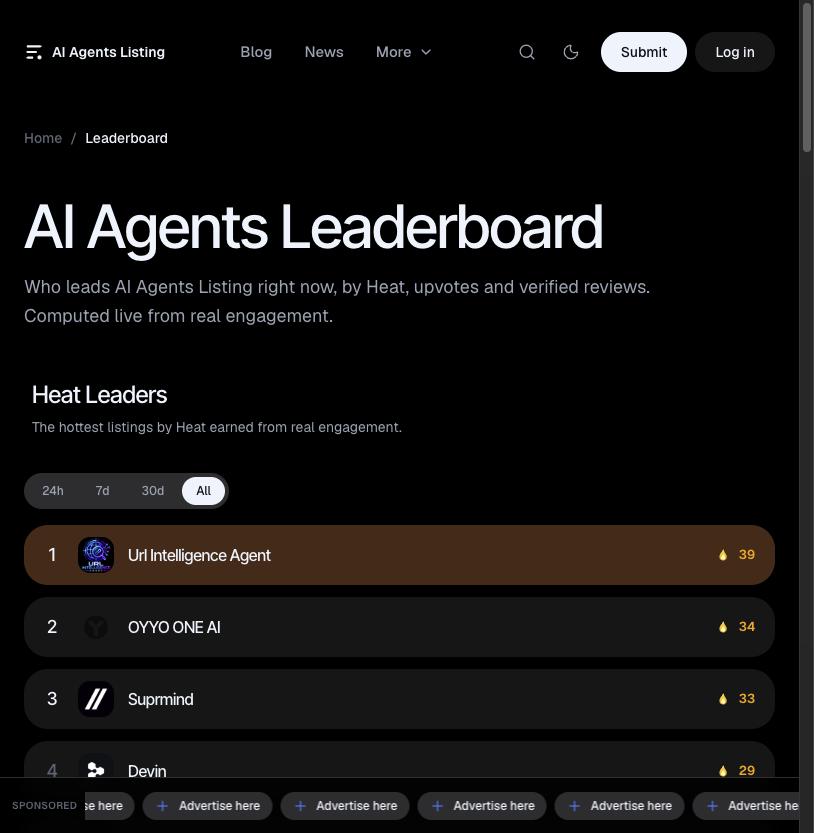
The AI Agents Listing leaderboard, ranked by Heat from real engagement.
Most people meet a new model through a product built on it, and that second wave is what AI Agents Listing tracks. On 26 October 2026 the directory held 1,407 published listings: 410 AI agents, 931 MCP servers and 66 agent skills, each reviewed by hand before it goes live. The leaderboard ranks them by Heat, upvotes and verified reviews, and no listing can pay its way up that ranking.
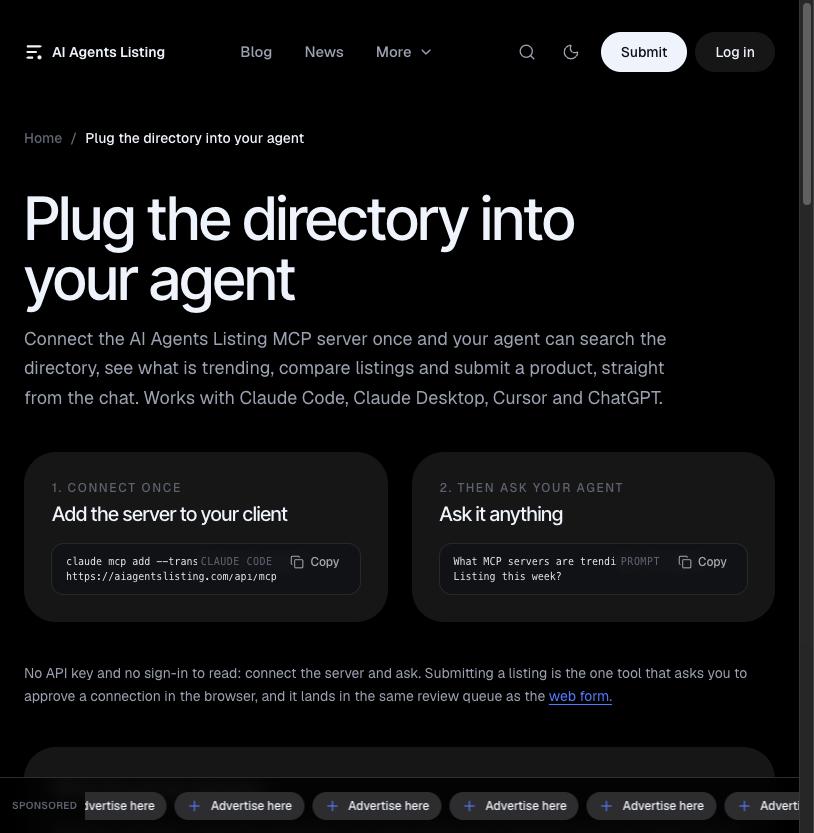
Connect the directory to Claude Code, Claude Desktop, Cursor or ChatGPT.
You can also ask your own agent. The directory runs a public MCP server that needs no API key or sign-in to read. Add it to Claude Code with one command:
claude mcp add --transport http aiagents https://aiagentslisting.com/api/mcpThen ask it which MCP servers are trending this week, or to compare two listings. If you shipped an agent, server or skill on one of October's models, submit it and it lands in the same review queue as every other listing.
The major releases were OpenAI GPT-6.1 Terra (26 October), Moonshot AI Kimi K3.1 Pro (23 October), Google Gemini 4 Argon (generally available 13 October), Meta Muse Wonder (12 October), Anthropic Claude Haiku 5.5 (7 October) and Mistral Large 4 (6 October, preview). Open-weight releases included Meta Muse Spark Open, Reflection AI Beam, NVIDIA Nemotron 3.5, Recursive Flint and MiniMax M3.1 Flash.
GPT-6.1 Terra costs $1 per million input tokens, $0.05 per million cached input tokens and $5 per million output tokens, according to OpenAI's API model page. It has a 1,050,000-token context window and supports the computer_use tool through the Responses API.
At published prices, Claude Haiku 5.5 ($0.10 in, $0.50 out for prompts up to 100k tokens), Inception Mercury 3 ($0.10 in, $0.35 out at its launch discount) and MiniMax M3.1 Flash ($0.15 in, $0.60 out) are the cheapest October releases. Haiku 5.5 is the one its vendor positions as a subagent for larger Claude models.
Muse Spark Open (Muse Model License), Beam (Apache 2.0), Nemotron 3.5 Super VL (OpenMDW-1.1), Nemotron 3.5 Bolt, Flint (Apache 2.0), MiniMax M3.1 Flash (minimax-community), DeepSeek V4.1-Flash-1017 (MIT), Mammoth-1 (MIT) and Carbon-X (Apache 2.0) all have weights on Hugging Face. Kimi K3.1 Pro and Mistral Large 4 weights were promised but not yet released on 26 October.
Not yet. Moonshot AI calls Kimi K3.1 Pro an open-weight model and says the weights will be available by 4 November 2026, but its quickstart does not state a licence. Until the weights and licence are published, you can only use it through Moonshot's API.
Claude Duet is a proactive agent from Anthropic, released as a research preview on 21 October 2026 for US Pro and Max subscribers by waitlist. It runs on Claude Opus 5.5 in a cloud virtual machine with its own browser, sends a morning brief, and asks for approval before it sends messages, makes payments, signs documents or deletes anything.
No. The latest Model Context Protocol specification is still 2026-07-28. In October, SEP-2127 (MCP Server Cards) merged on 6 October and a Tasks and Events Working Group formed on 20 October.
To see which agents and MCP servers are built on these models, browse the AI Agents Listing directory of AI agents.
One email a week. New agents, MCP servers and skills, and what is actually getting traction.
MCP vs OpenAPI: MCP lets AI agents call tools at runtime, while OpenAPI describes an HTTP API ahead of time. Here is how they differ and work together.
7 min read
AI agent skills are SKILL.md folders that give agents procedural knowledge on demand. Here is how the format works, what it's for, and what changed in October 2026.
6 min read
An AI agent marketplace comparison covering AWS, Google Cloud, Salesforce, Oracle, Moveworks, Kore.ai, AI Agent Store and Apify Store, and how to pick the right one.
7 min read