MCP vs REST API: What Actually Differs for AI Agents
MCP vs REST API comes down to who decides what to call: a developer at build time for REST, or the model itself at runtime for MCP.
8 min read
Vertical AI agents work inside one industry instead of many. See how they're built, real production examples, and when to choose one over a general agent.
Every general-purpose AI assistant eventually runs into the same wall: it does not know how your industry actually works. A vertical AI agent is built to clear that wall by trading breadth for depth, learning one domain's data, rules and software well enough to act inside it.
Vertical AI agents are AI systems built to work inside one industry or function, such as reading a clinical conversation into a patient's electronic health record or flagging a suspicious bank transaction. Instead of handling general requests across many domains, they pair a domain-tuned model with direct, permissioned access to that industry's own software, such as an EHR, a CRM or a core banking platform.
Most vertical agents start from a general-purpose foundation model such as GPT or an open source model, then get fine-tuned, instruction-tuned or adapted with retrieval-augmented generation (RAG) to specialize in one domain (IBM). Nexos.ai describes the build as a loop: domain data ingestion, contextual understanding, specialized processing with domain-tuned models, integration with the industry's own tools, decision execution, and continuous refinement from outcomes inside that one vertical (Nexos.ai).
Most of the engineering effort goes into the integration step. Airbyte's review of ten production vertical agents found the hardest part is rarely the model. It is reconciling data across systems that use different identifiers, formats and terminology: a healthcare agent translates between ICD-10 and SNOMED CT codes, a sales agent links the same contact across a CRM, an email inbox and a billing system, and a compliance agent correlates transactions across payment rails that each structure data differently (Airbyte). This is the layer an MCP server is meant to standardize for builders: one connection a vertical agent can call instead of a custom integration for every EHR, CRM or core banking API it needs to reach.
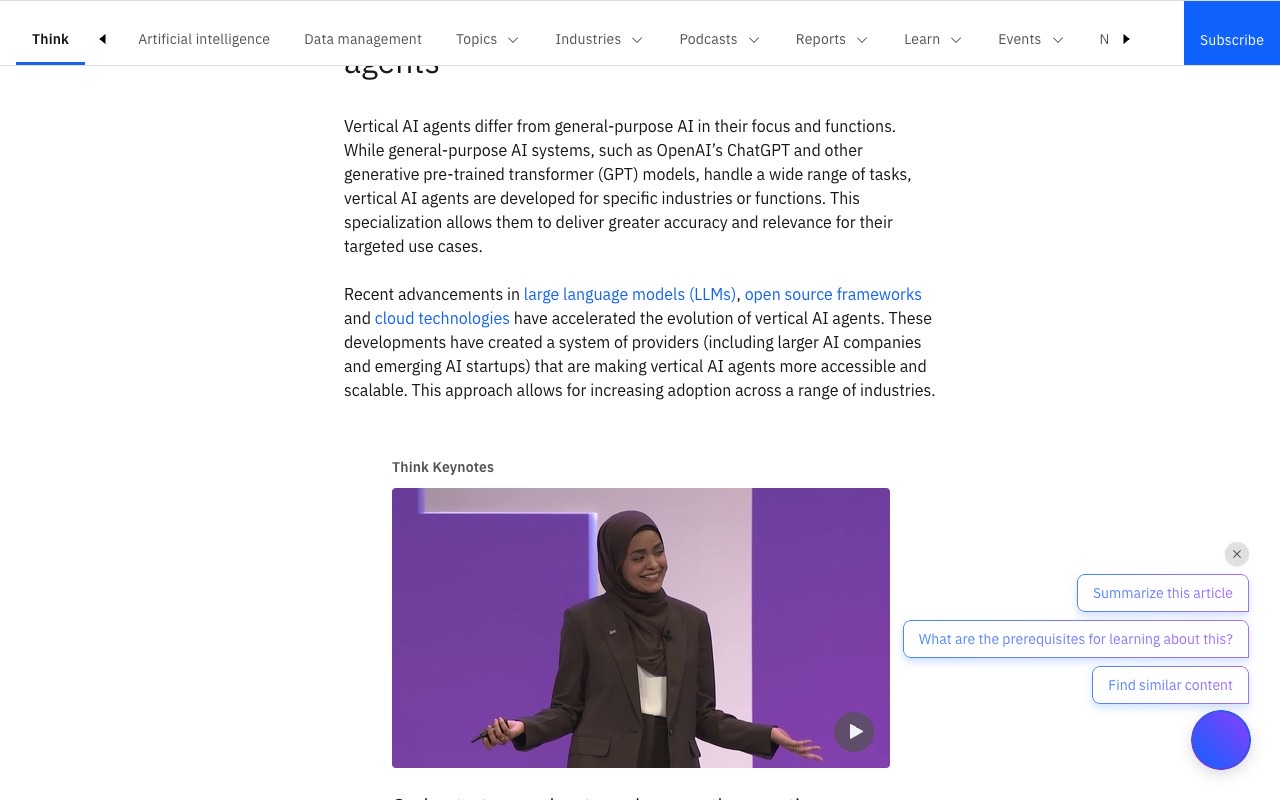
Domo frames the choice as breadth against depth. A horizontal AI agent is a general-purpose system built to work across many functions, teams or industries using the same core logic, such as scheduling, email drafting or basic data entry. A vertical AI agent operates deeply inside one function or industry, trained on specialized data and tuned to that domain's patterns, regulations and edge cases (Domo).
| Horizontal AI agents | Vertical AI agents | |
|---|---|---|
| Scope | Many teams, many industries | One industry or function |
| Deployment | Faster, less domain tuning needed | Slower, needs domain data and integration |
| Strength | Consistent governance, broad reuse | Higher precision, fewer errors in-domain |
| Weakness | Shallow in regulated or technical contexts | Limited outside its one domain, more upfront investment |
| Example task | Book a meeting using a calendar slot | Schedule a patient visit using acuity, provider specialty and insurance authorization |
Domo also cites a McKinsey finding behind the renewed interest in this distinction: organizations struggle with AI largely because they run too much horizontal, general-purpose deployment and too little domain-specific depth, and about 90 percent of vertical AI agent pilots never make it past that stage (Domo).
Abridge listens to clinician-patient conversations during a visit, generates structured SOAP notes in real time, and writes them directly into EHR systems through FHIR-based integrations while meeting HIPAA requirements (Airbyte).
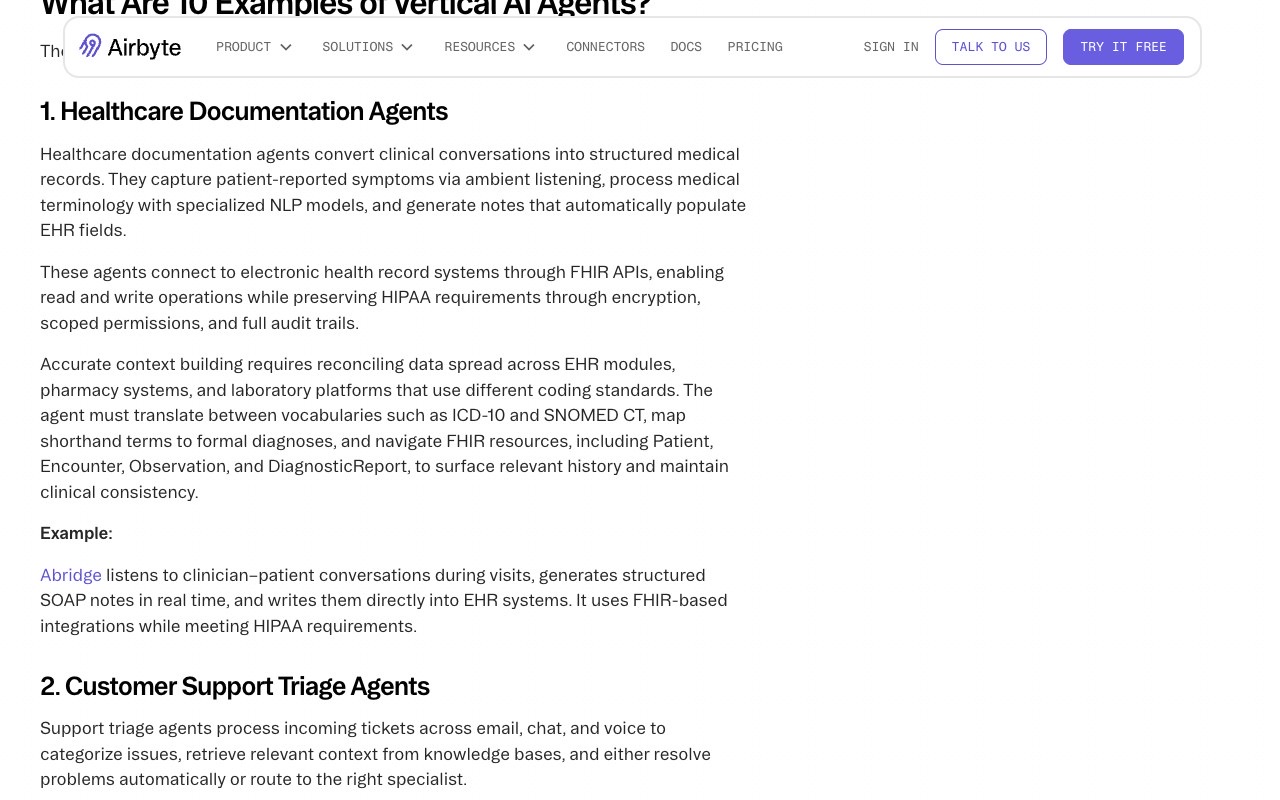
Zendesk AI runs several specialized agents that identify customer intent, retrieve knowledge base content and carry out routine tasks such as password resets across connected systems, so support teams can focus on harder cases (Airbyte). AI Agents Listing's customer support category tracks agents built for this job.
HockeyStack's Nova combines CRM records, call transcripts, emails, web activity and intent signals into a single account view, generating snapshots with recent engagement, key stakeholders and recommended next steps (Airbyte). Teams evaluating this category can browse the sales and outreach listings.
Unit21's AI Agent sits on top of a bank's existing rules and workflows to automate fraud and anti-money-laundering investigations, recommending rule changes with justifications and tuning itself based on analyst behavior and alert outcomes (Airbyte). The finance category on AI Agents Listing covers similar tools.
LinkedIn's Hiring Assistant converts hiring requirements into search queries, ranks candidates and generates personalized outreach, operating as a plan-and-execute agent across ATS and job board data (Airbyte). Moveworks runs a comparable agent for HR case intake, integrating with Workday and BambooHR while enforcing role-based access to sensitive case data. The HR and recruiting category lists agents in this space.
Siemens uses multi-agent automation to analyze sensor data, detect equipment issues early, and adjust maintenance and production schedules through its MES and ERP systems, moving plants from reactive repairs to condition-based maintenance (Airbyte). Walmart's inventory agents forecast demand from historical sales, seasonality and external factors like weather, then trigger replenishment automatically when stock drops to a threshold.
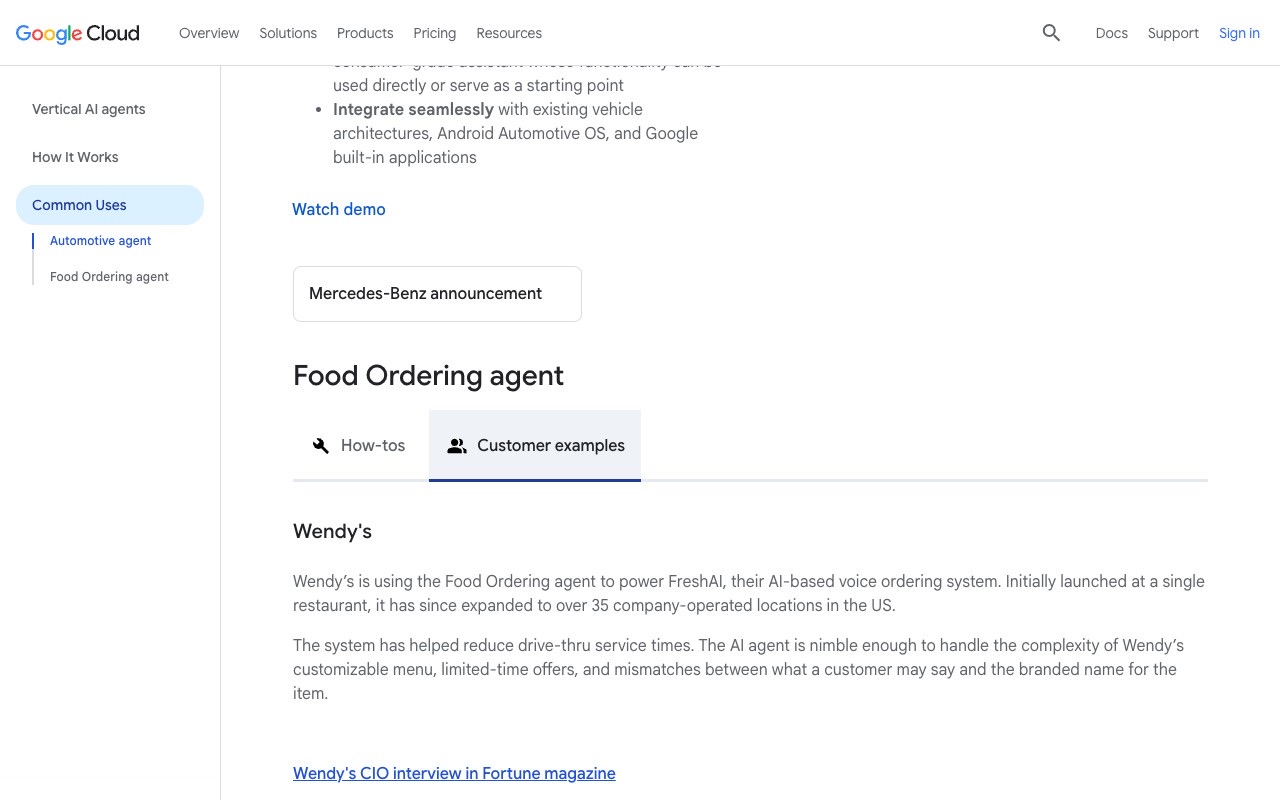
Google Cloud's Automotive agent powers Mercedes-Benz's MBUX Virtual Assistant, handling multi-turn, multilingual in-car conversations and retaining memory across a drive. Its Food Ordering agent powers Wendy's FreshAI voice ordering system, which launched at a single restaurant and has since expanded to more than 35 company-operated US locations, and also runs a Papa Johns ordering deployment announced 11 January 2026 (Google Cloud).
Build or buy a vertical agent when the task sits inside a regulated or technical domain where a general model's errors are expensive, such as a wrong diagnosis note, a missed compliance flag or a misrouted insurance claim. Nexos.ai argues the payoff shows up as fewer hallucinations, since a model trained on vetted domain data has less room to guess than one drawing on broad internet training (Nexos.ai).
A horizontal agent is the better starting point when the job is genuinely generic, such as drafting an email or summarizing a document, and when a team needs one governance model across many departments instead of a separate agent for each. Domo's comparison states the tradeoff plainly: vertical agents need more upfront investment in domain-specific training data, machine learning pipelines and data automation workflows, and they can create silos if an organization ends up running a separate specialized agent for every function (Domo).
The McKinsey figure Domo cites is worth checking before committing budget: if nine out of ten vertical AI agent pilots never reach production, the integration work described above, not the model choice, is usually where a build stalls.
Writer AI, one of the companies SuperAnnotate names, already has a listing on AI Agents Listing.
A vertical AI agent is an AI system built to work inside one industry or business function, such as healthcare documentation or financial compliance, rather than across many domains. It pairs a fine-tuned or RAG-grounded model with direct access to that industry's own software, such as an EHR or a core banking platform.
A horizontal AI agent uses the same general logic across many teams and industries, such as scheduling or email drafting. A vertical AI agent is trained on domain-specific data and tuned to one industry's terminology, regulations and workflows, which Domo's comparison credits with higher precision in exchange for a narrower range of use.
Examples include Abridge for clinical documentation, Zendesk AI for customer support triage, Unit21 for financial compliance, Siemens' Senseye for manufacturing maintenance, and Google Cloud's agents powering Wendy's FreshAI voice ordering and Mercedes-Benz's MBUX in-car assistant.
Domo cites a McKinsey estimate that about 90 percent of vertical AI agent pilots never reach production. Airbyte's review of ten production agents points to the same cause: reconciling data across systems that use different identifiers and formats is harder than building or fine-tuning the underlying model.
AI Agents Listing catalogs agents built for specific industries alongside the AI agents and MCP servers that connect them to the tools those industries already run on.
One email a week. New agents, MCP servers and skills, and what is actually getting traction.
MCP vs REST API comes down to who decides what to call: a developer at build time for REST, or the model itself at runtime for MCP.
8 min read
MCP transports are stdio and Streamable HTTP. Here is how each carries messages, what the 2026-07-28 revision removed, and how Claude Code connects to them.
4 min read
Adam Riccoboni, author of The AI Age, on why agents beat chatbots for productivity and five lessons from a decade of custom AI builds at Critical Future.
8 min read