
 Snowflake-Labs
MCP Server for Snowflake including Cortex AI, object management, SQL orchestration, semantic view co
MCP Server for Snowflake including Cortex AI, object management, SQL orchestration, semantic view consumption, and more
·
[DEPRECATED] Snowflake Cortex AI Model Context Protocol (MCP) Server
[!CAUTION] This project is deprecated and no longer maintained. Please migrate to the official Snowflake MCP Server. The official server is actively developed, fully supported by Snowflake, and continues to add new features.
This community MCP server previously provided tooling for Snowflake Cortex AI, object management, and SQL orchestration. It is no longer supported. For all new and existing use cases, please use the official Snowflake MCP Server instead.
Legacy documentation (for reference only)
The MCP server supported the below capabilities:
- Cortex Search: Query unstructured data in Snowflake as commonly used in Retrieval Augmented Generation (RAG) applications.
- Cortex Analyst: Query structured data in Snowflake via rich semantic modeling.
- Cortex Agent: Agentic orchestrator across structured and unstructured data retrieval
- Object Management: Perform basic operations against Snowflake's most common objects such as creation, dropping, updating, and more.
- SQL Execution: Run LLM-generated SQL managed by user-configured permissions.
- Semantic View Querying: Discover and query Snowflake Semantic Views
Getting Started
Service Configuration
A simple configuration file is used to drive all tooling. An example can be seen at services/configuration.yaml and a template is below. The path to this configuration file will be passed to the server and the contents used to create MCP server tools at startup.
Cortex Services
Many Cortex Agent, Search, and Analyst services can be added. Ideal descriptions are both highly descriptive and mutually exclusive. Only the explicitly listed Cortex services will be available as tools in the MCP client.
Other Services
Other services include tooling for object management, query execution, and semantic view usage.
These groups of tools can be enabled by setting them to True in the other_services section of the configuration file.
SQL Statement Permissions
The sql_statement_permissions section ensures that only approved statements are executed across any tools with access to change Snowflake objects.
The list contains SQL expression types. Those marked with True are permitted while those marked with False are not permitted. Please see SQL Execution for examples of each expression type.
agent_services: # List all Cortex Agent services
  - service_name: <service_name>
    description: > # Describe contents of the agent service
      <Agent service that ...>
    database_name: <database_name>
    schema_name: <schema_name>
  - service_name: <service_name>
    description: > # Describe contents of the agent service
      <Agent service that ...>
    database_name: <database_name>
    schema_name: <schema_name>
search_services: # List all Cortex Search services
  - service_name: <service_name>
    description: > # Describe contents of the search service
      <Search services that ...>
    database_name: <database_name>
    schema_name: <schema_name>
  - service_name: <service_name>
    description: > # Describe contents of the search service
      <Search services that ...>
    database_name: <database_name>
    schema_name: <schema_name>
analyst_services: # List all Cortex Analyst semantic models/views
  - service_name: <service_name> # Create descriptive name for the service
    semantic_model: <semantic_yaml_or_view> # Fully-qualify semantic YAML model or Semantic View
    description: > # Describe contents of the analyst service
      <Analyst service that ...>
  - service_name: <service_name> # Create descriptive name for the service
    semantic_model: <semantic_yaml_or_view> # Fully-qualify semantic YAML model or Semantic View
    description: > # Describe contents of the analyst service
      <Analyst service that ...>
other_services: # Set desired tool groups to True to enable tools for that group
  object_manager: True # Perform basic operations against Snowflake's most common objects such as creation, dropping, updating, and more.
  query_manager: True # Run LLM-generated SQL managed by user-configured permissions.
  semantic_manager: True # Discover and query Snowflake Semantic Views and their components.
sql_statement_permissions: # List SQL statements to explicitly allow (True) or disallow (False).
  # - All: True # To allow everything, uncomment and set All: True.
  - Alter: True
  - Command: True
  - Comment: True
  - Commit: True
  - Copy: True
  - Create: True
  - Delete: True
  - Describe: True
  - Drop: True
  - Insert: True
  - Merge: True
  - Rollback: True
  - Select: True
  - Transaction: True
  - TruncateTable: True
  - Unknown: False # To allow unknown or unmapped statement types, set Unknown: True.
  - Update: True
  - Use: True
[!NOTE] Previous versions of the configuration file supported specifying explicit values for columns and limit for each Cortex Search service. Instead, these are now exclusively dynamic based on user prompt. If not specified, a search service's default search_columns will be returned with a limit of 10.
Connecting to Snowflake
The MCP server uses the Snowflake Python Connector for all authentication and connection methods. Please refer to the official Snowflake documentation for comprehensive authentication options and best practices.
The MCP server honors the RBAC permissions assigned to the specified role (as passed in the connection parameters) or default role of the user (if no role is passed to connect).
Connection parameters can be passed as CLI arguments and/or environment variables. The server supports all authentication methods available in the Snowflake Python Connector, including:
- Username/password authentication
- Key pair authentication
- OAuth authentication
- Single Sign-On (SSO)
- Multi-factor authentication (MFA)
Connection Parameters
Connection parameters can be passed as CLI arguments and/or environment variables:
| Parameter | CLI Arguments | Environment Variable | Description |
|---|---|---|---|
| Account | --account | SNOWFLAKE_ACCOUNT | Account identifier (e.g. xy12345.us-east-1) |
| Host | --host | SNOWFLAKE_HOST | Snowflake host URL |
| User | --user, --username | SNOWFLAKE_USER | Username for authentication |
| Password | --password | SNOWFLAKE_PASSWORD | Password or programmatic access token |
| Role | --role | SNOWFLAKE_ROLE | Role to use for connection |
| Warehouse | --warehouse | SNOWFLAKE_WAREHOUSE | Warehouse to use for queries |
| Passcode in Password | --passcode-in-password | - | Whether passcode is embedded in password |
| Passcode | --passcode | SNOWFLAKE_PASSCODE | MFA passcode for authentication |
| Private Key | --private-key | SNOWFLAKE_PRIVATE_KEY | Private key for key pair authentication |
| Private Key File | --private-key-file | SNOWFLAKE_PRIVATE_KEY_FILE | Path to private key file |
| Private Key Password | --private-key-file-pwd | SNOWFLAKE_PRIVATE_KEY_FILE_PWD | Password for encrypted private key |
| Authenticator | --authenticator | - | Authentication type (default: snowflake) |
| Connection Name | --connection-name | - | Name of connection from connections.toml (or config.toml) file |
[!WARNING] Deprecation Notice: The CLI arguments
--account-identifierand--pat, as well as the environment variableSNOWFLAKE_PAT, are deprecated and will be removed in a future release. Please use--accountand--password(orSNOWFLAKE_ACCOUNTandSNOWFLAKE_PASSWORD) instead.
Transport Configuration
The MCP server supports multiple transport mechanisms. For detailed information about MCP transports, see FastMCP Transport Protocols.
| Transport | Description | Use Case |
|---|---|---|
stdio | Standard input/output (default) | Local development, MCP client integration |
sse (legacy) | Server-Sent Events | Streaming applications |
streamable-http | Streamable HTTP transport | Container deployments, remote servers |
Usage
# Default stdio transport
uvx snowflake-labs-mcp --service-config-file config.yaml

# HTTP transport with custom endpoint
uvx snowflake-labs-mcp --service-config-file config.yaml --transport streamable-http --endpoint /my-endpoint

# For containers (uses streamable-http on port 9000)
uvx snowflake-labs-mcp --service-config-file config.yaml --transport streamable-http --endpoint /snowflake-mcp
Transport Customizations
Server customizations available for sse and streamable-http transports:
| Parameter | CLI Argument | Environment Variable | Default |
|---|---|---|---|
| Host | --server-host | SNOWFLAKE_MCP_HOST | "0.0.0.0" |
| Port | --port | SNOWFLAKE_MCP_PORT | 9000 |
| Endpoint | --endpoint | SNOWFLAKE_MCP_ENDPOINT | /mcp |
| Debug Logging | --verbose | SNOWFLAKE_MCP_VERBOSE | false |
Example:
export SNOWFLAKE_MCP_ENDPOINT="/my-mcp"
uvx snowflake-labs-mcp --service-config-file config.yaml --transport streamable-http
Using with MCP Clients
The MCP server is client-agnostic and will work with most MCP Clients that support basic functionality for MCP tools and (optionally) resources. Below are examples for local installation. For connecting to containerized deployments, see Connecting MCP Clients to Containers.
Claude Desktop
To integrate this server with Claude Desktop as the MCP Client, add the following to your app's server configuration. By default, this is located at:
- macOS: ~/Library/Application Support/Claude/claude_desktop_config.json
- Windows: %APPDATA%\Claude\claude_desktop_config.json
Set the path to the service configuration file and configure your connection method:
{
  "mcpServers": {
    "mcp-server-snowflake": {
      "command": "uvx",
      "args": [
        "snowflake-labs-mcp",
        "--service-config-file",
        "<path_to_file>/tools_config.yaml",
        "--connection-name",
        "default"
      ]
    }
  }
}
Cursor
Register the MCP server in Cursor by opening Cursor and navigating to Settings -> Cursor Settings -> MCP. Add the below:
{
  "mcpServers": {
    "mcp-server-snowflake": {
      "command": "uvx",
      "args": [
        "snowflake-labs-mcp",
        "--service-config-file",
        "<path_to_file>/tools_config.yaml",
        "--connection-name",
        "default"
      ]
    }
  }
}
Add the MCP server as context in the chat.
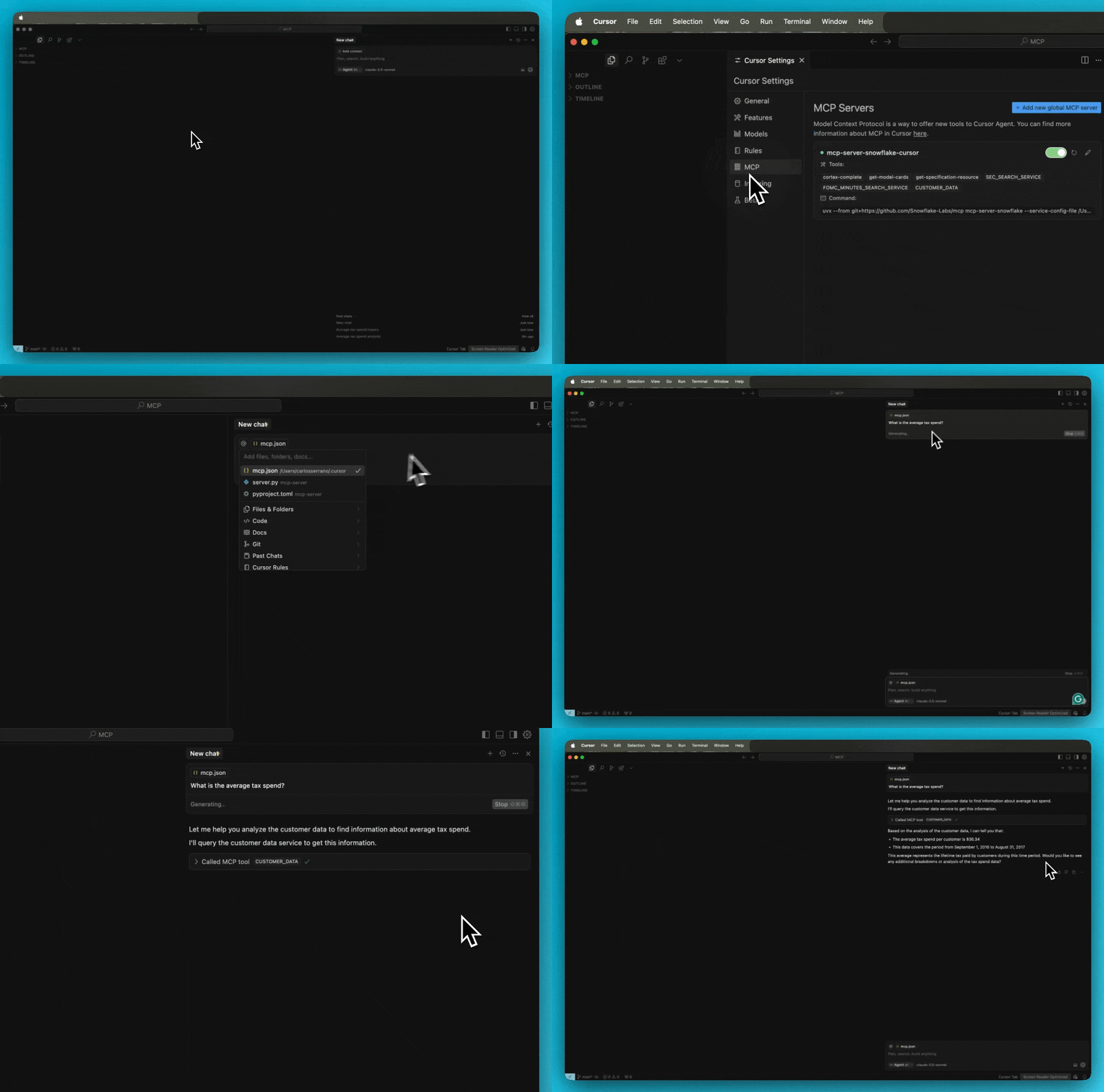
For troubleshooting Cursor server issues, view the logs by opening the Output panel and selecting Cursor MCP from the dropdown menu.
fast-agent
Update the fastagent.config.yaml mcp server section with the configuration file path and connection name:
# MCP Servers
mcp:
    servers:
        mcp-server-snowflake:
            command: "uvx"
            args: ["snowflake-labs-mcp", "--service-config-file", "<path_to_file>/tools_config.yaml", "--connection-name", "default"]
Microsoft Visual Studio Code + GitHub Copilot
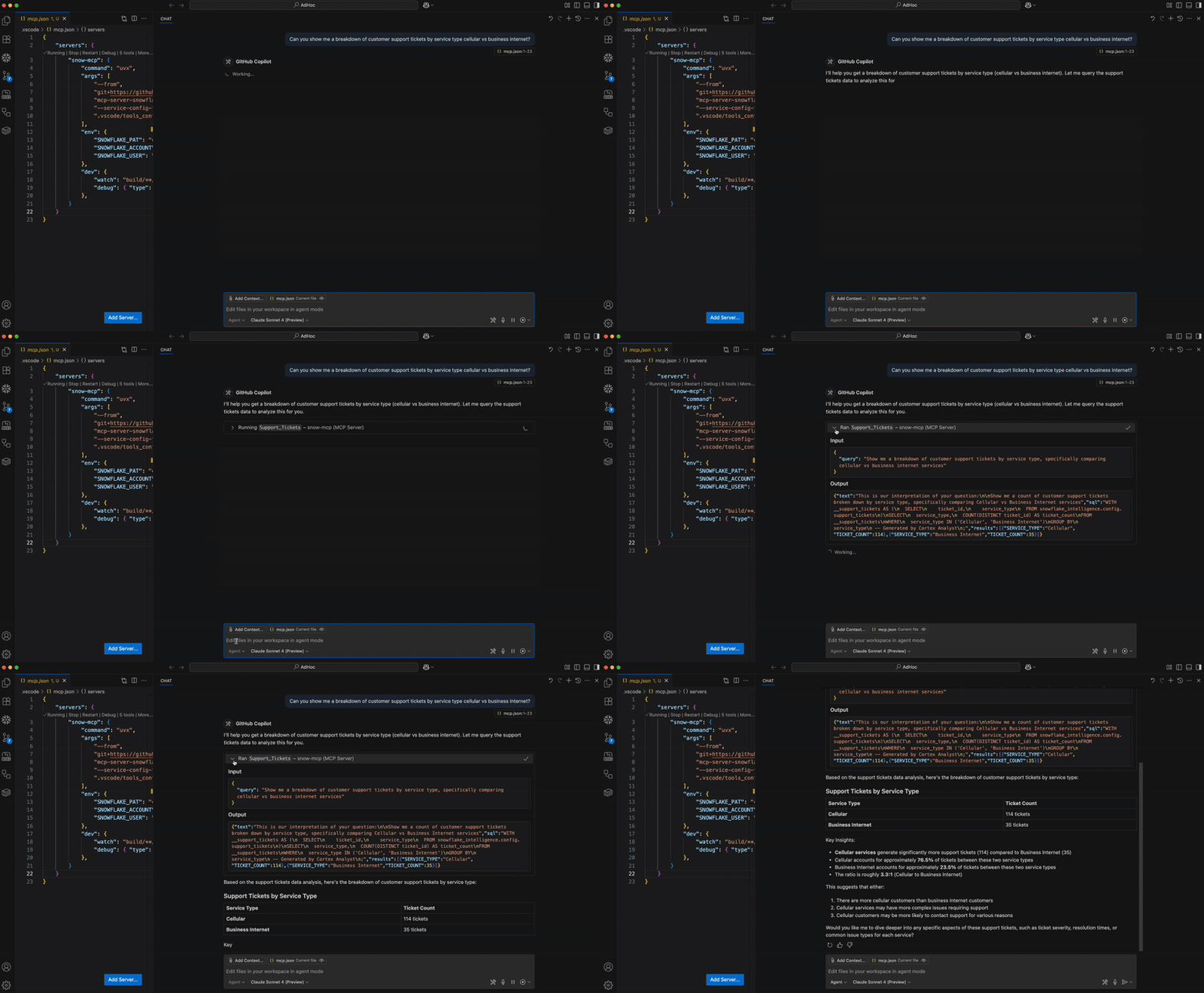
For prerequisites, environment setup, step-by-step guide and instructions, please refer to this blog.
Codex
Register the MCP server in codex by adding the following to ~/.codex/config.toml
[mcp_servers.mcp-server-snowflake]
command = "uvx"
args = [
    "snowflake-labs-mcp",
    "--service-config-file",
    "<path_to_file>/tools_config.yaml",
    "--connection-name",
    "default"
]
After editing, the snowflake mcp should appear in the output of codex mcp list run from the terminal.
Container Deployment
Deploy the MCP server as a container for remote access or production environments. This guide provides step-by-step instructions for both Docker and Docker Compose deployments.
Docker Deployment
Follow these steps to deploy the MCP server using Docker:
Step 1: Prepare Configuration File
Create a directory for MCP configuration and copy the template:
mkdir -p ${HOME}/.mcp/
cp services/configuration.yaml ${HOME}/.mcp/tools_config.yaml
Step 2: Configure Services
Edit the configuration file to match your environment:
# Edit the configuration file as needed
# Update service names, database/schema references, and enable desired features
nano ${HOME}/.mcp/tools_config.yaml
Step 3: Build Container Image
Build the Docker image from the provided Dockerfile:
docker build -f docker/server/Dockerfile -t mcp-server-snowflake .Step 4: Set Environment Variables
Configure your Snowflake connection parameters. Choose one of the following authentication methods:
Username/Password Authentication:
export SNOWFLAKE_ACCOUNT=<your_account>
export SNOWFLAKE_USER=<your_username>
export SNOWFLAKE_PASSWORD=<your_password>
Key Pair Authentication:
export SNOWFLAKE_ACCOUNT=<your_account>
export SNOWFLAKE_USER=<your_username>
export SNOWFLAKE_PRIVATE_KEY="$(cat <path_to_private_key.p8>)"
export SNOWFLAKE_PRIVATE_KEY_FILE_PWD=<your_key_password>
Step 5: Run Container
Start the container with your configuration and environment variables:
For Username/Password Authentication:
docker run -d \
  --name mcp-server-snowflake \
  -p 9000:9000 \
  -e SNOWFLAKE_ACCOUNT=${SNOWFLAKE_ACCOUNT} \
  -e SNOWFLAKE_USER=${SNOWFLAKE_USER} \
  -e SNOWFLAKE_PASSWORD=${SNOWFLAKE_PASSWORD} \
  -v ${HOME}/.mcp/tools_config.yaml:/app/services/tools_config.yaml:ro \
  mcp-server-snowflake
For Key Pair Authentication:
docker run -d \
  --name mcp-server-snowflake \
  -p 9000:9000 \
  -e SNOWFLAKE_ACCOUNT=${SNOWFLAKE_ACCOUNT} \
  -e SNOWFLAKE_USER=${SNOWFLAKE_USER} \
  -e SNOWFLAKE_PRIVATE_KEY="${SNOWFLAKE_PRIVATE_KEY}" \
  -e SNOWFLAKE_PRIVATE_KEY_FILE_PWD=${SNOWFLAKE_PRIVATE_KEY_FILE_PWD} \
  -v ${HOME}/.mcp/tools_config.yaml:/app/services/tools_config.yaml:ro \
  mcp-server-snowflake
Step 6: Verify Deployment
Check that the container is running and accessible:
# Check container status
docker ps

# Check container logs
docker logs mcp-server-snowflake

# Test endpoint (should return MCP server info)
curl http://localhost:9000/snowflake-mcp
Docker Compose Deployment
Follow these steps for a simplified deployment using Docker Compose:
Step 1: Prepare Configuration File
Create the configuration directory and copy the template:
mkdir -p ${HOME}/.mcp/
cp services/configuration.yaml ${HOME}/.mcp/tools_config.yaml
Step 2: Configure Services
Edit the configuration file to match your environment:
# Update service configurations as needed
nano ${HOME}/.mcp/tools_config.yaml
Step 3: Set Environment Variables
Configure your Snowflake connection parameters:
export SNOWFLAKE_ACCOUNT=<your_account>
export SNOWFLAKE_USER=<your_username>
# For username/password auth:
export SNOWFLAKE_PASSWORD=<your_password>
# For key pair auth, also set:
# export SNOWFLAKE_PRIVATE_KEY="$(cat <path_to_private_key.p8>)"
# export SNOWFLAKE_PRIVATE_KEY_FILE_PWD=<your_key_password>
Step 4: Start Services
Launch the container using Docker Compose:
docker-compose up -dStep 5: Verify Deployment
Check that the services are running:
# Check service status
docker-compose ps

# View logs
docker-compose logs

# Test endpoint
curl http://localhost:9000/snowflake-mcp
Connecting MCP Clients to Containers
Once your MCP server is running in a container, you can connect various MCP clients to it. The connection configuration is the same across all clients - only the configuration format differs.
Connection URL Format:
- Local deployment:
http://localhost:9000/snowflake-mcp - Remote deployment:
http://<hostname>:<port>/snowflake-mcp
Claude Desktop
Add this to your claude_desktop_config.json:
{
  "mcpServers": {
    "mcp-server-snowflake": {
      "url": "http://localhost:9000/snowflake-mcp"
    }
  }
}
Cursor
Add this to your MCP settings in Cursor (Settings -> Cursor Settings -> MCP):
{
  "mcpServers": {
    "mcp-server-snowflake": {
      "url": "http://localhost:9000/snowflake-mcp"
    }
  }
}
fast-agent
Add this to your fastagent.config.yaml:
# MCP Servers
mcp:
    servers:
        mcp-server-snowflake:
            url: "http://localhost:9000/snowflake-mcp"
Notes:
- For remote deployments, replace
localhost:9000with your server's hostname and port - Ensure your firewall allows connections on port 9000 (or your configured port)
- For production deployments, consider using HTTPS and proper authentication
Cortex Services
Instances of Cortex Agent (in agent_services section), Cortex Search (in search_services section), and Cortex Analyst (in analyst_services section) of the configuration file will be served as tools. Leave these sections blank to omit such tools.
Only Cortex Agent objects are supported in the MCP server. That is, only Cortex Agent objects pre-configured in Snowflake can be leveraged as tools. See Cortex Agent Run API for more details.
Ensure all services have accurate context names for service name, database, schema, etc. Ideal descriptions are both highly descriptive and mutually exclusive.
The semantic_model value in analyst services should be a fully-qualified semantic view OR semantic YAML file in a Snowflake stage:
- For a semantic view:
MY_DATABASE.MY_SCHEMA.MY_SEMANTIC_VIEW - For a semantic YAML file:
@MY_DATABASE.MY_SCHEMA.MY_STAGE/my_semantic_file.yaml(Note the@.)
Object Management
The MCP server includes dozens of tools narrowly scoped to fulfill basic operation management. It is recommended to use Snowsight directly for advanced object management.
The MCP server currently supports creating, dropping, creating or altering, describing, and listing the below object types.
To enable these tools, set object_manager to True in the configuration file under other_services.
- Database
- Schema
- Table
- View
- Warehouse
- Compute Pool
- Role
- Stage
- User
- Image Repository
Please note that these tools are also governed by permissions captured in the configuration file under sql_statement_permissions.
Object management tools to create and create or alter objects are governed by the Create permission. Object dropping is governed by the Drop permission.
It is likely that more actions and objects will be included in future releases.
SQL Execution
The general SQL tool will provide a way to execute generic SQL statements generated by the MCP client. Users have full control over the types of SQL statement that are approved in the configuration file.
Listed in the configuration file under sql_statement_permissions are sqlglot expression types. Those marked as False will be stopped before execution. Those marked with True will be executed (or prompt the user for execution based on the MCP client settings).
To enable the SQL execution tool, set query_manager to True in the configuration file under other_services.
To allow all SQL expressions to pass the additional validation, set All to True.
Not all Snowflake SQL commands are mapped in sqlglot and you may find some obscure commands have yet to be captured in the configuration file.
Setting Unknown to True will allow these uncaptured commands to pass the additional validation. You may also add new expression types directly to honor specific ones.
Below are some examples of sqlglot expression types with accompanying Snowflake SQL command examples:
| SQLGlot Expression Type | SQL Command |
|---|---|
| Alter | ALTER TABLE my_table ADD COLUMN new_column VARCHAR(50); |
| Command | CALL my_procedure('param1_value', 123);GRANT ROLE analyst TO USER user1;SHOW TABLES IN SCHEMA my_database.my_schema; |
| Comment | COMMENT ON TABLE my_table IS 'This table stores customer data.'; |
| Commit | COMMIT; |
| Create | CREATE TABLE my_table ( id INT, name VARCHAR(255), email VARCHAR(255) );CREATE OR ALTER VIEW my_schema.my_new_view AS SELECT id, name, created_at FROM my_schema.my_table WHERE created_at >= '2023-01-01'; |
| Delete | DELETE FROM my_table WHERE id = 101; |
| Describe | DESCRIBE TABLE my_table; |
| Drop | DROP TABLE my_table; |
| Error | COPY INTO my_table FROM @my_stage/data/customers.csv FILE_FORMAT = (TYPE = CSV SKIP_HEADER = 1 FIELD_DELIMITER = ',');REVOKE ROLE analyst FROM USER user1;UNDROP TABLE my_table; |
| Insert | INSERT INTO my_table (id, name, email) VALUES (102, 'Jane Doe', '[email protected]'); |
| Merge | MERGE INTO my_table AS target USING (SELECT 103 AS id, 'John Smith' AS name, '[email protected]' AS email) AS source ON target.id = source.id WHEN MATCHED THEN UPDATE SET target.name = source.name, target.email = source.email WHEN NOT MATCHED THEN INSERT (id, name, email) VALUES (source.id, source.name, source.email); |
| Rollback | ROLLBACK; |
| Select | SELECT id, name FROM my_table WHERE id < 200 ORDER BY name; |
| Transaction | BEGIN; |
| TruncateTable | TRUNCATE TABLE my_table; |
| Update | UPDATE my_table SET email = '[email protected]' WHERE name = 'Jane Doe'; |
| Use | USE DATABASE my_database; |
Semantic View Querying
Several tools support the discovery and querying of Snowflake Semantic Views and their components. Semantic Views can be listed and described. In addition, you can list their metrics and dimensions. Lastly, you can query Semantic Views directly.
To enable these tools, set semantic_manager to True in the configuration file under other_services.
Troubleshooting
Running MCP Inspector
The MCP Inspector is a powerful debugging tool that provides a web interface to interact with your MCP server directly. It's essential for troubleshooting configuration issues, testing tools, and validating your setup.
Basic Inspector Usage
Launch the inspector with your MCP server configuration:
npx @modelcontextprotocol/inspector uvx snowflake-labs-mcp --service-config-file <path_to_file>/tools_config.yaml --connection-name "default"What the Inspector Shows You
Once launched, the inspector will open a web interface where you can:
- View Available Tools: See all MCP tools loaded from your configuration file
- Test Tool Execution: Call tools directly with custom parameters to verify they work
- Inspect Resources: View any resources exposed by the server
- Debug Connection Issues: See detailed error messages if connection fails
- Validate Configuration: Ensure your service configurations are properly loaded
Common Troubleshooting Scenarios
Configuration File Issues:
- If tools don't appear, check your
tools_config.yamlsyntax - Verify that service names and database/schema references are correct
- Ensure
other_servicesare set toTruefor the tool groups you want
Connection Problems:
- Verify your Snowflake connection parameters are correct
- Check that your role has the necessary permissions for the services you've configured
- For key pair authentication, ensure your private key is properly formatted
Tool Execution Errors:
- Use the inspector to test individual tools with known-good parameters
- Check the server logs for detailed error messages
- Verify that the underlying Snowflake objects (databases, schemas, services) exist
Alternative Debugging Methods
Using Cursor MCP Logs:
- Open Output panel in Cursor
- Select "Cursor MCP" from the dropdown
- View real-time logs as you interact with the MCP server
Command Line Debugging:
Enable debug logging with --verbose or set SNOWFLAKE_MCP_VERBOSE=true:
uvx snowflake-labs-mcp --service-config-file <path_to_file>/tools_config.yaml --connection-name "default" --verboseFAQs
How do I connect to Snowflake?
- The MCP server supports all connection methods supported by the Snowflake Python Connector. See Connecting to Snowflake with the Python Connector for more information.
I'm receiving a tool limit error/warning.
- While LLMs' support for more tools will likely grow, you can hide tool groups by setting them to False in the configuration file. Only listed Cortex services will be made into tools as well.
Can I use a Programmatic Access Token (PAT) instead of a password?
- Yes. Pass it to the CLI flag --password or set as environment variable SNOWFLAKE_PASSWORD.
How do I try this?
- The MCP server is intended to be used as one part of the MCP ecosystem. Think of it as a collection of tools. You'll need an MCP Client to act as an orchestrator. See the MCP Introduction for more information.
Where is this deployed? Is this in Snowpark Container Services?
- All tools in this MCP server are managed services, accessible via REST API. No separate remote service deployment is necessary. Instead, the current version of the server is intended to be started by the MCP client, such as Claude Desktop, Cursor, fast-agent, etc. By configuring these MCP client with the server, the application will spin up the server service for you. Future versions of the MCP server may be deployed as a remote service in the future.
I'm receiving permission errors from my tool calls.
- If using a Programmatic Access Tokens, note that they do not evaluate secondary roles. When creating them, please select a single role that has access to all services and their underlying objects OR select any role. A new PAT will need to be created to alter this property.
How many Cortex Search or Cortex Analysts can I add?
- You may add multiple instances of both services. The MCP Client will determine the appropriate one(s) to use based on the user's prompt.
Help! I'm getting an SSLError?
- If your account name contains underscores, try using the dashed version of the URL.
- Account identifier with underscores:
acme-marketing_test_account - Account identifier with dashes:
acme-marketing-test-account
- Account identifier with underscores:
How do I run the MCP server in a container for multiple users?
- Deploy using Docker or Docker Compose as shown in the Container Deployment section. The containerized server runs on HTTP and can handle multiple concurrent MCP client connections. Configure your environment variables for authentication and mount your configuration file as a read-only volume.
Why aren't my Cortex services showing up as tools?
- Verify that your configuration file syntax is correct (use MCP Inspector to validate)
- Ensure the service names, database names, and schema names match exactly what exists in Snowflake
- Check that your role has access to the specified databases and schemas
- Confirm that the Cortex services actually exist in the specified locations
Can I use different authentication methods for different environments?
- Yes. You can set environment variables differently for each deployment, use different connection names in your connections.toml file, or pass different CLI arguments. The server supports all Snowflake Python Connector authentication methods including username/password, key pairs, OAuth, and SSO.
How do I limit which SQL statements can be executed?
- Use the
sql_statement_permissionssection in your configuration file. Set specific statement types toTrue(allow) orFalse(deny). For maximum security, only enable the statement types you actually need. SetUnknowntoFalseto block unrecognized statement types.
The MCP server is slow to start up. Is this normal?
- Initial startup can take a few seconds as the server connects to Snowflake and validates your configuration. Subsequent tool calls should be much faster. If startup takes more than 30 seconds, check your network connection to Snowflake and verify your authentication credentials.
Pick your client and paste the snippet. Each one is the same server, written the way that client expects it.
- Run the command below in your terminal.
- Restart Claude Code, then check the connection with /mcp.
- Open your client's MCP config file, usually mcp.json.
- Merge this block into it.
- Restart the client to pick up the server.
- Run the command below in your terminal.
- Reload VS Code and check the MCP section of the Extensions view.
- Open ~/.codex/config.toml.
- Append this block.
- Restart Codex to pick up the server.
claude mcp add mcp-server-snowflake -- uvx snowflake-labs-mcp --service-config-file <path_to_file>/tools_config.yaml --connection-name default{
"mcpServers": {
"mcp-server-snowflake": {
"args": [
"snowflake-labs-mcp",
"--service-config-file",
"<path_to_file>/tools_config.yaml",
"--connection-name",
"default"
],
"command": "uvx"
}
}
}code --add-mcp '{"name":"mcp-server-snowflake","args":["snowflake-labs-mcp","--service-config-file","<path_to_file>/tools_config.yaml","--connection-name","default"],"command":"uvx"}'[mcp_servers.mcp-server-snowflake]
command = "uvx"
args = ["snowflake-labs-mcp", "--service-config-file", "<path_to_file>/tools_config.yaml", "--connection-name", "default"]Runs locally on your device. Your client starts the server itself, so nothing has to be hosted.
Install with your agent
Paste this prompt into your agent. It reads this page and does the setup for you.
Read https://aiagentslisting.com/mcp/snowflake-mcp-server to learn what the "Snowflake MCP Server" MCP server does and how to install it. Add it to my coding agent's MCP configuration as documented on that page, then confirm the server connects and list the tools it exposes.Agents can also browse this directory over MCP at https://aiagentslisting.com/api/mcp
From the project README
uvx snowflake-labs-mcp --service-config-file config.yaml
uvx snowflake-labs-mcp --service-config-file config.yaml --transport streamable-http --endpoint /my-endpoint
uvx snowflake-labs-mcp --service-config-file config.yaml --transport streamable-http --endpoint /snowflake-mcp
uvx snowflake-labs-mcp --service-config-file config.yaml --transport streamable-http
docker run -dnpx @modelcontextprotocol/inspector uvx snowflake-labs-mcp --service-config-file <path_to_file>/tools_config.yaml --connection-name "default"This server runs locally, so we can't read its tool list over the web yet.
What's missing
- Exposes toolsRequiredThe server reports at least one tool, from its manifest or a live read.0/15
- Verified liveWe connected to the server and it answered a real MCP handshake.0/20
- Ships promptsThe server exposes at least one prompt template.0/8
- Ships resourcesThe server exposes at least one resource.0/8
- Claimed by ownerThe maintainer proved ownership of this listing.0/4
All 9 checks (4 passed)
- Installation methodRequiredThe README documents at least one way to install or connect.15/15
- Exposes toolsRequiredThe server reports at least one tool, from its manifest or a live read.0/15
- Has a READMERequiredThe repository ships documentation we could read.10/10
- Verified liveWe connected to the server and it answered a real MCP handshake.0/20
- Easy installA paste-ready client config (an mcpServers block) is documented.12/12
- Has a licenseThe repository declares a license.8/8
- Ships promptsThe server exposes at least one prompt template.0/8
- Ships resourcesThe server exposes at least one resource.0/8
- Claimed by ownerThe maintainer proved ownership of this listing.0/4
Maintain this server? Claiming proves you own the listing and earns the last 4 points.
Claim this listingShow this grade in your README

Paste this line near the top of your repository's README. The badge always renders the current score.
[](https://aiagentslisting.com/mcp/snowflake-mcp-server)Alternatives to Snowflake MCP Server
View all in AI & ML Services
A visualization mcp & skills contains 25+ visual charts using @antvis. Using for chart generation

An official Qdrant Model Context Protocol (MCP) server implementation

Welcome to the official Hugging Face MCP Server 🤗. Connect your LLM to the Hugging Face Hub and tho
v.1.4.2Release notesv.1.4.1Release notesv.1.4.0v1.4.0Release notesv1.3.5Release notesv1.3.4Release notesv1.3.3Release notesv1.3.2Release notesv1.3.1Release notesv1.3.0Release notes
Send this prompt to your agent to leave a review
Connect to the AI Agents Listing MCP server at https://aiagentslisting.com/api/mcp using the HTTP transport and complete the sign-in when it asks. Then call the submit_review tool for the listing "snowflake-mcp-server" with a rating from 1 to 5 and a short note on what worked and what did not.No reviews yet
Be the first to share your experience with this tool.
Related MCP Servers
A visualization mcp & skills contains 25+ visual charts using @antvis. Using for chart generation
AI & ML Services
An official Qdrant Model Context Protocol (MCP) server implementation
AI & ML Services
Welcome to the official Hugging Face MCP Server 🤗. Connect your LLM to the Hugging Face Hub and tho
AI & ML Services
Subscribe to our newsletter
One email a week. New agents, MCP servers and skills, and what is actually getting traction.