Anthropic ships Scion, source control built for AI agents
Anthropic replaced git with Scion, an in-house version control system built for AI agents, after Claude-driven merges topped 30,000 a day in September 2026.
Written by AiAgentsListing Team
Anthropic replaces git with Scion for agent-scale coding
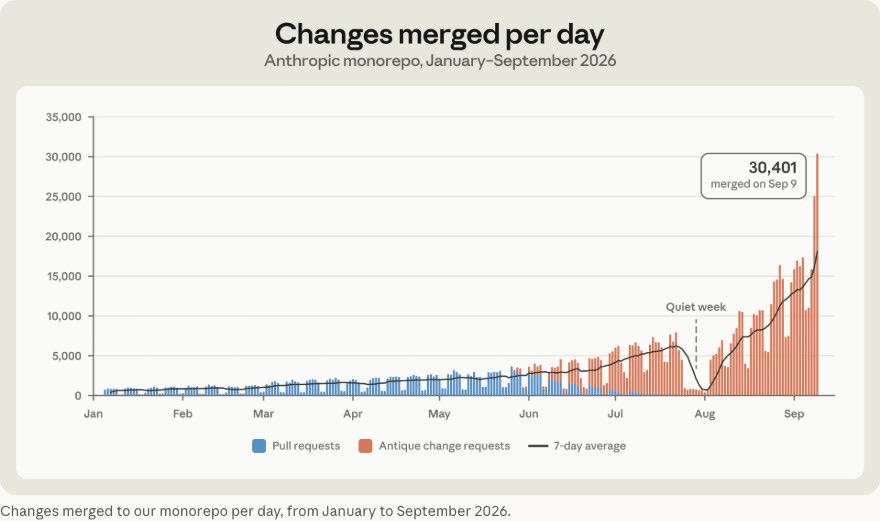
Anthropic has retired git across its main code repository and replaced it with an in-house version control system called Scion. The company's engineering team published the details on 13 October 2026, reporting that code merges driven by Claude grew from about 2,500 a day in May 2026 to more than 30,000 a day by September. A team of seven engineers built Scion, a new code review tool called Antique, and several related systems, and finished the migration off git in five months.
Scion is Anthropic's replacement for git, built because git's design for offline, human-paced work could not keep up once most of its clients became AI agents and automated jobs that never go offline. It drops local clones in favor of server-side commits and content-addressed storage, with a client that fetches only the files it actually needs.
What changed
- Git assumes every client holds a full copy of the repository. Anthropic's monorepo history is close to 100 GB and a compressed working copy tops 25 GB; the company performs on the order of 25 million code checkouts a day for CI alone, which would mean over 600 petabytes of git traffic a day if fetched the normal way.
- At peak, Anthropic ran several hundred internal git mirrors to cope with the load, but the mirrors fell further behind the tip of main between refreshes and became harder to operate as the merge rate rose.
- Scion inverts the design: the server is always reachable and does the work of computing commits, merges and blame, while the client keeps only a bounded local cache. All source data is content addressed, so any cache server can answer a request without checking with the others.
- The basic unit in Scion is a "changeset," a write-ahead log entry listing only the files that changed, with pointers into compressed blob storage. Anything else, such as blame or commit-graph lookups, is computed on demand as "derived data" rather than stored with the changeset itself.
- Anthropic says its Scion infrastructure footprint is 200 times smaller than its old git-mirroring setup in CPU and memory, that checkouts for CI and research jobs run two orders of magnitude faster, in seconds rather than minutes, and that CI alone freed up 25% of its CPU capacity.
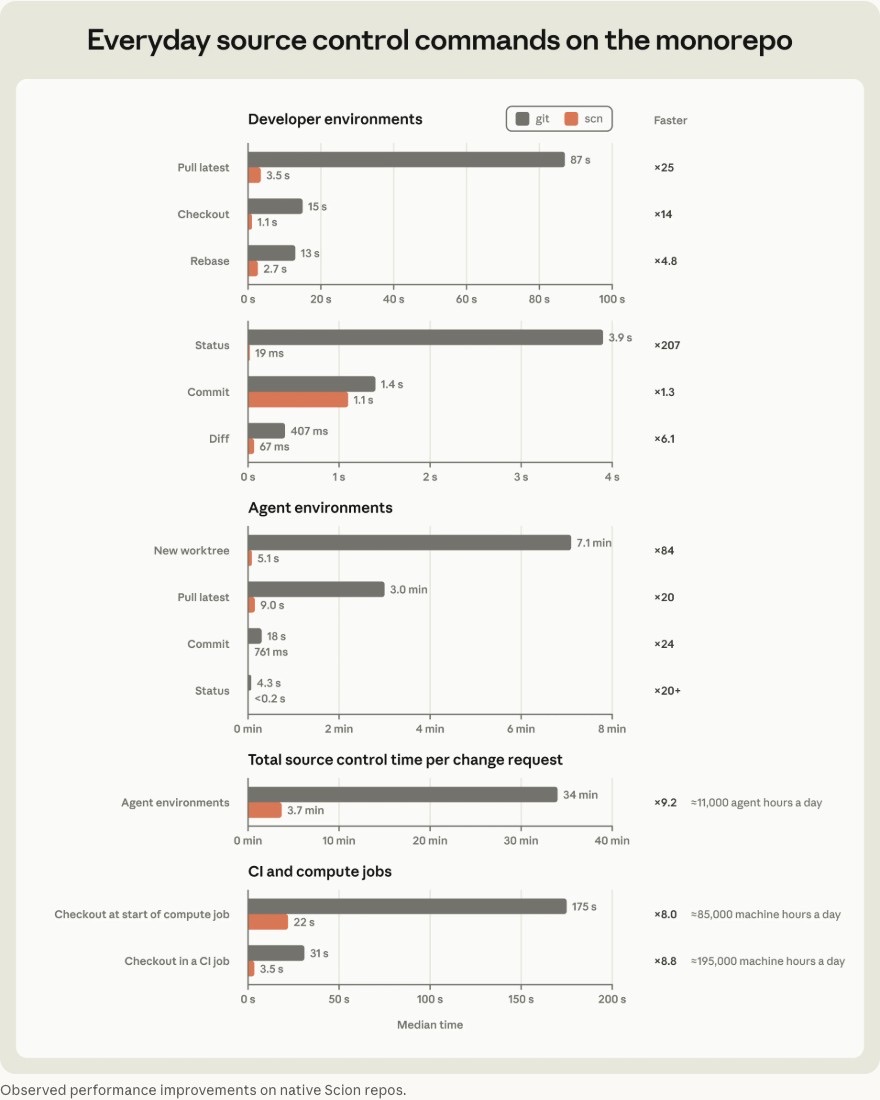
A benchmark chart in the post shows Scion cutting the time to create a new agent worktree from 7.1 minutes on git to 5.1 seconds, and total source control time per change request in agent environments from 34 minutes to 3.7 minutes, a saving Anthropic estimates at about 11,000 agent hours a day.
Why it matters for agent builders
Scion targets a problem any team running many coding agents at once will eventually hit: tooling built for developers who check in code a few times a day breaks down once most of the traffic is autonomous and constant. Anthropic's design principles are worth borrowing even without rewriting your own source control: assume the server is always reachable rather than the client, make writes cheap and lock-free with no cross-client coordination, keep the working copy optional and sparse so an agent only pulls the files it touches, and expose source control as an API so tools like CI and bisect pipelines never need a local repository at all.
The company also rethought code review and CI around the same assumptions. It replaced a global merge-queue lock, which it says "doesn't make much sense at agent scale," with post-merge and pre-deploy automated testing, accepting that concurrent changes can conflict because Claude can fix those conflicts faster than a person could identify them. It also built what it calls "superfans," dedicated Claude Tag instances that watch the telemetry of one system component, such as the scion-daemon or the Antique merge queue, around the clock. Teams evaluating coding agents like Claude Code and the infrastructure that supports them can see in concrete numbers what breaks first as agent-driven commit volume scales up.
What to watch
Anthropic says it has no plans to ship Scion as a product. It calls the system too bespoke to adopt piecemeal, since it depends on its own code review, code search and CI, and says a version built to please every organization "wouldn't actually be very useful." Instead, the company wants to share the design with the git community, GitHub and GitLab, arguing that the mismatch between git and agent-heavy workloads will become common over the next six to 12 months. On the Hacker News thread, commenter frangonf asked whether source control is even needed once code changes constantly with no direct human supervision; commenter nater5000 replied that agents still need history and blame to avoid looping on changes that were already reverted once.
Key takeaways
- Anthropic's monorepo went from about 2,500 merges a day in May 2026 to more than 30,000 a day by September, driven mostly by Claude-written code.
- Scion, Anthropic's git replacement, moves commits, merges and blame to an always-reachable server and gives the client only a bounded local cache.
- A seven-person team built Scion, the Antique code review tool and related systems, and migrated the whole monorepo off git in five months.
- Anthropic reports agent worktree creation 84 times faster and about 11,000 agent hours a day saved on source control operations.
- Anthropic will not ship Scion itself but plans to share its design with the git community, GitHub and GitLab.
FAQ
What is Scion?
Scion is the in-house version control system Anthropic built to replace git across its main code repository. It stores commits as server-side "changesets" rather than git's local trees, treats the client as a thin, always-online cache, and computes history and blame as data derived from the changeset log rather than data the client must fetch and assemble itself.
Why did Anthropic replace git?
Anthropic says git's assumption that every client works offline with a full copy of the repository stopped scaling once nearly all of its clients became AI agents and automated jobs that are always online. Its monorepo history approached 100 GB, the company ran several hundred internal git mirrors to keep up, and those mirrors still fell behind as merges rose past 30,000 a day.
Will Scion be available outside Anthropic?
No. Anthropic says Scion is not a suitable replacement for git in general use and has no plans to offer it as a product, since it requires its own code review, code search and CI to function. It says it is sharing the design instead, so that the wider git ecosystem, including GitHub and GitLab, can adapt some of the same ideas without abandoning git itself.
Source: Anthropic Discussion: Hacker News
Developers comparing coding agents and the infrastructure built around them can browse the full list in the developer tools category on AI Agents Listing.
Subscribe to our newsletter
One email a week. New agents, MCP servers and skills, and what is actually getting traction.
More news
LFM2.5-24B-A2B ships as Liquid AI's on-device agent model
Liquid AI released LFM2.5-24B-A2B, a 24B-parameter open-weight reasoning model with 2.45B active parameters, built for on-device AI agents.
Security experts say AI labs skip basic agent containment
Cybersecurity experts told CSO Online that OpenAI, Anthropic and other AI labs are skipping basic containment and monitoring behind 2026's AI agent hacking incidents.
Harvard study: AI coding agents hit a review bottleneck
A Harvard study of 718 firms finds AI coding agents raise code output 30% but code review time rises 49%, blocking the software gains.