Perplexity ships Teammates, agents for ongoing work
Perplexity launched Teammates on 6 November 2026, agents built on its Computer platform that own ongoing work like sales follow-ups, not single tasks.
Written by AiAgentsListing Team
Perplexity ships Teammates, agents for ongoing work
Perplexity launched Teammates on 6 November 2026, personal AI agents built on its Computer platform that take on long-running work instead of answering a single prompt and stopping. A teammate plans a project, coordinates with other teammates, and checks back in for review as priorities shift. The feature rolls out first on the web for Perplexity Max subscribers, with iOS access coming soon.
Perplexity Teammates is a new agent type inside Perplexity Computer that owns an ongoing piece of work, such as a sales pipeline or a marketing calendar, rather than answering one prompt and stopping. A teammate plans the work, monitors it over days or weeks, acts without a fresh query each time, and reports back for review.
What changed
Teammates build on Perplexity Computer, the general-purpose agent Perplexity describes as able to run workflows for hours or months by deploying subagents. A teammate adds standing ownership on top of that: it can notice a change on its own and act before anyone asks. Perplexity's own example is a sales teammate that notices a regular customer has stopped buying, reviews their order history and support tickets, then prepares an offer or flags issues to resolve before reaching out.
Teammates remember what they are told across sessions. If a user tells an operations teammate that a vendor needs two weeks' notice, it applies that lead time to future scheduling. They can also be added to a Slack channel so colleagues can hand them work or ask for updates, and they can pass tasks to each other, such as one teammate finding bugs on a website and handing the list to another to prepare fixes.
Each teammate runs in its own isolated environment with a separate browser session from other teammates, and saved credentials are encrypted. Users can review completed work, take over the desktop, or redirect a teammate mid-task.
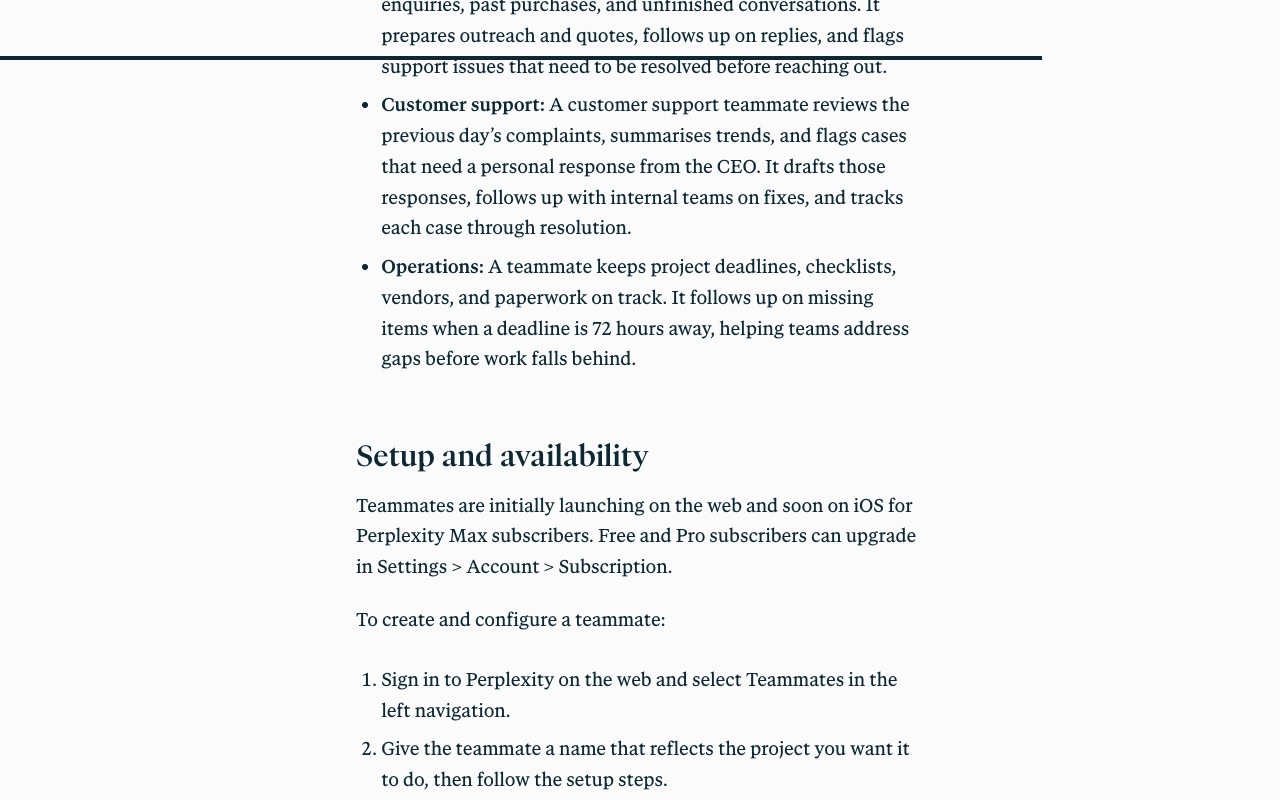
To set one up, a user signs in to Perplexity on the web, selects Teammates in the left navigation, names it after the project it should own, connects tools such as Slack, GitHub or Gmail (choosing specific repositories for GitHub), describes the work it owns, and assigns it to a project with an initial task. Perplexity says it will expand teammates' access and features "in the coming weeks."
The same day, Perplexity also introduced Brain, a self-improving memory system for Computer, rolling out in Research Preview to Max and Enterprise Max subscribers. Brain builds a context graph of a user's past sessions overnight and uses it to give Computer a better starting point on new tasks. Perplexity says early measurements show Brain raises answer correctness by 25% and recall by 16% on tasks Computer has seen before, and cuts the cost of tasks needing historical context by 13%.
Why it matters for agent builders
Teammates is a working example of agents coordinating other agents rather than one assistant answering prompts in isolation, with a parent teammate directing Computer sessions and handing tasks to peer teammates. The connector setup, choosing which GitHub repositories a teammate can reach, running each teammate in its own browser session, encrypting stored credentials, gives builders a concrete permission model to compare against their own tool-connected agents.
Brain's design is also worth a look on its own: it separates memory about the user's preferences from memory about what the agent's past work did and did not get right, then uses that record to cut tokens and turns on repeat tasks. That is a different split than the user-preference memory most agent products ship today.
What to watch
On Hacker News, the top comments were skeptical of Perplexity as a company rather than of Teammates specifically, with several calling it a "wrapper company" and questioning why it still exists against ChatGPT and Claude. Perplexity has not said when teammates will reach iOS or what connectors beyond Slack, GitHub and Gmail are coming. Whether unsupervised, proactive monitoring holds up once a teammate is juggling several real connectors instead of a product demo is the open question.
Key takeaways
- Perplexity launched Teammates on 6 November 2026: agents built on Computer that own ongoing work, such as sales follow-ups or marketing calendars, instead of answering single prompts.
- Teammates coordinate with each other and with Computer sessions, remembering project goals and past corrections across runs.
- Each teammate runs in an isolated environment with its own browser session and encrypted credentials; users can review, take over, or redirect it at any point.
- Perplexity also launched Brain, a self-improving memory system for Computer, the same day, in Research Preview for Max and Enterprise Max subscribers; Perplexity says early results show a 25% increase in answer correctness and a 16% increase in recall on tasks Computer has seen before.
- Teammates launches first on the web for Perplexity Max subscribers, with iOS "soon"; Free and Pro subscribers can upgrade to try it.
FAQ
What is Perplexity Teammates?
Teammates is a feature inside Perplexity Computer, launched 6 November 2026, that lets a user set up a persistent agent to own an ongoing piece of work, such as a sales pipeline or an operations checklist, rather than complete a single task and stop.
How is Teammates different from Perplexity Computer?
Computer is Perplexity's general-purpose agent that executes a task or workflow a user starts, deploying subagents to browse, research and connect tools. A teammate is a persistent agent built on Computer that owns a piece of work across multiple sessions, coordinating other teammates and Computer runs and remembering context between them, rather than stopping once one task finishes.
Who can use Perplexity Teammates and what does it cost?
Teammates launches first on the web for Perplexity Max subscribers, with iOS access coming soon. Free and Pro subscribers can upgrade to Max in Settings, Account, Subscription to use it.
What is Brain, and how does it relate to Teammates?
Brain is Perplexity's self-improving memory system for Computer, launched the same day in Research Preview for Max and Enterprise Max subscribers. It builds a context graph of a user's past sessions overnight, and Perplexity says early measurements show it raises answer correctness by 25% and recall by 16% on tasks Computer has already seen.
Source: Perplexity
Discussion: Hacker News
Teammates joins a growing field of agents built for standing work rather than single tasks; compare it with others in the AI agents directory.
Subscribe to our newsletter
One email a week. New agents, MCP servers and skills, and what is actually getting traction.
More news
Anthropic details how Claude's agent memory system works
Anthropic's 6 November 2026 research post explains how Claude agents build, prune and correct memory across sessions through a process it calls dreaming.
Goldman Sachs pulls Claude Code from traders and bankers
Goldman Sachs limited Claude Code and GitHub Copilot to its roughly 12,000 engineers in October 2026, cutting off traders and bankers, Bloomberg reports.
Runlayer ships MCP Explained, an interactive protocol guide
Runlayer's free interactive guide, MCP Explained, walks through every JSON-RPC message in the Model Context Protocol, including the 2026-07-28 spec.