Claude Code vs Codex: The Real Differences in 2026
Claude Code vs Codex compared on pricing, GitHub automation, open source status and the latest releases from Anthropic and OpenAI.
7 min read
AI agent examples compared: Claude Code, Devin, ChatGPT agent, Intercom's Fin, Salesforce Agentforce and Manus, each sourced from the vendor's own docs.
"AI agent" gets used for anything from a chatbot with a system prompt to a program that ships its own pull requests. The clearest way to see the difference is to look at what is actually shipping: tools that plan a task, use software on their own, and hand back a finished result rather than a reply.
AI agent examples that are live today include Claude Code (Anthropic's coding tool), Devin (Cognition's autonomous software engineer), ChatGPT agent (OpenAI's browsing and computer-use agent), Fin (Intercom's customer service agent), Agentforce (Salesforce's enterprise agent platform) and Manus (a general-purpose task agent). Each one runs inside a sandboxed environment and finishes multi-step work with limited supervision.
| Agent | What it is | Best for | Access |
|---|---|---|---|
| Claude Code | Anthropic's agentic coding tool for terminal, IDE, desktop and web | Developers automating coding, testing and PRs | Claude subscription or Anthropic Console/API |
| Devin | Cognition's autonomous software engineer | Engineering teams offloading backlog tickets and migrations | Individual and Teams plans, sign-up required |
| ChatGPT agent | OpenAI's unified browsing and computer-use agent | Research, bookings and spreadsheet work done end to end | ChatGPT Pro, Plus and Team plans |
| Fin (Intercom) | A customer experience agent with service, sales and ecommerce roles | Support teams automating conversations across channels | Free trial, usage-based pricing |
| Agentforce | Salesforce's digital labor platform | Enterprises deploying agents across service, sales, HR and commerce | Free start via Salesforce Foundations, or Flex Credits, resolutions, or per-user licensing |
| Manus | A general-purpose agent with its own sandboxed virtual computer | Individuals and teams delegating end-to-end tasks | Paid plans |
Claude Code is an agentic coding tool that reads your codebase, edits files, runs commands, and integrates with your development tools, according to Anthropic's own documentation. It runs on five surfaces: the terminal, IDE extensions for VS Code and JetBrains, a desktop app, a web interface, and mobile.
Anthropic's docs describe it handling whole workflows rather than single edits: writing tests for untested code, tracing a bug from an error message to its root cause, staging commits and opening pull requests directly through git, and spawning multiple sub-agents that work on separate parts of a task under a lead agent. It connects to external tools through the Model Context Protocol (MCP), an open standard that lets it read design docs in Google Drive, update Jira tickets, or pull messages from Slack. Teams extend it with a CLAUDE.md file for project-specific standards, packaged skills for repeatable workflows, and hooks that run shell commands around its actions, such as auto-formatting after every edit.
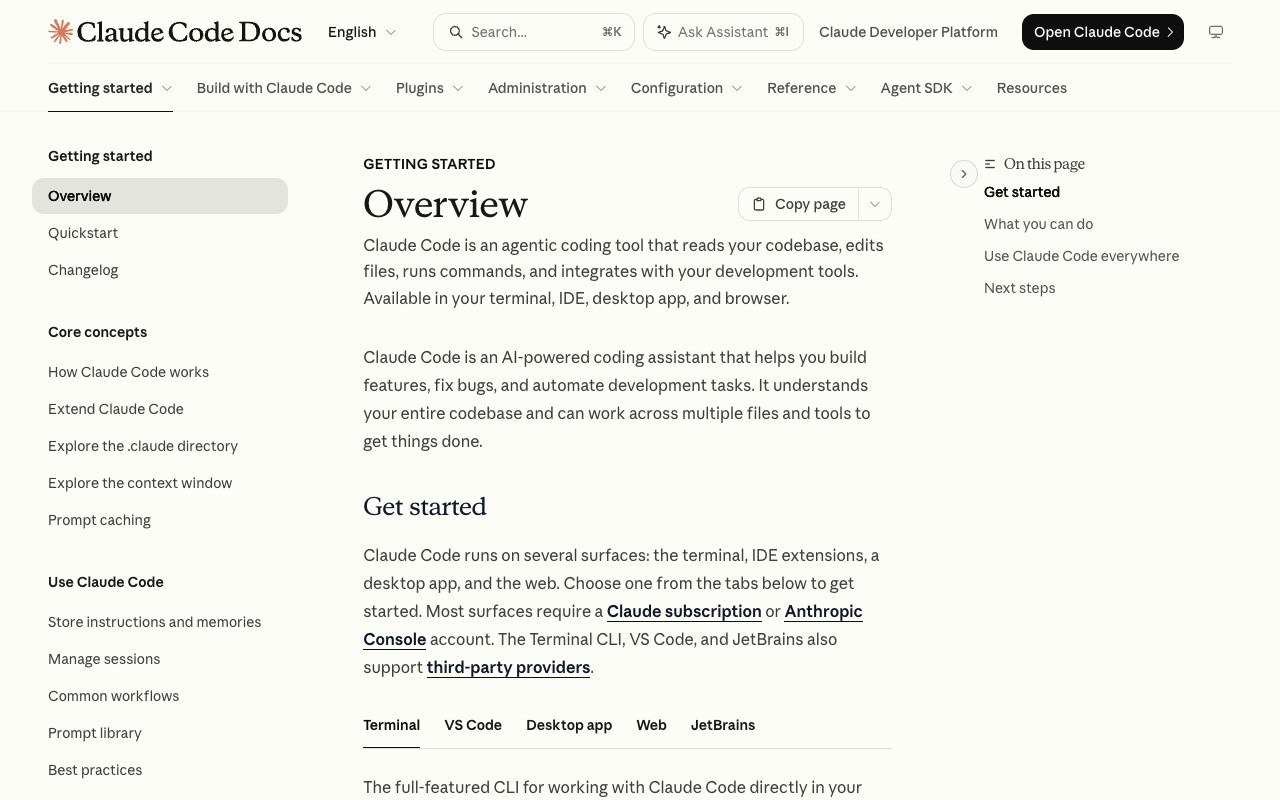
AI Agents Listing carries the current Claude Code listing, next to its coding category of comparable tools.
Cognition introduced Devin on 12 March 2024 as, in its own words, "the first AI software engineer," equipped with a shell, a code editor and a browser inside a sandboxed compute environment, according to Cognition's launch post. On the SWE-bench benchmark, which asks agents to resolve real GitHub issues from open source projects like Django and scikit-learn, Devin resolved 13.86% of issues end to end, against a prior best of 1.96% and 4.80% for models given the exact files to edit.
Devin's own documentation lists where it is strongest: clearing a backlog of Linear or Jira tickets in parallel, code migrations such as JavaScript to TypeScript or framework upgrades, repetitive engineering work like PR review and writing unit tests, and building customer integrations against unfamiliar APIs. The docs recommend writing prompts with explicit completion criteria and tasks that are easy to verify, such as checking that CI passes. Cognition's blog lists a steady run of 2026 updates: Devin Desktop on 2 June 2026, Devin 2.2 on 24 February 2026, an SWE-1.6 model preview on 1 March 2026, and a Series D funding round covered in a post titled "More Devins in More Places" on 27 May 2026.
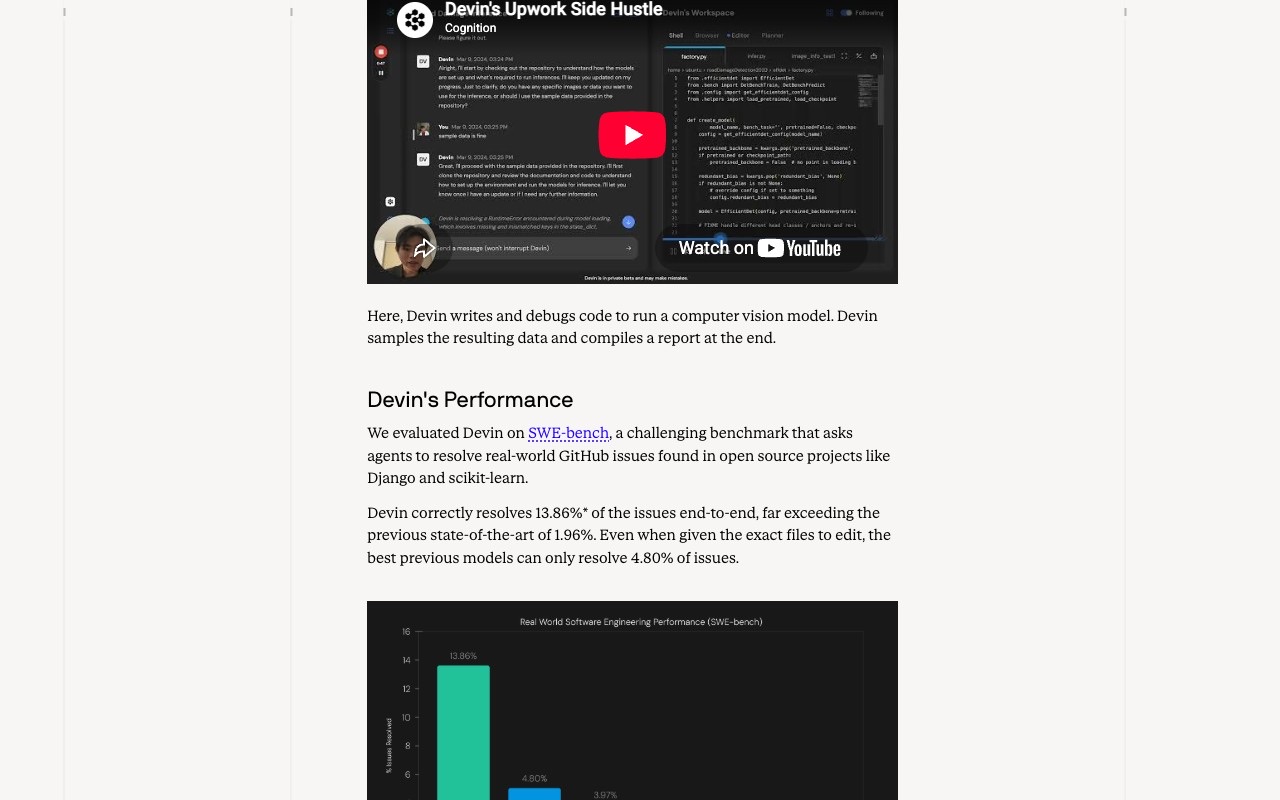
Devin has its own listing on AI Agents Listing.
OpenAI launched ChatGPT agent on 17 July 2025 as a merger of two earlier tools, according to OpenAI's announcement: Operator's ability to click and type on real websites, and deep research's skill at synthesizing information into a report. The combined agent works from its own virtual computer, choosing between a visual browser, a text-based browser, a terminal and direct API access depending on the task, and it asks for permission before actions of consequence.
OpenAI's post reports the model scoring a pass@1 of 41.6 on Humanity's Last Exam (44.4 when run eight times in parallel and picking the most confident result), 27.4% on FrontierMath, and 68.9% on BrowseComp, 17.4 percentage points above deep research alone. On SpreadsheetBench, it scored 45.5% against Copilot in Excel's 20.0% on the same 912-question set. At launch, OpenAI shipped the capability to ChatGPT Pro, Plus and Team users through an "agent mode" option in the tools dropdown. The same page now carries a notice from OpenAI that the launch post is outdated and points readers to two newer products, Workspace agents and ChatGPT Work, for current agentic workflows.
Fin is described on Intercom's own help page as "the best-performing AI agent for customer experience," built to resolve complex queries across every channel a business supports. Rather than running on a single generic model, Fin works in three layers: an app layer for training, testing, deploying and analyzing its behavior; a retrieval-augmented generation (RAG) layer that searches a company's own content for accurate answers; and a model layer built from five specialized custom models, one each for retrieval, reranking, summarizing a customer's issue, detecting when to escalate to a human, and understanding the customer's response.
Fin switches between three roles inside a single conversation: Fin for Service handles the majority of customer questions across channels, Fin for Sales runs inbound conversations through qualification and meeting booking, and Fin for Ecommerce acts as a shopping assistant that recommends products and guides checkout. Intercom's page also describes Fin Vision, which reads screenshots, invoices and error messages a customer shares, and real-time translation across more than 45 languages.
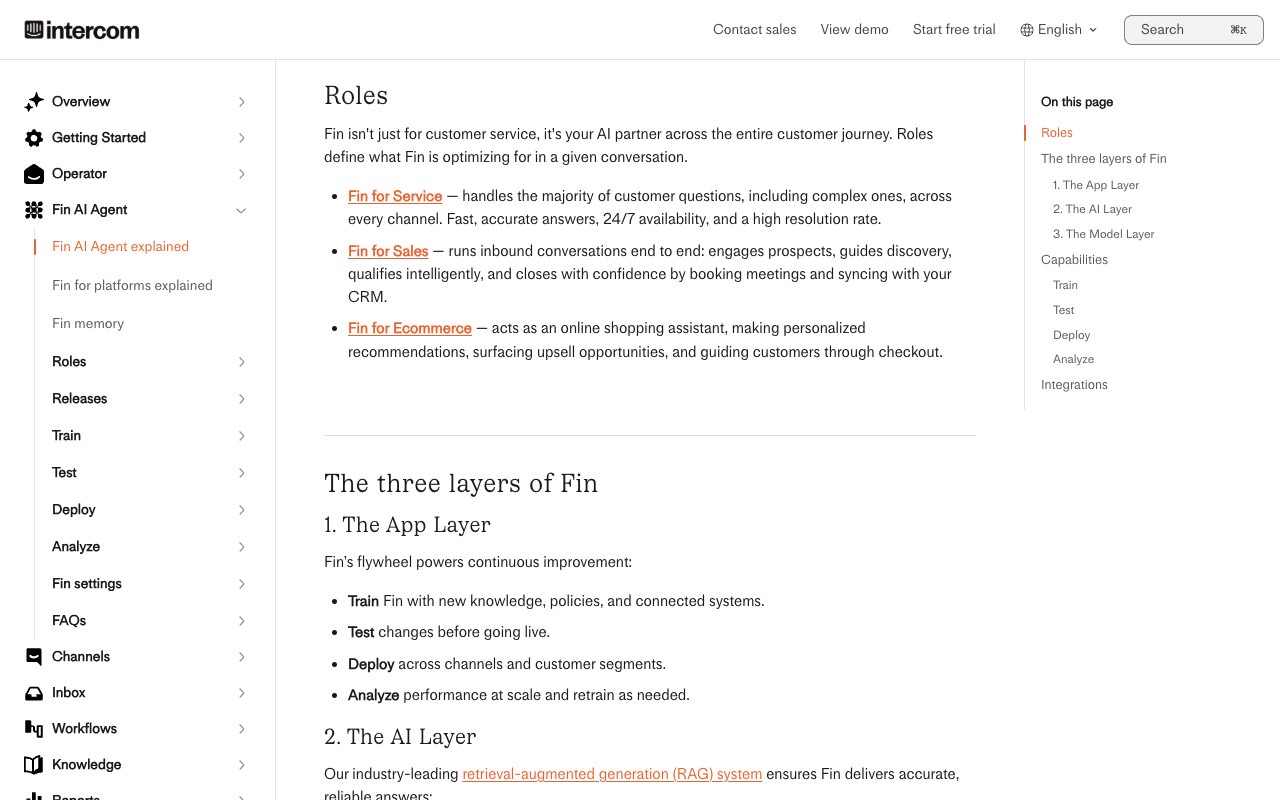
Intercom's current listing sits on AI Agents Listing, next to the customer support category.
Agentforce is Salesforce's platform for building and deploying what the company calls a "digital labor force," according to Salesforce's own product page. Salesforce states that more than 18,000 companies already run on it. Agents reason through requests using what Salesforce calls the Atlas Reasoning Engine, which breaks a prompt into smaller steps, evaluates each one, and proposes a plan before acting, grounding its answers in a company's own CRM and external data.
The page lists purpose-built agent types ready to deploy out of the box: a Service Agent that replaces scripted chatbots, a Sales Development Representative that qualifies leads and books meetings, a Sales Coach that runs role-play practice for sellers, a Merchandiser for ecommerce site setup, a Buyer Agent and Personal Shopper for B2B and consumer purchasing, and a Campaign Optimizer that runs a marketing campaign's full lifecycle. Businesses build and customize these with a low-code Agent Builder, using flows, prompts, Apex code and MuleSoft API connectors. Every Salesforce customer can start with Agentforce for free through Salesforce Foundations, with further access priced through Flex Credits, per-resolution charges, or per-user licensing.
Manus is described in its own documentation as "an autonomous general AI agent designed to complete tasks and deliver results." It differs from a chatbot because it takes action instead of only answering. It operates inside a sandbox: a virtual computer with internet access, a persistent file system, and the ability to install software and build its own tools as a task requires, which lets it keep context across long-running work instead of needing a person to reassemble results after every step.
Manus connects to services a team already uses, including Gmail, Notion, Slack and GitHub, so a task can read a calendar, post to a channel, or open an issue as part of completing a broader request.
Manus has its own listing on AI Agents Listing as well.
The six agents above split cleanly by job. Pick a coding agent, Claude Code or Devin, when the task is writing, testing or migrating software. Pick ChatGPT agent or Manus when the task spans research, booking and file or spreadsheet work with no fixed domain. Pick Fin or Agentforce when the job is customer-facing and needs to plug into an existing CRM or helpdesk. None of these agents replace the others, since each one is built around a different sandbox and a different set of tools.
Cognition kept shipping Devin through 2026: Devin Desktop landed 2 June 2026, Devin 2.2 on 24 February 2026, and an SWE-1.6 model preview on 1 March 2026, alongside a Series D funding announcement on 27 May 2026. On OpenAI's side, the original ChatGPT agent launch page from July 2025 now carries a notice that it is outdated, with OpenAI pointing readers to two newer products, Workspace agents and ChatGPT Work, for current agentic work. Salesforce's Agentforce page currently cites more than 18,000 companies running the platform and references an IDC MarketScape 2026 Vendor Assessment of agentic AI platforms.
An AI agent plans a task, uses tools such as a terminal, browser or API on its own, and completes multi-step work before reporting back, rather than only answering a single message. Every example above, from Claude Code editing files to Manus running its own sandboxed computer, acts inside a real environment instead of just generating text.
Cognition's documentation lists Individual and Teams plans but does not publish exact prices on its intro page; pricing is quoted after signing up at app.devin.ai.
The original announcement page from 17 July 2025 is still live, but OpenAI has added a notice calling it outdated and directs readers to Workspace agents and ChatGPT Work for current agentic workflows, so a reader evaluating OpenAI's agent tools today should start with those two products instead.
Yes. Manus's documentation lists connectors for Gmail, Notion, Slack and GitHub, which give it access to those services while it works on a task.
No. Salesforce's own page lists out-of-the-box agent types for service, sales, HR, ecommerce and marketing, including a Sales Development Representative, a Sales Coach, a Merchandiser and a Campaign Optimizer, not just a support chatbot replacement.
Source pages: Claude Code overview, Cognition's Devin launch post, Devin documentation, OpenAI's ChatGPT agent announcement, Intercom's Fin AI Agent explained, Salesforce's Agentforce page, Manus documentation.
Compare these and hundreds of other tools in the AI Agents Listing directory.
One email a week. New agents, MCP servers and skills, and what is actually getting traction.
Claude Code vs Codex compared on pricing, GitHub automation, open source status and the latest releases from Anthropic and OpenAI.
7 min read
AI agent vs chatbot compared on control flow, tool use and autonomy, with sourced definitions from Salesforce, Google Cloud and Wikipedia.
6 min read
MCP logging lets a server send log messages to its client. The 2026-07-28 MCP spec deprecated it in favor of stderr logging and OpenTelemetry.
6 min read