Claude Code vs Codex: The Real Differences in 2026
Claude Code vs Codex compared on pricing, GitHub automation, open source status and the latest releases from Anthropic and OpenAI.
7 min read
AI agent vs chatbot compared on control flow, tool use and autonomy, with sourced definitions from Salesforce, Google Cloud and Wikipedia.
Salesforce, Google Cloud and half the SaaS industry now sell both "AI agents" and "chatbots," often on the same pricing page, which makes the two terms sound interchangeable. They are not. The distinction comes down to who or what decides what happens next.
In an AI agent vs chatbot comparison, the core difference is control: a chatbot follows a fixed script or decision tree to answer a question, while an AI agent uses a large language model to reason about a goal, call external tools, and complete a multi-step task without a human directing each step.
A chatbot is a computer program that uses pre-defined rules, decision trees and scripted responses to hold a conversation. The idea is old: the first chatbot, ELIZA, was built by Joseph Weizenbaum in 1964, and Salesforce traces the direct line from ELIZA to today's customer-support bots in its own AI agent vs. chatbot comparison.
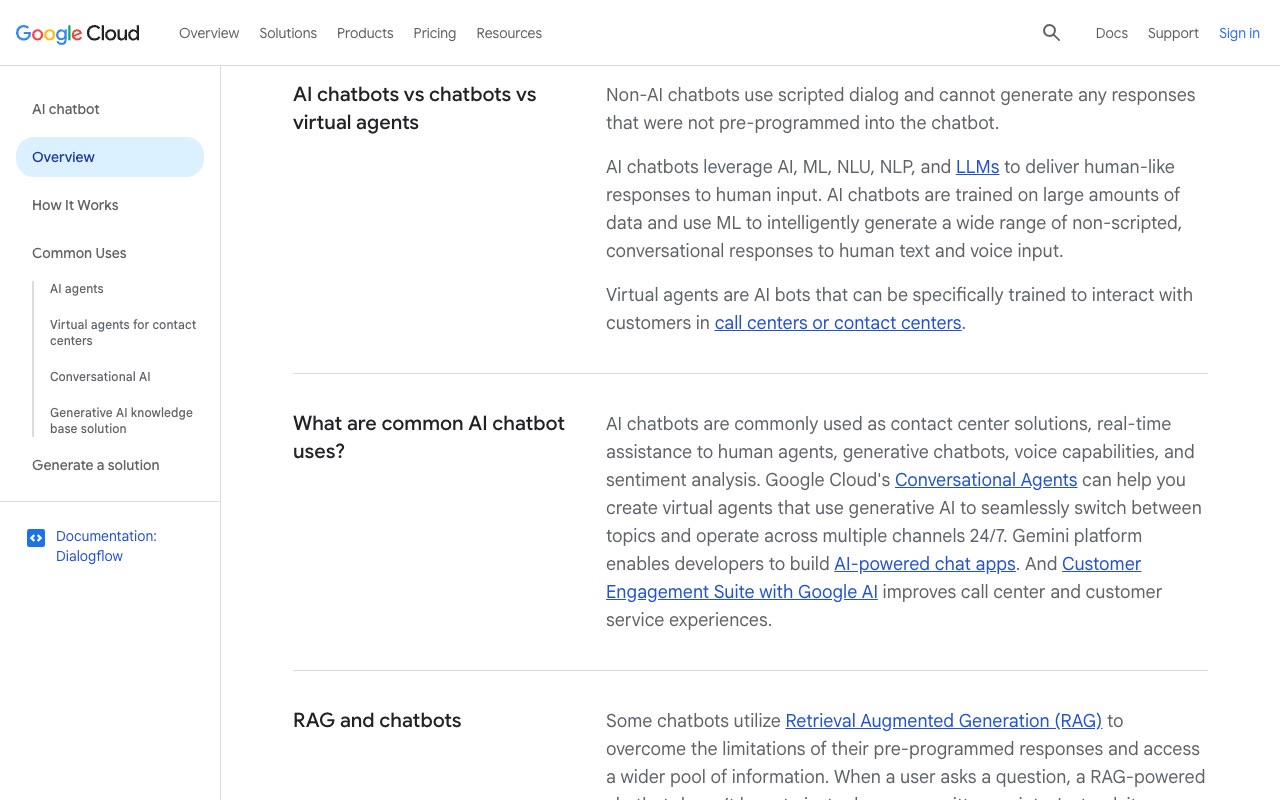
A chatbot's conversational flow is, in Salesforce product management director Abhi Rathna's words, "built in a very declarative and pre-defined manner," which is why a chatbot gives quick, consistent answers to routine questions but struggles the moment a request falls outside its script. Google Cloud draws the same line in its own chatbot documentation: "non-AI chatbots use scripted dialog and cannot generate any responses that were not pre-programmed into the chatbot," while an AI-enhanced chatbot adds large language models to generate non-scripted replies, without gaining the ability to act on a user's behalf.
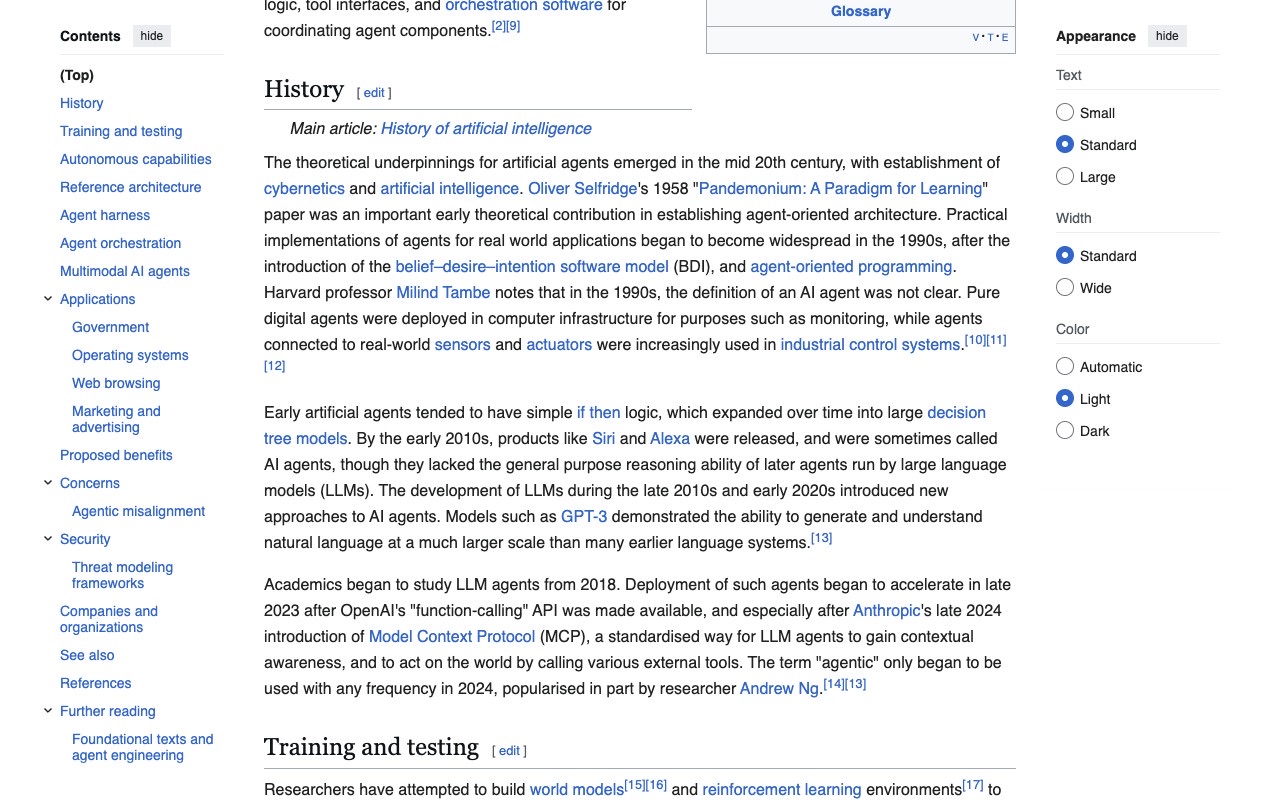
An AI agent is a program that can make decisions, pursue goals and take actions independent of a human, according to Wikipedia's AI agent article. Common attributes include goal-directed behavior, use of external tools, the ability to modify an external environment, and the ability to carry out multi-step tasks on its own, with the control flow usually driven by a large language model.
Practical LLM-driven agents are recent. Academics began studying LLM agents in 2018, but deployment accelerated only after OpenAI's "function-calling" API became available in late 2023, and again after Anthropic introduced the Model Context Protocol in late 2024, a standardized way for an LLM agent to gain context and act on the world by calling external tools. The term "agentic" itself only started appearing with any frequency in 2024, popularized in part by researcher Andrew Ng.
Salesforce describes the practical effect the same way: "An AI agent connects directly to company data, assesses incoming requests, and completes tasks without requiring manual intervention." Where a chatbot answers a question, an agent can look up a record, call an API and take the next step on its own.
| Aspect | Chatbot | AI agent |
|---|---|---|
| Control flow | Follows pre-defined rules, decision trees or scripted dialogue | Reasons toward a goal using a large language model, deciding its own steps |
| Tool use | Limited to pre-programmed responses or a knowledge base lookup | Calls external tools, APIs and data sources to take action |
| Autonomy | Reactive: answers what it is asked, then hands off to a human | Proactive: completes multi-step tasks without a human directing each step |
| Origin | Traces to ELIZA, built by Joseph Weizenbaum in 1964 | Practical deployment accelerated after OpenAI's function-calling API (late 2023) and Anthropic's Model Context Protocol (late 2024) |
| Typical task | FAQs, store hours, password resets, routing to a human | Resolving a billing dispute, prioritizing sales prospects, processing a multi-step return |
Sources: Salesforce, Google Cloud, Wikipedia.
The line is not fixed. Salesforce's own FAQ states that "as chatbots integrate more advanced AI capabilities like reasoning, planning, and external tool use, they can evolve from conversational interfaces into more autonomous AI agents." Wikipedia's survey of AI agent applications, citing a breakdown by The Information, lists "conversational agents, which act as chatbots for customer support" as one of seven recognized agent archetypes, alongside business-task agents, research agents, analytics agents, coding agents, domain-specific agents and web browser agents. A chatbot and an agent are not always two separate products; a chatbot can be the conversational front end of an agent that reasons and acts behind it.
They can be either. A traditional, rule-based chatbot is not an AI agent because it cannot reason or act independently. But Wikipedia's breakdown of AI agent archetypes includes "conversational agents, which act as chatbots for customer support" as one recognized category, so a chatbot built on an agentic backend counts as an agent.
Yes. According to Salesforce, as a chatbot gains reasoning, planning and external tool use, it evolves from a scripted conversational interface into a more autonomous AI agent. The conversational front end can stay the same while what happens behind it changes.
Not entirely, at least not yet. Salesforce expects a hybrid approach for the near term, using chatbots where brand-controlled, scripted answers matter and agents where multi-step reasoning and action are needed, with the mix shifting toward agents as the technology matures.
Check whether it can take an action outside the conversation, such as calling an API, looking up a live database record or completing a task, without a human carrying out that step. A tool limited to generating a text reply, however fluent, is a chatbot; a tool that can also act on a system is an agent.
It depends on the use case rather than the technology. Salesforce's own guidance ties the choice to who is being served: primarily customer-facing scenarios suit a mix of chatbots and agents, while employee-facing scenarios favor an agent, since employees need help spanning more systems and workflows than a scripted bot can cover.
AI Agents Listing tracks both kinds of product, from scripted customer-support bots to multi-step autonomous agents, alongside the customer support tools built on each approach.
One email a week. New agents, MCP servers and skills, and what is actually getting traction.
Claude Code vs Codex compared on pricing, GitHub automation, open source status and the latest releases from Anthropic and OpenAI.
7 min read
AI agent examples compared: Claude Code, Devin, ChatGPT agent, Intercom's Fin, Salesforce Agentforce and Manus, each sourced from the vendor's own docs.
8 min read
MCP logging lets a server send log messages to its client. The 2026-07-28 MCP spec deprecated it in favor of stderr logging and OpenTelemetry.
6 min read