AI Agent Pricing Models Explained: What Vendors Charge
AI agent pricing models explained with real numbers from Salesforce Agentforce, Intercom's Fin AI Agent, and Anthropic's Claude API pricing pages.
6 min read
MCP vs Agent Skills, compared on how each connects an AI agent to the outside world: MCP as a client-server protocol for live tools, Agent Skills as local Markdown instructions.
A developer picking tools for an agent keeps running into both names in the same sentence: Model Context Protocol (MCP) and Agent Skills. They look like they solve the same problem, extending what an AI model can do, and plenty of comparison posts treat them as competitors. They aren't built the same way, and the choice between them changes how much infrastructure a project needs.
MCP is a client-server protocol: an agent connects over JSON-RPC to a separate running server that exposes tools, data and prompt templates through a fixed schema. An Agent Skill is a folder with a SKILL.md file that an agent reads directly and loads into its own context, no server or network call required. One wires an agent to a live system; the other hands it written know-how.
Five dimensions decide which one a given job actually needs, laid out by ByteByteGo's newsletter on 2 May 2026:
| Dimension | MCP | Agent Skills |
|---|---|---|
| Integration | Client-server protocol connecting many agents to many backends through one interface | A folder with SKILL.md that the agent loads when it matches the task |
| Architecture | Runs as a separate process speaking JSON-RPC | Just a directory: SKILL.md, optional scripts, references, assets |
| Invocation | Tools called with typed parameters validated against a schema, and can be chained | Agent reads SKILL.md and runs whatever it describes, such as bash, Python or curl |
| Runtime | Server often runs in its own container or hosted service | Runs inside the agent's own environment, no extra infrastructure |
| Where it fits | Connects agents to live systems and changing data | Gives agents reusable, stable know-how and instructions |
MCP standardizes how an AI application talks to external services: a database, a CRM, a cloud API, a filesystem. The official MCP documentation breaks a server's capabilities into three building blocks, each with a different controller. Tools are model-controlled: the LLM decides when to call them, and each one defines typed inputs and outputs validated with JSON Schema. Resources are application-controlled: passive, read-only data such as file contents or a database schema that the host application decides how to use. Prompts are user-controlled: pre-built templates a person explicitly invokes, often through a slash command.
That schema-first design is also where MCP gets expensive. LlamaIndex's Clelia Astra Bertelli and Tuana Çelik wrote on 3 February 2026 that scaling the number of MCP tools is hard, since each one needs a name and description an agent can discover and a strict input schema it must follow, which has pushed some teams toward building MCP gateways just to manage tool sprawl. Unoptimized tools can also return large responses that clutter an agent's context window, and because each tool call is a network request to an external service, it adds latency a purely local operation wouldn't have. A dev.to piece from Google AI's Tilde A. Thurium, posted 30 July 2026, names the same cost directly: loading hundreds of lines of tool definitions for tools the agent never ends up calling bloats the context before a single task starts. Directories such as AI Agents Listing's MCP servers hub exist largely because of that tool sprawl, since picking the right handful of servers for a job beats installing every one available.
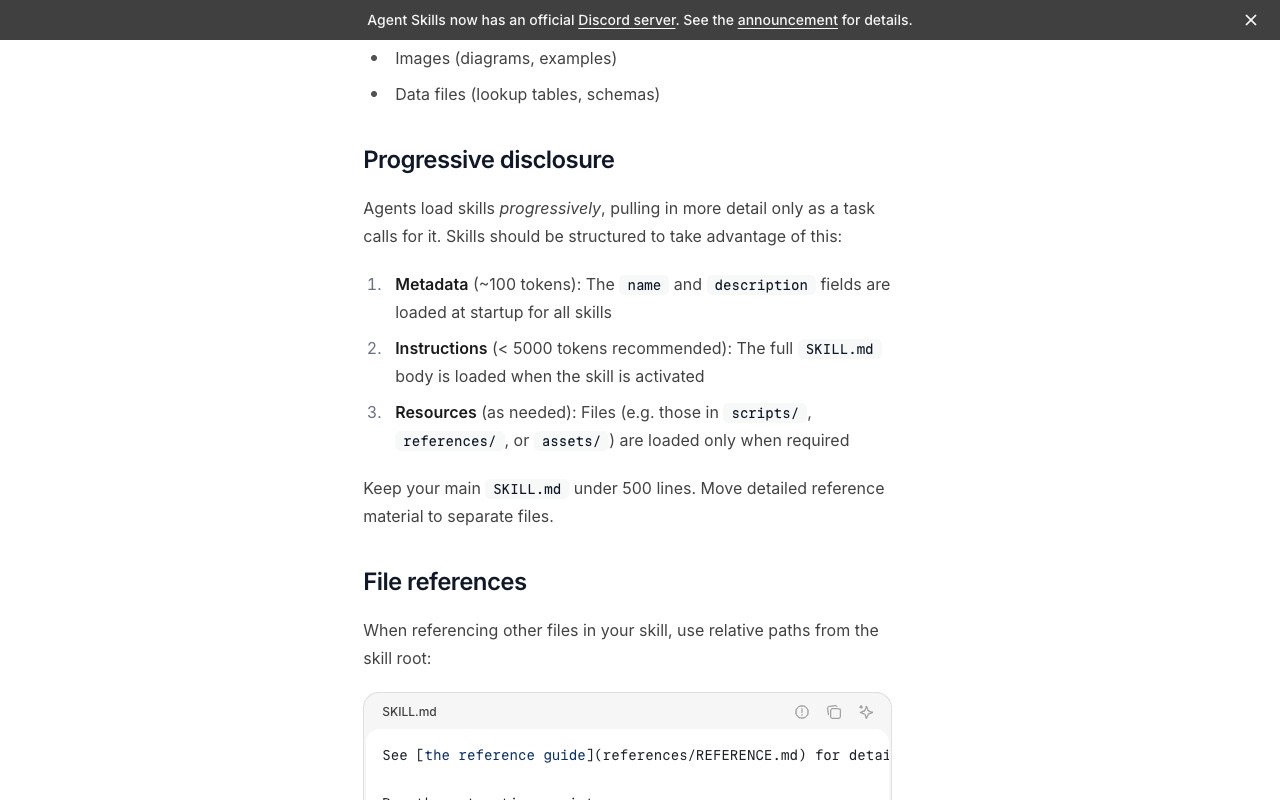
An Agent Skill is defined by the open Agent Skills specification: a directory containing at minimum a SKILL.md file with YAML frontmatter (a required name under 64 characters and a required description under 1024 characters) followed by Markdown instructions, plus optional scripts/, references/ and assets/ folders. The spec's progressive disclosure model is the core design choice: an agent loads only the name and description of every installed skill at startup, costing roughly 100 tokens each, then loads the full SKILL.md body, kept under the recommended 5,000 tokens, only once it decides the skill applies, and pulls in any referenced scripts or files only when the task actually needs them.
LlamaIndex describes the execution side of that same flow: the agent matches a skill to the user's request, confirms it has permission to follow the skill's instructions, opens a fresh context window, loads the skill's prompt into it, and executes the task there before returning the result to the main conversation. Because a skill is natural-language instructions rather than a schema-validated function call, it's open to misinterpretation in a way a typed MCP tool call isn't; the agent itself has to decide how to carry out what the skill describes, not just whether to call it. Claude Code's skills documentation confirms Claude Code follows this same open Agent Skills standard, then layers on its own extensions: invocation control over whether a person or the model triggers a skill, running a skill inside a subagent, and injecting dynamic context at load time. Claude Code is one of several clients implementing the standard; AI Agents Listing's skills hub tracks more of them.
Querying a live system or taking an action on it, such as checking a database, calling a billing API or sending a message through a connected service, needs MCP. The data changes between calls, so the agent needs a live round trip, not a cached instruction file.
Teaching an agent a stable procedure, such as a team's code review checklist, a document formatting convention or how to interpret a particular report, fits a Skill. Nothing here changes between invocations, so writing it down once in a SKILL.md file is cheaper than standing up and maintaining a server.
Combining both is where Red Hat Developer's Cedric Clyburn, writing on 25 May 2026, frames the real-world answer: his article's own structure moves from "When to use MCP servers" through "When to use skills" to a dedicated section on combining the two for comprehensive workflows, treating the pairing as the default rather than an edge case. The MCP project's own developer docs agree in practice, if not by name: Anthropic's mcp-server-dev plugin uses Agent Skills to help a coding agent design and scaffold an MCP server in the first place, covered below.
The current MCP specification, version 2026-07-28, added a dedicated "Build with Agent Skills" page to its official developer documentation. It describes the mcp-server-dev plugin, a reference set of three Agent Skills built specifically to help a coding assistant design and scaffold an MCP server: build-mcp-server is the entry point that interrogates the use case and picks a deployment model, build-mcp-app adds interactive UI widgets rendered inline in chat, and build-mcpb packages a local stdio server with its own runtime so it can be installed without Node or Python. Each skill ships a SKILL.md file plus a references/ folder the agent reads on demand, and the page gives the Claude Code install command directly: /plugin marketplace add anthropics/claude-plugins-official followed by /plugin install mcp-server-dev.
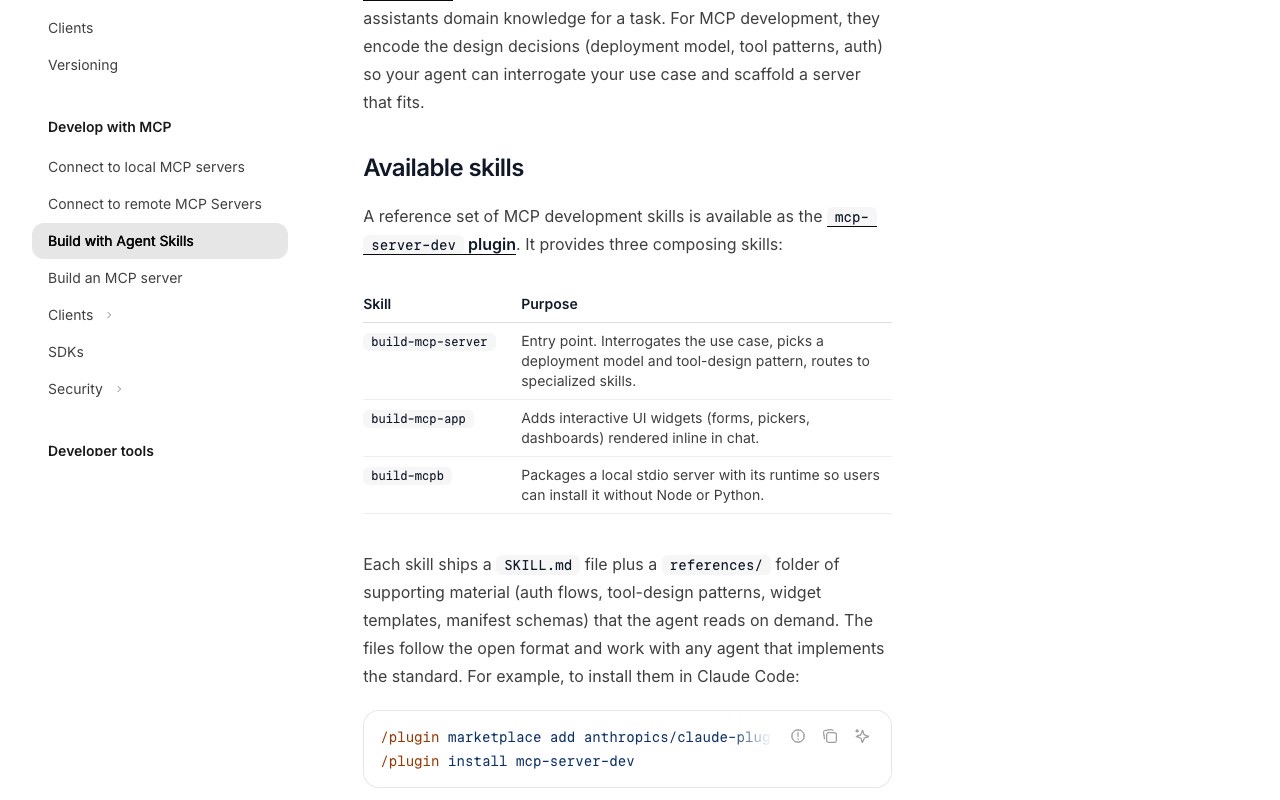
That page is the clearest signal yet that the MCP project doesn't treat Agent Skills as a rival format: it ships official skills that use the open Agent Skills standard to help developers build MCP servers faster, folding both technologies into the same workflow instead of asking a developer to pick a side.
SKILL.md file; it runs inside the agent's own environment with no server, container or network call.mcp-server-dev plugin, to help developers scaffold MCP servers, treating the two as complementary rather than competing formats.Yes. Nothing in either specification stops an agent from having both installed, and the MCP project's own mcp-server-dev plugin is built from three Agent Skills that help a coding agent design and scaffold an MCP server, which is itself an example of the two working together rather than competing.
No. Per the Agent Skills specification, a skill is a directory containing a SKILL.md file plus optional scripts/, references/ and assets/ folders. The agent reads these files directly inside its own environment; there's no separate process, container or network connection involved, unlike an MCP server.
For operations that don't need external data, Skills are typically faster, since they run locally with no network round trip. LlamaIndex notes that MCP tools call external services over the network on every invocation, which adds latency a Skill running in the agent's own environment doesn't have. An MCP tool call is still the only option when the agent genuinely needs live data from an external system.
Yes. Claude Code's documentation confirms its skills follow the open Agent Skills standard, with added features like invocation control and subagent execution, and the same docs site maintains a separate MCP quickstart and reference for connecting Claude Code to MCP servers.
Picking between them comes down to whether the agent needs live access to something that changes, or stable instructions it can keep in a file; browse how other builders are shipping both inside AI Agents Listing's directory of AI agents.
One email a week. New agents, MCP servers and skills, and what is actually getting traction.
AI agent pricing models explained with real numbers from Salesforce Agentforce, Intercom's Fin AI Agent, and Anthropic's Claude API pricing pages.
6 min read
Vertical AI agents work inside one industry instead of many. See how they're built, real production examples, and when to choose one over a general agent.
7 min read
MCP vs REST API comes down to who decides what to call: a developer at build time for REST, or the model itself at runtime for MCP.
8 min read