Claude Sonnet 5.5 ships as Anthropic's fastest Sonnet yet
Anthropic released Claude Sonnet 5.5 on September 28, 2026: a faster, cheaper Sonnet model built for agentic coding, with a 1M-token context window.
Written by AiAgentsListing Team
Anthropic ships Claude Sonnet 5.5
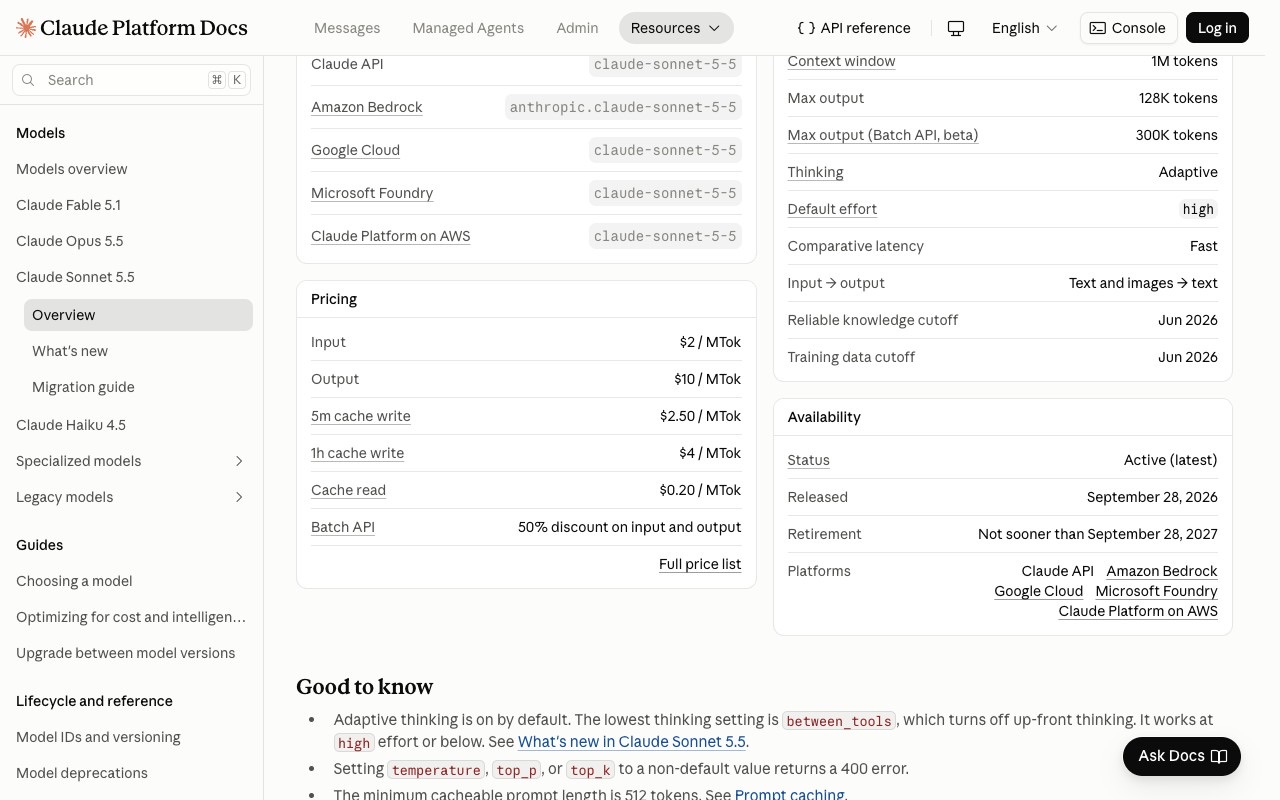
Anthropic released Claude Sonnet 5.5 on September 28, 2026, the second model in its Claude 5.5 family after Claude Opus 5.5. The company says it runs more than 30% faster than Claude Sonnet 5 and costs up to 30% less per task at the same per-token price, with the model ID claude-sonnet-5-5 live on the Claude API, Amazon Bedrock, Google Cloud, Microsoft Foundry and the Claude Platform on AWS.
Claude Sonnet 5.5 is Anthropic's updated mid-tier language model, released September 28, 2026, as the second model in the Claude 5.5 family after Opus 5.5. It scores 70.6% on the Terminal-Bench 4.0 agentic coding benchmark, up from Sonnet 5's 10.3%, runs more than 30% faster, and costs up to 30% less per task at the same per-token price.
What changed
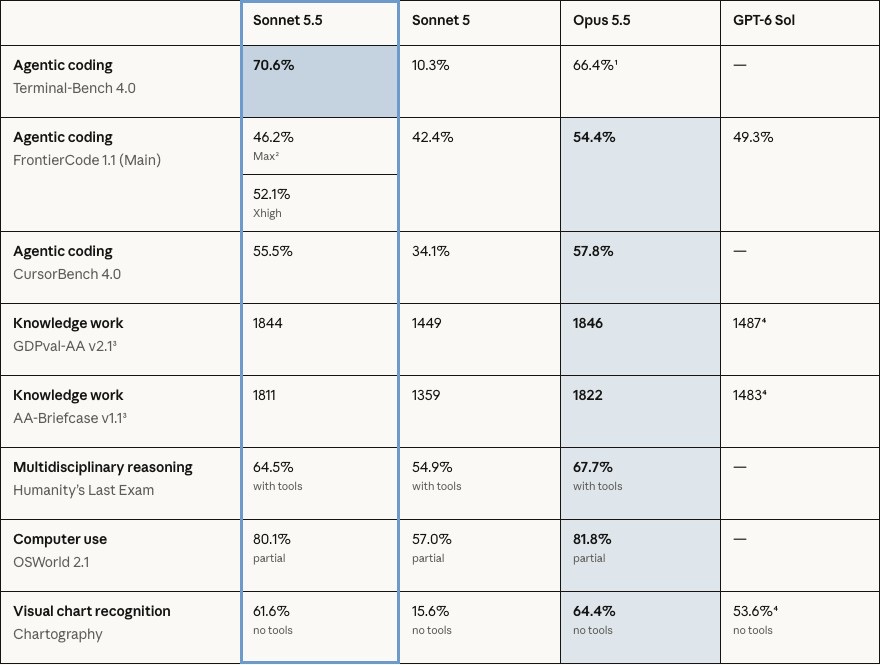
Anthropic's own benchmark table puts the gains mostly in agentic coding:
- Terminal-Bench 4.0 (agentic coding): 70.6% for Sonnet 5.5, versus 10.3% for Sonnet 5 and 66.4% for Opus 5.5 at its highest effort setting.
- FrontierCode 1.1 (whether an agent's code change would be merged without edits): 46.2% at Max effort, up from Sonnet 5's 42.4%, against Opus 5.5's 54.4% and GPT-6 Sol's 49.3%.
- CursorBench 4.0 (tasks pulled from real Cursor sessions): 55.5%, up from 34.1%, within about two points of Opus 5.5's 57.8%.
- GDPval-AA v2.1 (knowledge work across 44 occupations): 1844, up from 1449, close to Opus 5.5's 1846.
- Sonnet 5.5 is also the first Sonnet model to beat Pokémon Red working only from screenshots, Anthropic's shorthand test for long-horizon, image-based reasoning.
Pricing is unchanged from Sonnet 5: $2 per million input tokens, $10 per million output tokens, $0.20 per million tokens for cache reads. Anthropic says the model needs far fewer tokens to finish the same work, which is where the stated 30% cost cut comes from. The context window is 1 million tokens with a 128K token output limit (300K in a Batch API beta). Claude Haiku 5.5 has not shipped yet; Anthropic says it will join the family "in the coming weeks."
Sonnet 5.5 is also the first Sonnet model to launch with the cyber safeguards Anthropic previously reserved for its most capable models, because its cybersecurity capabilities now compare to Opus 5's. Routine software development is unaffected, but higher-risk cybersecurity requests fall back to Sonnet 5. It is also the first Sonnet model with safety classifiers meant to block reasoning-extraction attacks, and it expands "preserved thinking," which ties a model's thinking output to the account that produced it.
Why it matters for agent builders
Terminal-Bench and CursorBench measure exactly what a coding agent does: work a command line, make multi-file edits, and get tool calls right. A jump from 10.3% to 70.6% on Terminal-Bench 4.0 at a similar list price changes what a Sonnet-tier agent can be trusted to run unsupervised. Anthropic's customer quotes back this up with numbers: Balyasny Asset Management says Sonnet 5.5 used about 121,000 tokens per answer across 2,441 finance tasks, against 497,000 for Sonnet 5, and Box reports it ran 2.4 times faster with 12% fewer total tokens. Claude Code and other terminal-based coding agents are the most direct beneficiaries of that drop in tool-call overhead.
The release also carries five breaking changes for anyone with agent code already built against Sonnet 5: forced tool use now returns an error instead of executing, the earlier computer_20251124 computer-use tool is rejected on the Claude API and Google Cloud, text generated between tool calls now arrives inside thinking blocks rather than plain text, thinking blocks are tied to the specific model and conversation that produced them, and the advisor tool no longer accepts Opus 4.8, Opus 4.7 or Sonnet 5 as advisors. An application that streamed text between tool calls will go quiet unless it turns on the right display setting or switches thinking to between_tools.
What to watch
Anthropic flags its own comparison numbers for GPT-6 Sol as possibly out of date: OpenAI recently fixed a bug that had degraded GPT-6 Sol's image understanding, and Artificial Analysis had not yet rerun GDPval-AA and AA-Briefcase against the fixed version at publication time. Claude Haiku 5.5's release, still pending, will complete the price and latency ladder Anthropic is building across the 5.5 family. The real test is whether the efficiency gains customers reported in curated testing, fewer tool calls, fewer output tokens, fewer retries, hold up once Sonnet 5.5 becomes the default model behind Claude Code, Cursor and similar agent harnesses at scale.
Key takeaways
- Anthropic released Claude Sonnet 5.5 on September 28, 2026, priced the same as Sonnet 5 at $2 per million input tokens and $10 per million output tokens.
- Its Terminal-Bench 4.0 agentic coding score rose from Sonnet 5's 10.3% to 70.6%, close to Opus 5.5's 66.4%.
- It is the first Sonnet model to ship with Opus-tier cyber safeguards and anti-distillation safety classifiers.
- Five API behaviors changed from Sonnet 5, including forced tool use now returning an error and dropped support for the
computer_20251124tool. - Claude Haiku 5.5 has not shipped; Anthropic says it is coming "in the coming weeks."
FAQ
What is Claude Sonnet 5.5?
Claude Sonnet 5.5 is Anthropic's mid-tier language model, released September 28, 2026, as the second model in the Claude 5.5 family after Claude Opus 5.5. Anthropic positions it as a faster, lower-cost model for well-scoped everyday tasks, bug fixes and document creation, with Opus 5.5 reserved for more complex, open-ended work.
How much does Claude Sonnet 5.5 cost to run?
Claude Sonnet 5.5 is priced the same as Claude Sonnet 5: $2 per million input tokens, $10 per million output tokens, and $0.20 per million tokens for cache reads. Anthropic says it typically needs far fewer tokens to complete the same task, which brings the effective cost per task down by up to 30% in its own testing.
What breaks when upgrading from Sonnet 5 to Sonnet 5.5?
Five behaviors change: forced tool use returns an error instead of running, the older computer_20251124 computer-use tool is no longer accepted on the Claude API or Google Cloud, text generated between tool calls now returns inside thinking blocks, thinking blocks are tied to the specific model and conversation, and the advisor tool stops accepting Opus 4.8, Opus 4.7 or Sonnet 5 as advisors. Anthropic's migration guide covers each change.
Source: Anthropic Discussion: Hacker News
Compare Claude-based agents and the harnesses built on them in the AI Agents Listing directory.
Subscribe to our newsletter
One email a week. New agents, MCP servers and skills, and what is actually getting traction.
More news
Claude formally verifies 123 open source libraries with Theorem
Anthropic and Theorem used Claude to write machine-checked proofs that 123 open-source libraries never crash, finding bugs years of fuzzing missed.
OpenShell ships as NVIDIA's sandboxed runtime for AI agents
NVIDIA's OpenShell is an open source runtime that sandboxes what AI agents can touch, using kernel enforcement and formally verified policy changes.
Anthropic ships Scion, source control built for AI agents
Anthropic replaced git with Scion, an in-house version control system built for AI agents, after Claude-driven merges topped 30,000 a day in September 2026.