Whiteboard ships open-source canvas for agent-drawn code review
Whiteboard, a YC W26 open-source desktop app from /dev/fast, lets Claude Code and Codex draw diagrams and semantic diffs so humans can review agent work.
Written by AiAgentsListing Team
Whiteboard ships open-source canvas for agent-drawn code review
/dev/fast, a Y Combinator W26 startup, released Whiteboard on 24 September 2026 and launched it on Hacker News the same day. It is an MIT-licensed desktop app for macOS and Linux that gives coding agents such as Claude Code and Codex an SDK to draw on a canvas beside the code they changed. The repository had 562 stars and 24 forks when we read it.
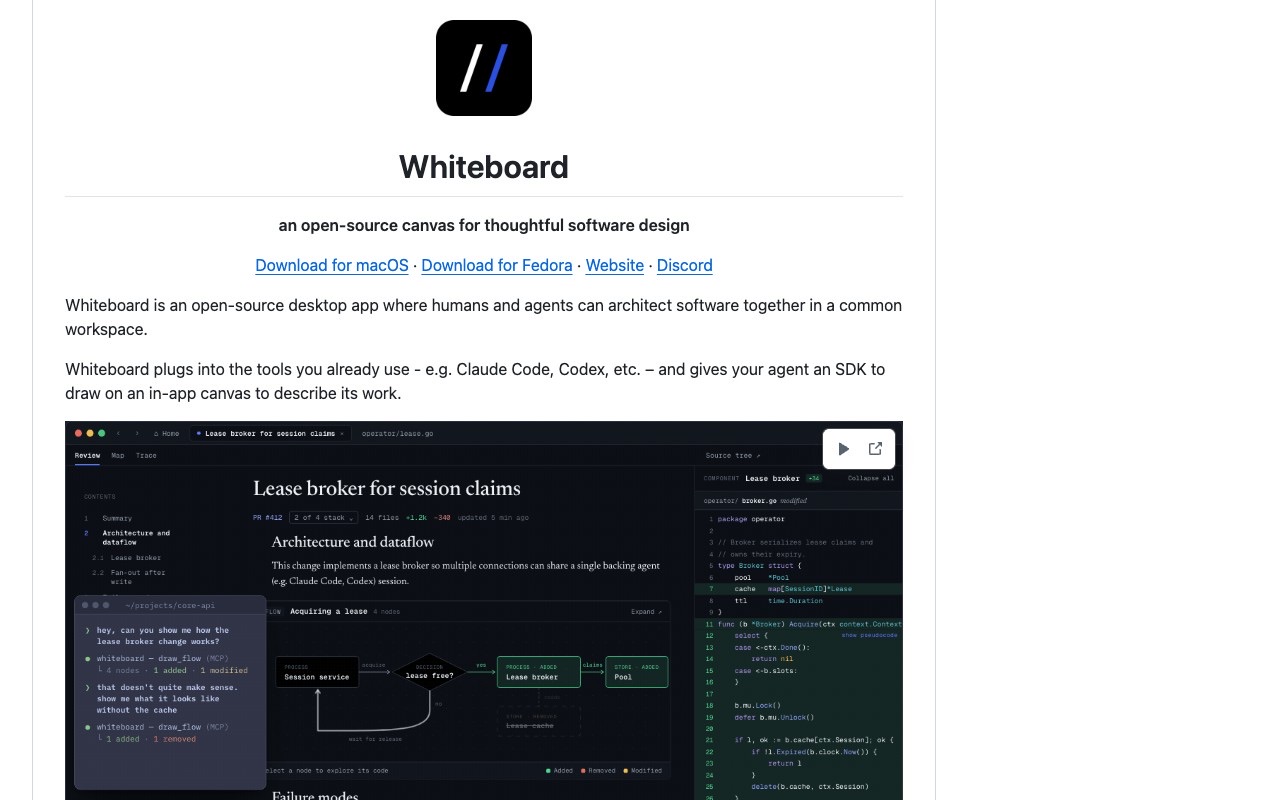
Whiteboard is an open-source desktop app where a coding agent draws sequence diagrams, entity relationship diagrams and semantic diffs for a change, and a human reviews the change at the architecture level. Clicking a diagram node or a quoted agent trace jumps to the code it describes. It is free and local-only for now.
What it does
The README describes the app as a common workspace for humans and agents. It plugs into tools you already run, names Claude Code and Codex, and exposes an SDK the agent uses to draw. In the demo frame above, the terminal shows the agent calling whiteboard - draw_flow (MCP) twice: once to draw the flow, once to redraw it after the developer asks for a version without the cache. On Hacker News, a founder described the app as a complement to your existing terminal, where agents call MCPs and APIs to draw on it.
The pieces the README and the product page list:
- Diagrams that lead to code. Clicking a sequence diagram, an entity relationship diagram or a quote from the agent's trace opens the underlying code. Whiteboard vendors Code OSS, so code navigation comes with VS Code keybindings and LSP support.
- Semantic diff viewer. An AST-aware diff library written in Rust summarizes large added functions as pseudocode and collapses unit tests and documentation changes. A WASM-based plugin system customizes the defaults.
- Decision log. The team built tools for agents to query and link their own traces, so a reviewer can see the requirements they set, how the agent implemented them, and which decisions the agent made alone.
- Quickstart. Download the app, connect Claude Code, Codex or another coding agent from the welcome screen, then ask the agent to review your current branch against up-to-date main and open the result in Whiteboard.
The README says the team finds Whiteboard works best with GPT-6 Sol and Claude Opus 5.5. The repository also ships an AGENTS.md, a CLAUDE.md, a .claude-plugin directory and an .agents/plugins directory.
Known limitations
The README lists three. You cannot edit files in Whiteboard. Working across multiple repos in one review is poorly supported. A review shared between machines does not update after you share it, so you have to share it again.
The Hacker News thread added two more. A commenter complained that the macOS app weighs 736MB; a founder replied that it builds on VS Code and committed to native rewrites and to shrinking the 138MB diff viewer. Another commenter questioned calling it an IDE when it cannot edit files, and a founder said the team renamed it a canvas.
Why it matters for agent builders
Agents now merge changes faster than people read them, and Whiteboard is aimed at that gap. The founders wrote in their launch post that they hit "cognitive debt" while using agentic coding tools: agents merged pull requests, and the humans lost track of how the system worked.
For someone building or wrapping a coding agent, the useful part is the integration surface. The agent does not need a custom UI. It calls a tool, and the app renders the result next to the code. The decision log is the second thing to look at: it treats the agent's own trace as reviewable evidence instead of a chat transcript to scroll.
The thread also shows the disagreement. One commenter argued that agents already implement reliably and that review effort belongs in planning. A founder answered that reviewing a plan without the implementation is less useful, because key tradeoffs often surface only during implementation.
What to watch
Whiteboard is a desktop app with local checkouts, and the README says a hosted product for teams is planned, with everything remaining self-hostable. The open question is editing: the tool is read-only today, and the founders said on Hacker News they are hesitant about adding it. The repository's CONTEXT.md also defines "headless authoring" as creating and editing a Review without the desktop app, including from a CI job, which points at a CI path that the README does not document yet.
Key takeaways
- Whiteboard is MIT-licensed, runs on macOS and Linux, and is free and local-only for now.
- Agents draw on it through an SDK; the demo shows Claude Code-style terminal sessions calling a
draw_flowMCP tool. - Its Rust semantic diff viewer collapses tests and docs and summarizes large added functions as pseudocode.
- The decision log links an agent's own traces to the requirements a human set.
- It cannot edit files yet, and multi-repo reviews are poorly supported.
FAQ
What is Whiteboard by /dev/fast?
Whiteboard is an open-source desktop app where humans and coding agents review and design software together. The agent draws diagrams and semantic diffs through an SDK, and the human clicks through from a diagram to the code. It is MIT-licensed, and the team is a YC W26 startup.
Does Whiteboard work with Claude Code and Codex?
Yes. The README says it plugs into tools you already use, naming Claude Code and Codex, and you connect an agent from the welcome screen. The README recommends GPT-6 Sol and Claude Opus 5.5 for the best intelligence, cost and speed tradeoff.
Is Whiteboard free?
Yes for now. A founder answered on Hacker News that it is free, open source and local-only right now, with a hosted product for teams planned. The README says everything will remain self-hostable. The app also sends anonymous telemetry that excludes code, diffs, prompts and model output, and you can switch it off.
Source: Whiteboard on GitHub Discussion: Hacker News
Compare more review tools and coding agents, including Claude Code, in the coding review category on aiagentslisting.com.
Subscribe to our newsletter
One email a week. New agents, MCP servers and skills, and what is actually getting traction.
More news
Claude formally verifies 123 open source libraries with Theorem
Anthropic and Theorem used Claude to write machine-checked proofs that 123 open-source libraries never crash, finding bugs years of fuzzing missed.
OpenShell ships as NVIDIA's sandboxed runtime for AI agents
NVIDIA's OpenShell is an open source runtime that sandboxes what AI agents can touch, using kernel enforcement and formally verified policy changes.
Anthropic ships Scion, source control built for AI agents
Anthropic replaced git with Scion, an in-house version control system built for AI agents, after Claude-driven merges topped 30,000 a day in September 2026.