AI Agent Guardrails Explained: Types, Tools and How They Work
AI agent guardrails are the enforceable checks that keep autonomous agents inside safe limits. How OpenAI, LangChain, NVIDIA and AWS build them, and when to use each type.
3 min read
A comparison of seven AI sales agents for 2026, covering what each one automates, who it fits, and what it costs.
A sales rep spends roughly 28% of the week actually selling, according to Salesforce's own research; the rest goes to admin, research, and chasing replies. That gap is why a wave of AI sales agents now books meetings, qualifies leads, and in one case runs the entire product demo, without a human touching the conversation until it is time to close. This roundup compares seven of them, what each one automates, and what it actually costs.
AI sales agents are software that run parts of a sales process on their own, using a language model to reason instead of following a fixed script. They prospect, qualify leads, write outreach, handle replies, and book meetings, working inbound (answering a website visitor) or outbound (chasing a target list) without a human driving every step.
| Tool | Best for | Motion | Starting price |
|---|---|---|---|
| Fin for Sales | Teams already on Intercom that want one agent for sales and support | Inbound | Outcome-based, not published |
| Qualified (Piper) | Salesforce-native enterprise teams with heavy website traffic | Inbound | Custom, quoted per plan |
| 11x (Alice) | High-volume, enterprise-scale outbound prospecting | Outbound | Custom, quoted per plan |
| Artisan (Ava) | Enterprise BDR teams consolidating a multi-tool outbound stack | Outbound | Custom, credit-based, quoted per plan |
| AiSDR | Founders and small teams who want published pricing | Outbound | From $250/month |
| SalesCloser AI | Teams that want the agent to run the live demo itself | Demo and close | Custom, quoted on a call |
| SalesAi | SMBs that want a fully managed voice and SMS agent roster | Voice, SMS, full funnel | Custom, quoted via demo |
Fin for Sales handles inbound sales end to end on the same Fin AI Engine that Intercom says powers its customer service agent across 12,000 businesses. It engages a website visitor at the moment of highest intent, answers product and pricing questions grounded in the company's own content, qualifies the lead conversationally against a sales playbook, and books the meeting through Calendly or Chili Piper.
The feature that sets it apart is what Fin calls Agent Orchestration: the same conversation can shift from a sales question to a support question without a handoff. A prospect asking about pricing who follows up with a technical integration question gets both answered by the same agent, in the same thread. Setup runs on AI-generated playbooks pulled from a company's existing documentation rather than a manual flow builder.
Fin for Sales is inbound only (no outbound prospecting), does not yet support voice or Slack for sales workflows, and currently requires the Intercom platform. Pricing is outcome-aligned rather than per seat, and it integrates with Salesforce, HubSpot, Marketo, Calendly, and Chili Piper.
Piper is Qualified's AI SDR agent, built specifically for companies already deep in the Salesforce ecosystem. It engages website visitors through live chat, pulls account ownership and intent signals straight from Salesforce CRM data to personalize the conversation, and books meetings in real time rather than just logging a form submission.
The integration list on Qualified's own site runs to Marketo, Eloqua, HubSpot, Outreach, Salesloft, 6sense, Demandbase, Gong, and Slack, on top of its native Salesforce connection. Neither Qualified's product page nor its pricing page publishes a number; like several tools in this list, it is scoped to lead volume and built on a call with sales.
Alice is 11x's outbound digital worker, positioned as an autonomous SDR rather than a sequencing tool. It tracks buyer signals across the market, identifies ICP-fit leads, writes and sends personalized multi-channel sequences across email, LinkedIn, and phone, and handles replies through to a booked meeting, all without a human queuing the next step.
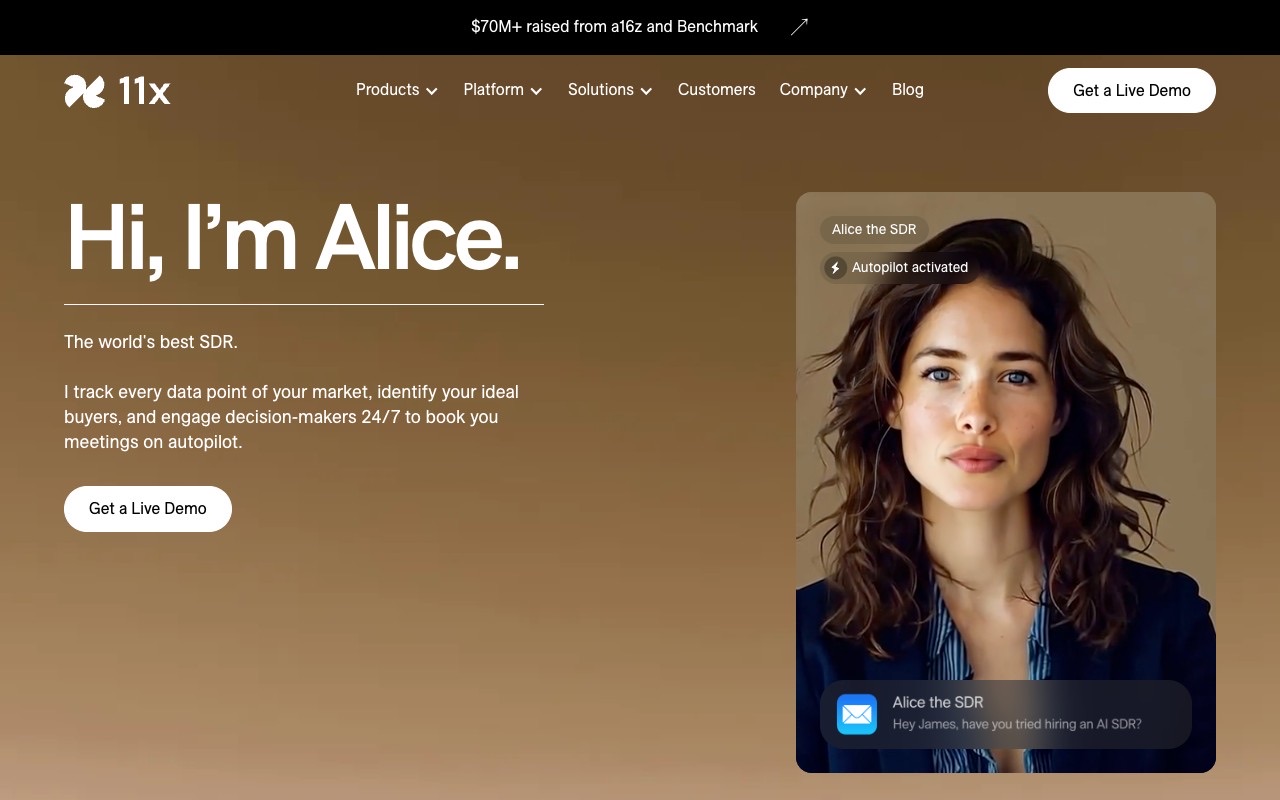
11x has raised more than $70 million from a16z and Benchmark, and Alice reaches prospects in more than 105 languages. A companion product, Julian, handles inbound speed-to-lead and qualification, so the two together cover both directions of the funnel. 11x does not publish pricing; access runs through a live demo request.
Ava is Artisan's AI BDR, rebuilt from the ground up as Ava 2.0 on 25 May 2026. Where most AI sales tools still need a human reviewing every reply, Artisan says Ava 2.0 is the first AI BDR to close the loop end to end on its own: researching prospects, writing one-to-one outreach instead of templated blasts, running sequences, handling objections, and booking meetings directly on a rep's calendar, with approval gates available at any stage a team wants them.
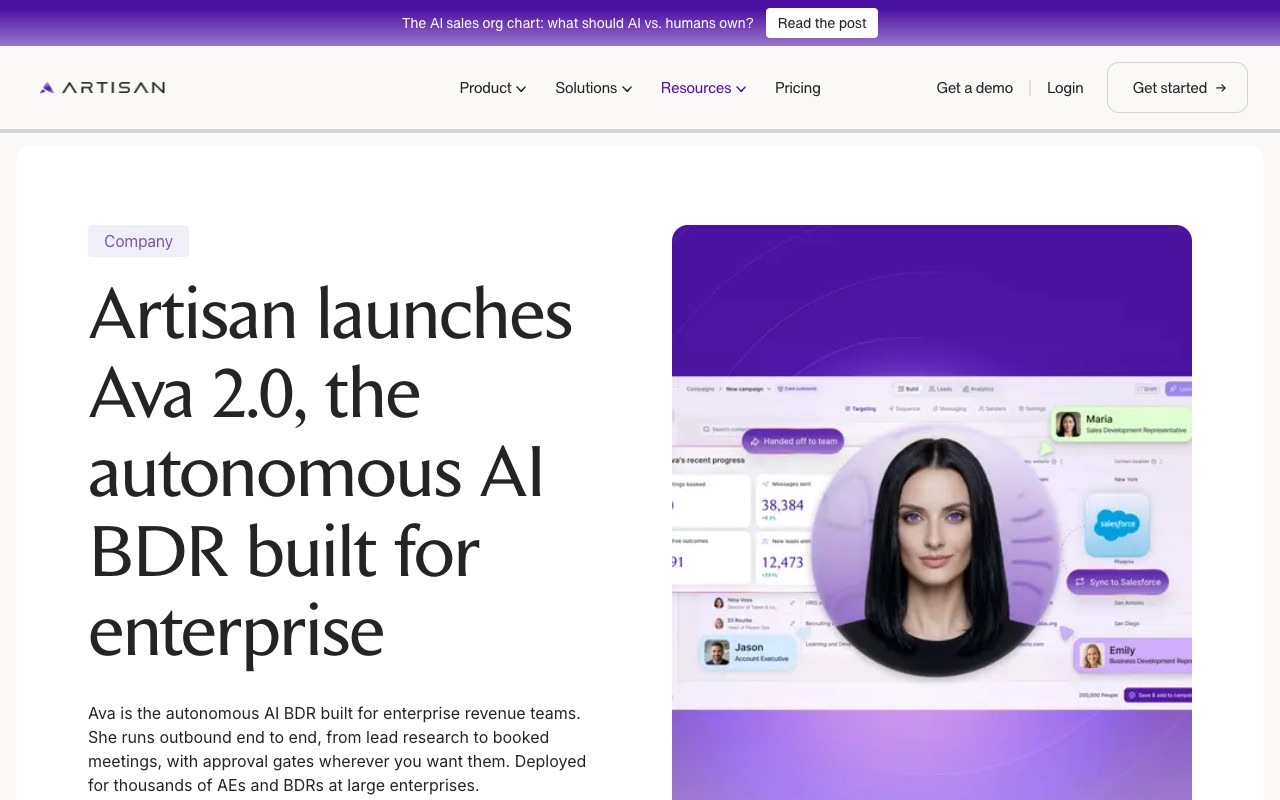
Artisan is backed by $36 million in venture funding, is SOC 2 Type II audited, and its largest single customer deployment runs Ava across more than 1,000 reps, according to Artisan's own launch announcement. Ava draws on a database of more than 250 million verified B2B contacts, includes a built-in dialer, and moved to credit-based pricing with Ava 2.0. Artisan's pricing page lists Team, Scale, and Enterprise tiers, all scoped on a call rather than published as a number.
AiSDR runs outbound through an AI agent called Ami, which the company says is trained on more than 17,000 real campaigns. It researches prospects in real time across the web, writes personalized email and LinkedIn outreach, and syncs two-way with HubSpot on every plan and with Salesforce starting on its top tier.
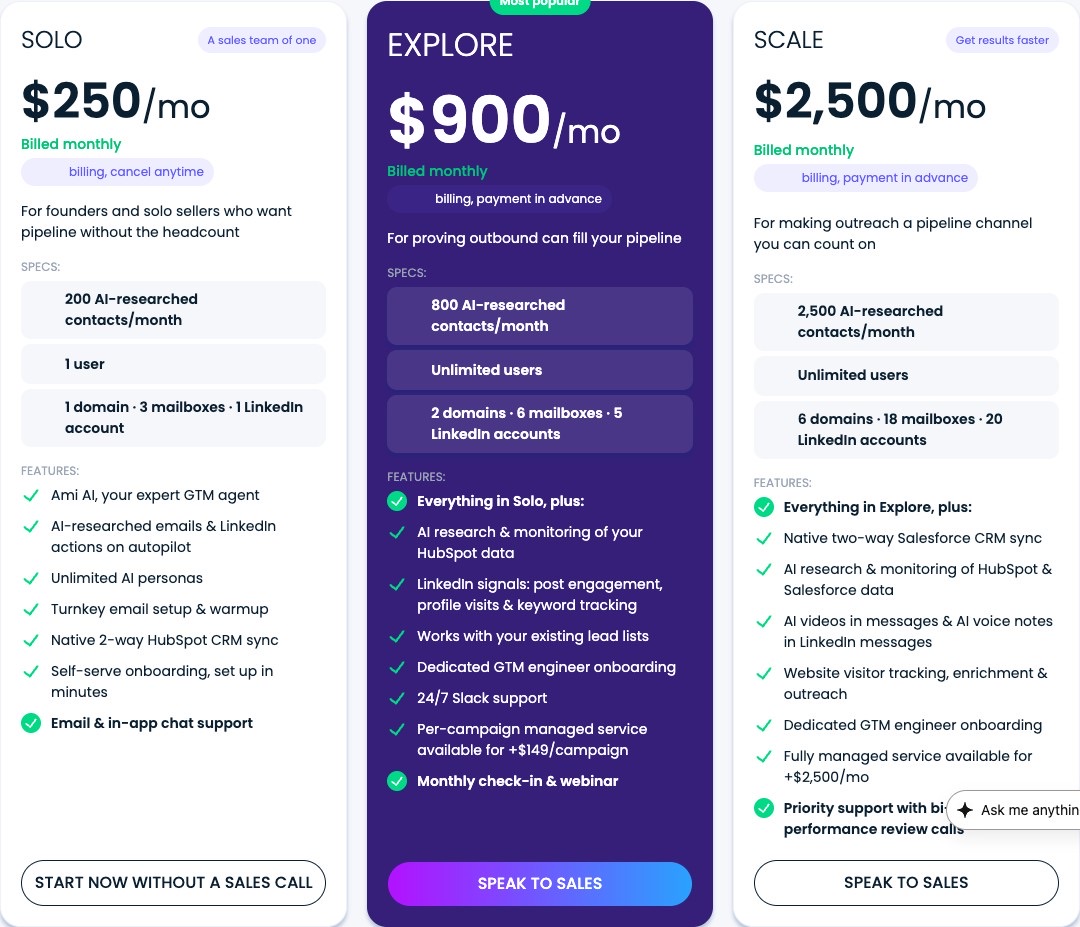
What separates AiSDR from most of this list is that its pricing is actually public: Solo runs $250 a month for 200 AI-researched contacts and one user, Explore (its most popular tier) runs $900 a month for 800 contacts and unlimited users, and Scale runs $2,500 a month for 2,500 contacts with native two-way Salesforce sync. Plans bill monthly or quarterly, with a 20% discount on annual billing, and Solo can be started without a sales call.
SalesCloser's agent does not stop at booking a meeting. Once the call starts, the agent joins over live video, shares its screen, and runs the actual product demo, branching to whatever the buyer asks and handling objections mid-demo rather than reciting a script. SalesCloser says it does this in 32 languages and connects to more than 200 other tools in a sales stack.
The same four-agent roster also covers discovery and qualification, customer onboarding, and tier-one support, each trained on a company's own knowledge base and writing results back to the CRM when the call ends. SalesCloser does not publish pricing; the company says cost depends on languages, call volume, and integrations needed, and is quoted live during a call.
SalesAi is structured differently from the rest of this list: instead of selling software a team configures itself, it sells a managed roster of voice and SMS agents that SalesAi's own team builds, deploys, and tunes on a company's behalf. Named agents cover inbound lead response, reception, dispatch, onboarding, renewals, and review requests, with SalesAi reporting more than 2 million calls handled and 99.9% platform uptime.
Because it is agent-as-a-service rather than self-serve software, setup starts with a discovery call rather than a signup form, and pricing is not published. SalesAi has also recently added SMS agents alongside its original voice lineup, extending the same always-on coverage to text-based follow-up.
Match the tool to the motion that is actually broken. If demo requests are going unanswered after hours, an inbound agent like Fin for Sales or Qualified closes that gap without touching outbound at all. If the problem is an empty top of funnel, 11x, Artisan, or AiSDR run outbound prospecting, and the real decision between them is enterprise scale and white-glove rollout (11x, Artisan) against a plan a small team can see the price of and start alone (AiSDR). If the bottleneck sits after the meeting is booked, in the 45 minutes a human actually has to run the call, SalesCloser is solving a different problem than the other six. And if a team wants the whole thing managed rather than configured, SalesAi's agent-as-a-service model trades self-serve control for a team that builds and tunes the agents on its behalf.
CRM fit narrows the list fast. Qualified, AiSDR's top tier, and Artisan all lean on native, two-way Salesforce sync; Fin for Sales and AiSDR's lower tiers work natively with HubSpot. A team already committed to one CRM should start there before comparing anything else.
Artisan launched Ava 2.0 on 25 May 2026, a ground-up rebuild that the company says is the first AI BDR to run the full outbound loop end to end without a human in every step, backed by $36 million in venture funding and a SOC 2 Type II audit. AiSDR's published pricing, checked on its site on 2 October 2026, holds three tiers: Solo at $250 a month, Explore at $900 a month, and Scale at $2,500 a month. Fin's own comparison of the category, published 19 May 2026, frames Agent Orchestration, switching between a sales and a support role inside one conversation, as the feature none of its competitors have shipped. And Salesforce's AI sales agent guide, last updated 13 February 2026, is the source behind the 28% selling-time statistic that several vendors in this category now use to justify the category itself.
An AI sales agent is software that uses a language model to run sales development work with little or no human input: engaging buyers, qualifying them against a company's ideal customer profile, booking meetings, and updating the CRM. The difference from a scripted chatbot is that it can hold a multi-turn conversation and adapt when a buyer changes direction mid-conversation.
A chatbot follows a decision tree and breaks on the first question outside its script. An AI sales agent reasons through the conversation, adapts to what the buyer actually asks, and can take an action, like booking a meeting or updating a CRM record, rather than only replying with text.
Not according to any of the vendors in this comparison. Artisan's own FAQ puts it directly: Ava "doesn't replace your reps, she replaces their busywork." The pattern across this category is that the agent handles prospecting, qualification, and first-touch conversations, and a human still runs the negotiation and the close.
It depends heavily on the tool. AiSDR publishes its pricing at $250 to $2,500 a month depending on tier. Qualified, 11x, Artisan, Fin for Sales, SalesCloser, and SalesAi all quote custom pricing scoped to a company's lead volume, team size, or call volume, usually after a demo call.
Most of the tools in this list integrate directly with Salesforce or HubSpot, and several sync with both. Qualified, Artisan, and AiSDR's top tier offer native two-way Salesforce sync; Fin for Sales and AiSDR's lower tiers integrate with HubSpot. Checking which CRM a tool syncs with natively, rather than through a third-party connector, is worth doing before a trial.
Looking for where these agents fit alongside the rest of the category? AI Agents Listing's sales and outreach directory tracks agents and tools built for this exact part of the funnel.
One email a week. New agents, MCP servers and skills, and what is actually getting traction.
AI agent guardrails are the enforceable checks that keep autonomous agents inside safe limits. How OpenAI, LangChain, NVIDIA and AWS build them, and when to use each type.
3 min read
MCP resources vs tools comes down to who decides when each is used: the model calls tools, the application loads resources. Here is how the two differ and when to use each.
6 min read
MCP server examples worth reading: the seven official reference servers, the weather tutorial in Python and TypeScript, and how to run and debug each one.
8 min read