Submit

MCP vs A2A: How the Two Agent Protocols Differ

MCP vs A2A explained: MCP links one agent to its own tools, A2A links separate agents to each other, and most production systems now use both.

Written by AiAgentsListing Team

•7 min read
MCP vs A2A: How the Two Agent Protocols Differ

MCP vs A2A: two protocols with different jobs

MCP vs A2A comes up the moment a team moves from one agent with tools to several agents that need to work together. Model Context Protocol (MCP) and Agent2Agent (A2A) solve two different problems, and the people who built both protocols say so directly: in the official comparison on the A2A project's own GitHub repository, they describe the two as "distinct but highly complementary."

MCP vs A2A is a question of direction, not of which protocol is better. MCP connects a single AI agent to its own tools, APIs and data, deepening what that one agent can do. A2A connects separate agents, often built on different frameworks or owned by different teams, so they can discover each other, hand off tasks and exchange results. Most production agent systems that need both ends up using them together.

MCP vs A2A at a glance

Model Context Protocol (MCP)Agent2Agent (A2A)
ConnectsAn agent to its own tools, APIs and resourcesOne agent to another agent, across frameworks and vendors
DirectionVertical: deepens a single agentHorizontal: reaches across agent boundaries
Core unitsTools, Resources, Prompts, NotificationsAgent Card, Task, Message, Artifact
TransportStdio (local) or Streamable HTTP (remote)HTTP endpoint, with request/response polling, Server-Sent Events, or push notifications
Originated atAnthropicGoogle
Now governed byThe MCP project, a Growth Stage project at the Agentic AI FoundationA Technical Steering Committee with AWS, Cisco, Google, IBM Research, Microsoft, Salesforce, SAP and ServiceNow, also at the Agentic AI Foundation
LicenseOpen specification, version 2026-07-28 is currentApache License 2.0

Model Context Protocol (MCP)

MCP follows a client-server architecture. An MCP host, an AI application such as Claude Code or Cursor, creates one MCP client for every MCP server it connects to, and each client keeps a dedicated connection to its own server. That is how an editor can talk to a filesystem server and a database server at the same time without the two crossing wires, according to the protocol's own architecture page.

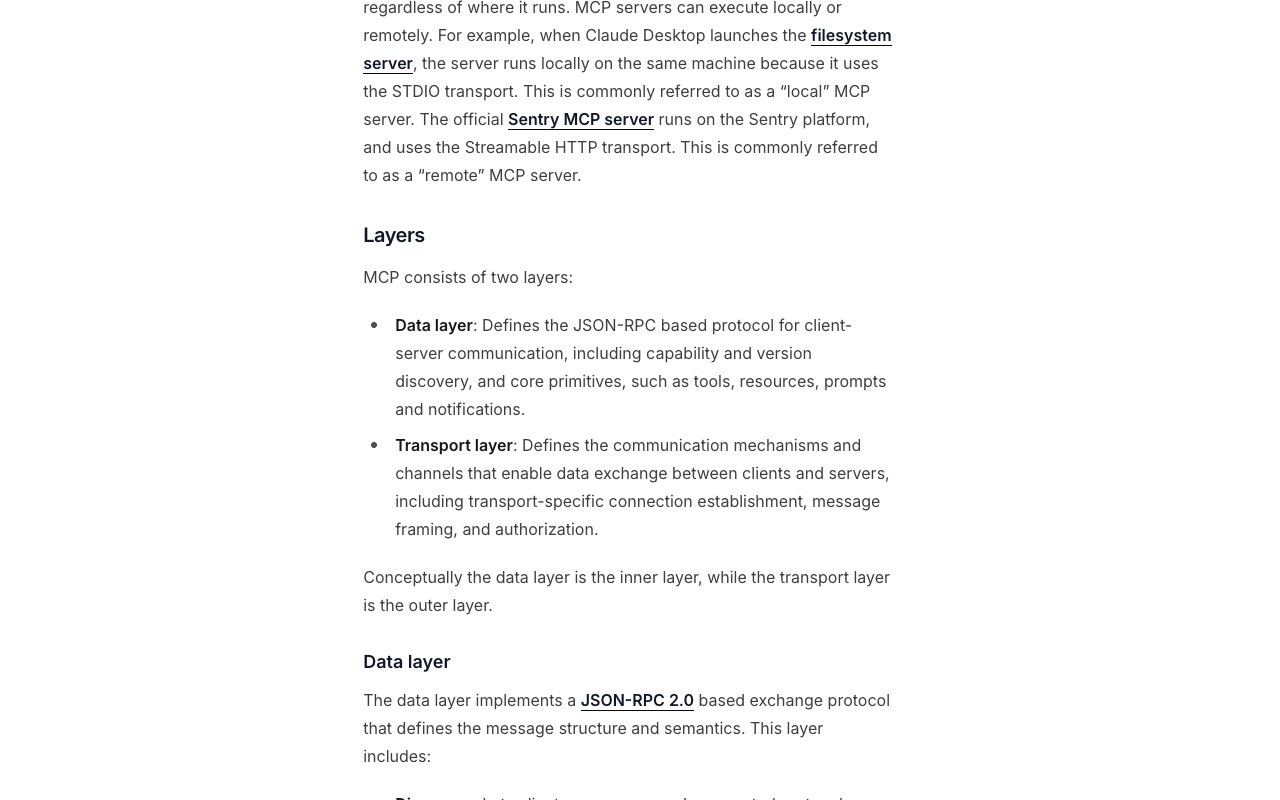
The protocol has two layers. The data layer defines a JSON-RPC 2.0 based exchange: capability discovery, and the core primitives of tools, resources, prompts and notifications. The transport layer handles how messages actually move, over stdio for a local server running on the same machine, or over Streamable HTTP for a remote one. MCP is stateless: every request carries its protocol version and capabilities, and a client can query a server's supported versions through the mandatory server/discover request before sending anything else.

Documentation page showing MCP's two architectural layers: the data layer, which defines the JSON-RPC message format and primitives like tools and resources, and the transport layer, which handles stdio and Streamable HTTP connections.

The current spec, version 2026-07-28, deprecated Sampling, one of MCP's client features, according to the same architecture page. Auth0's developer guide describes MCP's origin plainly: Anthropic built it to give an agent a predictable toolbelt, a structured way to find out what a tool does, call it safely and get a structured result back, instead of wiring up a separate integration for every API by hand.

Agent2Agent (A2A)

A2A is an open protocol for communication and interoperability between independent, often opaque, agentic applications, as the project's own homepage puts it. Where MCP hands one agent more tools, A2A lets that agent reach other agents it does not control and cannot see inside.

Google announced A2A in April 2025 with more than 50 launch partners, according to Descope's A2A explainer. On 23 June 2025, Google donated the A2A specification, its SDKs and its developer tooling to the Linux Foundation, seeding a new Agent2Agent project with AWS, Cisco, Microsoft, Salesforce, SAP and ServiceNow as founding members, per Google's own announcement of the donation. A2A is licensed under the Apache License 2.0 and is now steered by a Technical Steering Committee drawn from those same companies plus IBM Research, according to the A2A Protocol homepage.

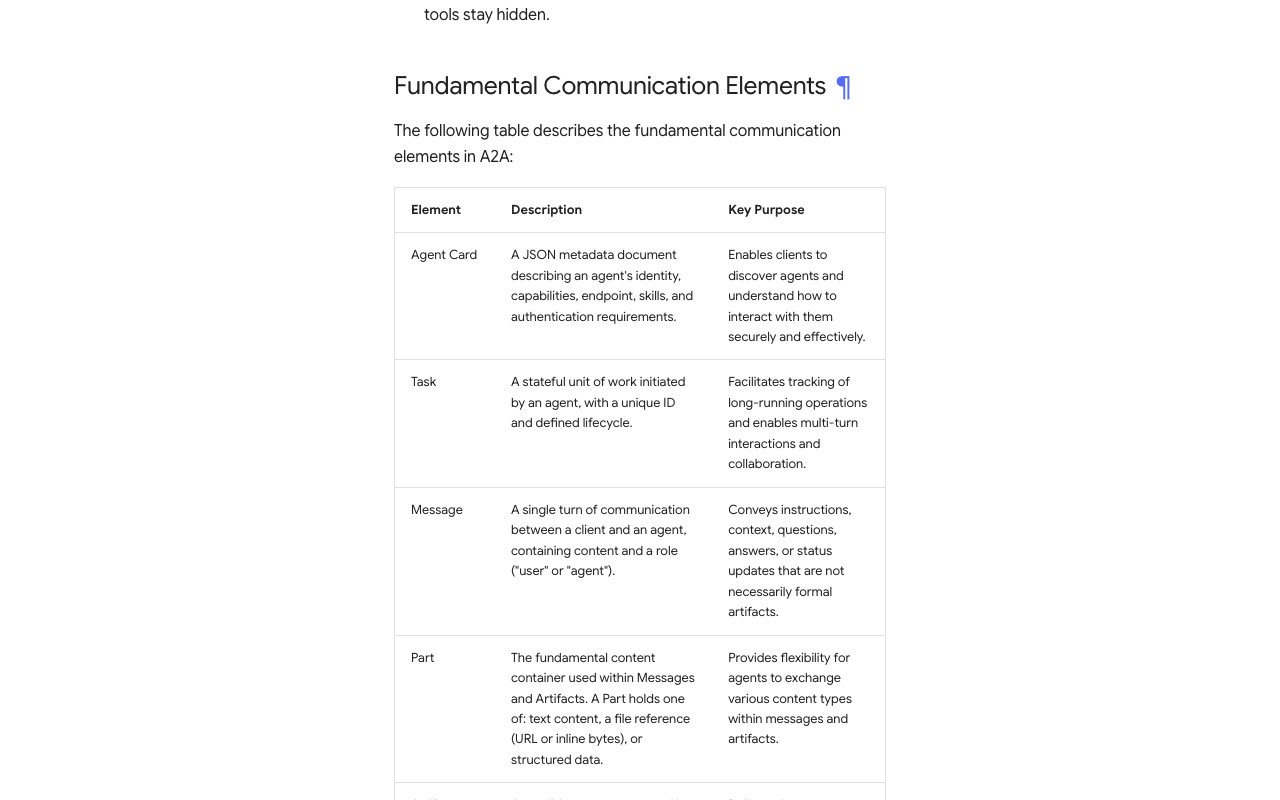
A2A interactions run on a small set of building blocks. The Agent Card is a JSON metadata document describing an agent's identity, capabilities, endpoint and authentication requirements, so a client can decide whether that agent fits a task before contacting it. A Task is a stateful unit of work with a unique ID and a defined lifecycle, used to track a long-running operation across multiple turns. A Message is a single turn of communication built from one or more Parts, which can hold text, a file reference or structured data, and an Artifact is the tangible output an agent hands back, such as a document or a structured result.

Table from the A2A Protocol documentation listing its four fundamental communication elements: Agent Card, Task, Message and Part, with each element's description and purpose.

Agents exchange these over three interaction mechanisms: request and response with polling for simple cases, streaming over Server-Sent Events for real-time updates, or push notifications to a client-provided webhook for very long-running or disconnected clients, according to the A2A Core Concepts documentation.

How MCP and A2A fit together

The A2A project's own comparison document frames the split as vertical against horizontal: "MCP is vertical. It deepens a single agent... A2A is horizontal. It connects agents across that boundary." The same document walks through an auto repair shop example: a customer talks to a "Shop Manager" agent over A2A, that agent coordinates with specialist mechanic agents over A2A, and each mechanic agent then uses MCP on its own to read diagnostic scanners and repair manuals.

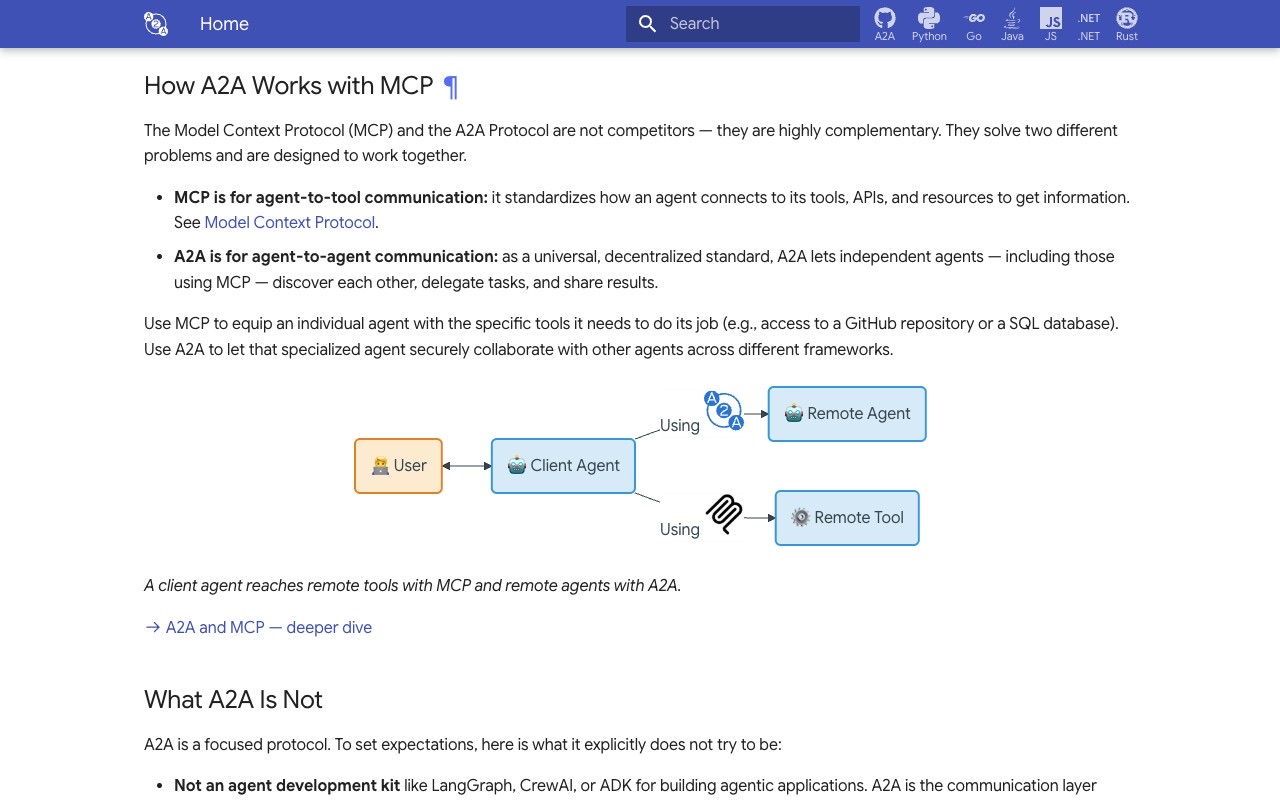
The A2A Protocol homepage diagram showing a Client Agent connecting to a Remote Agent using A2A and to a Remote Tool using MCP, illustrating that a client agent reaches other agents with A2A and reaches tools with MCP.

The A2A homepage is explicit about what the protocol is not: not an agent development kit like LangGraph, CrewAI or ADK, not a sub-agent or tool-call protocol, and not a replacement for MCP. A client agent reaches remote tools with MCP and remote agents with A2A, in the project's own words, and that line is the whole comparison in one sentence.

Verdict by use case

A single agent that needs more tools, such as a coding agent reading a database or calling one external API, needs MCP alone. A2A adds nothing there.

A system built from several agents on different frameworks, say one built on LangGraph and another on CrewAI, that need to hand work to each other, needs A2A. Each of those agents can still keep its own MCP connections to its own tools underneath.

An enterprise workflow that crosses vendor boundaries, such as a customer service agent delegating a billing question to a separate billing agent built by another team, is the scenario A2A's Agent Card and Task model were built for, per the protocol's own documentation.

What's new (as of 17 October 2026)

On 27 August 2026, A2A was accepted as a Growth Stage project at the Agentic AI Foundation (AAIF), the A2A project announced on its blog. The announcement put A2A's adoption at over 150 organizations, running in production across supply chains, financial services and mobile platforms, with Google Cloud, AWS Bedrock AgentCore Runtime and Microsoft Azure AI Foundry having built native A2A support directly into their infrastructure. The same post named LangGraph, CrewAI, Pydantic AI, AG2 and IBM BeeAI as frameworks supporting A2A, and ServiceNow, Salesforce, Atlassian and SAP as enterprise platforms using it to connect workflows. AAIF's other projects include MCP itself, alongside goose and AGENTS.md, now sibling projects under the same Linux Foundation governance.

On 1 October 2026, the A2A project shipped the official A2A CLI, a command-line client speaking A2A Protocol v1.0 that lets a shell script, a CI pipeline, or a coding assistant message an A2A agent without writing any SDK code, according to the project's announcement post. Its --exec mode turns any program that reads standard input and writes standard output into a working A2A server for testing, and its --echo mode gives a one-command way to confirm a connection.

On the MCP side, the current protocol revision, version 2026-07-28, deprecated the Sampling client feature, as the architecture documentation states.

Key takeaways

  • MCP connects one agent to its own tools and data; A2A connects separate agents to each other across frameworks and vendors.
  • A2A's core units are the Agent Card, Task, Message and Artifact; MCP's are Tools, Resources, Prompts and Notifications.
  • Google donated A2A to the Linux Foundation on 23 June 2025; it was accepted as a Growth Stage project at the Agentic AI Foundation on 27 August 2026, where MCP is also a sibling project.
  • A2A is licensed under Apache License 2.0 and backed by over 150 organizations as of the August 2026 announcement, with LangGraph, CrewAI, Pydantic AI, AG2 and IBM BeeAI among the supporting frameworks.
  • The two protocols are designed to be used together: an agent typically reaches its own tools with MCP and reaches other agents with A2A.

FAQ

Is A2A a replacement for MCP?

No. The A2A project's own documentation states directly that A2A is not a replacement for MCP: MCP standardizes agent-to-tool communication, and A2A standardizes agent-to-agent communication. They are built to be used together rather than instead of each other.

Can one agent use both MCP and A2A at the same time?

Yes, and the official examples describe exactly this pattern. An agent can use MCP internally to work with its own tools and resources, while using A2A to communicate with other, independent agents outside its own application.

Who governs MCP and A2A today?

Both are projects hosted by the Agentic AI Foundation under the Linux Foundation. A2A is steered by a Technical Steering Committee with representatives from AWS, Cisco, Google, IBM Research, Microsoft, Salesforce, SAP and ServiceNow, following Google's original donation of the protocol to the Linux Foundation in June 2025.

What is an A2A Agent Card?

An Agent Card is a JSON metadata document that describes an agent's identity, capabilities, service endpoint, authentication requirements and skills. A client reads the card to decide whether an agent fits a task and how to contact it securely, before any task begins.

What transports does MCP support?

MCP supports two transports: stdio, used for a local server running as a process on the same machine, and Streamable HTTP, used for a remote server that can serve many clients and supports standard authentication methods including OAuth.

Developers comparing the two protocols before wiring up a multi-agent system can browse the servers already built for each host in the MCP server directory on AI Agents Listing.

Share:

Subscribe to our newsletter

One email a week. New agents, MCP servers and skills, and what is actually getting traction.

Read next

MCP vs OpenAPI: What's the Real Difference?

MCP vs OpenAPI: What's the Real Difference?

MCP vs OpenAPI: MCP lets AI agents call tools at runtime, while OpenAPI describes an HTTP API ahead of time. Here is how they differ and work together.

7 min read