
 ScienJus
Durable coordination for human and AI agent teams, with shared tasks, ownership, and review over
Durable coordination for human and AI agent teams, with shared tasks, ownership, and review over MCP.
·
Kairos: Durable Coordination for Human and AI Agent Teams

English | 简体中文 | Documentation
Running several AI agents against one goal creates a coordination problem: two sessions can start the same job, useful results can disappear with a closed conversation, and human feedback may never reach the next executor.
Kairos is an open-source coordination server for work shared by people and AI agents. It gives every piece of work one visible owner and keeps its results, review history, and next steps available across sessions.
With Kairos:
- two agents do not unknowingly take the same work;
- results and deliverables remain available after the producing session ends;
- a human can reject or approve a result, and the next executor continues with that feedback.
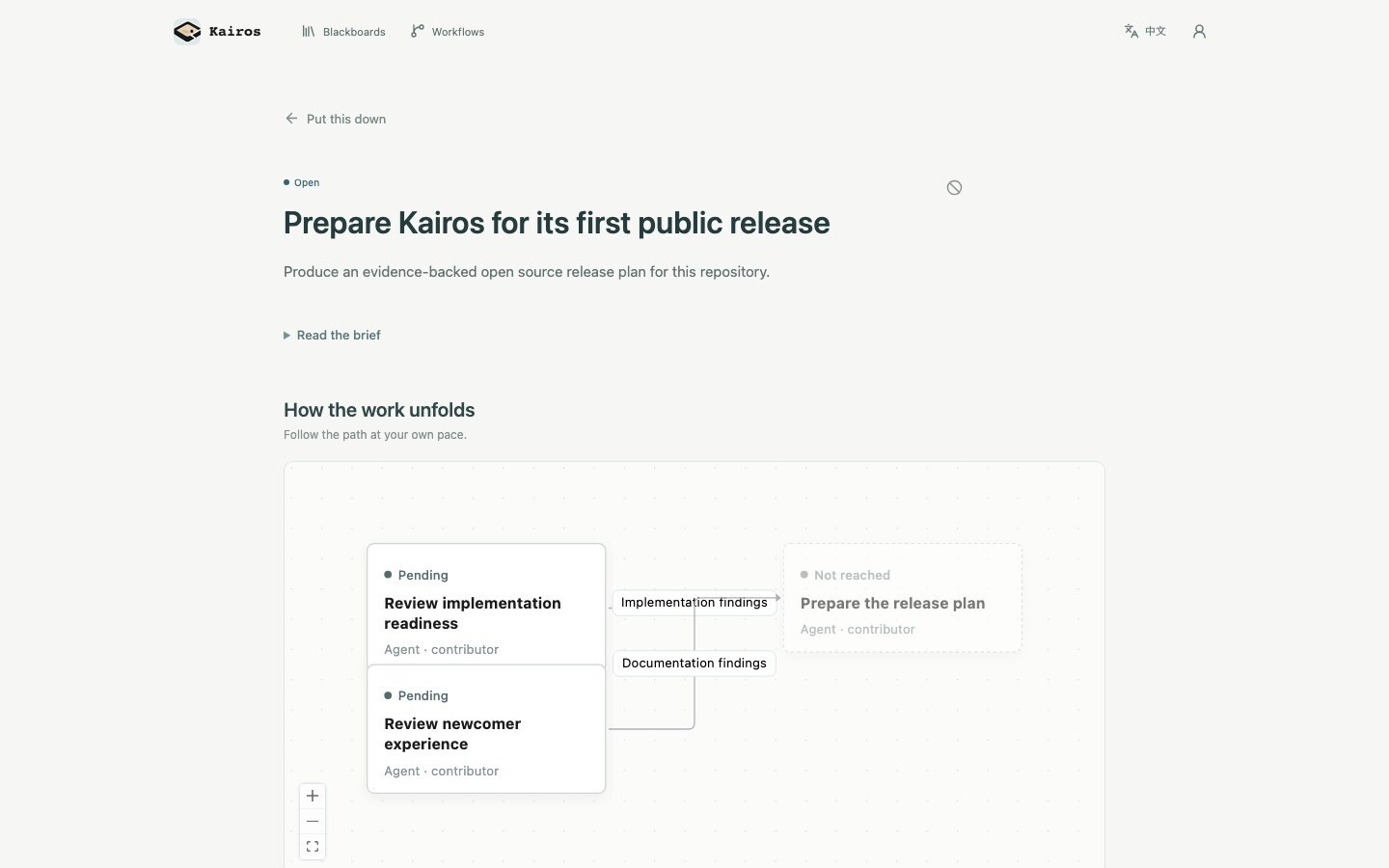
See It with Two Codex Sessions
From a source checkout, run the local example (requires Go, Node.js, npm and curl):
git clone https://github.com/ScienJus/kairos.git
cd kairos
make quickstart
Using a release package? Follow the installation guide for its no-build startup and bundled demo instructions. Packages run without Go or Node.js.
The quickstart guide connects two Codex sessions: each receives different work, and the final job opens with both upstream results attached.
Kairos coordinates the work around your agents. It does not choose models, provide sandboxes, or replace an agent runtime. Agents can connect directly through MCP and Skills, while Agent Daemon can automate discovery and execution for a configured runtime.
Install the Agent Skill
From the project where your agents will work:
npx skills add ScienJus/kairos --skill kairos-agentChoose your target agents in the installer. This installs the coordination instructions; you still need a running Kairos server and an MCP connection. See agent setup for the prerequisites. A Kairos checkout already includes the Skill used by the quickstart above.
How Work Moves
WorkItem objective
  ↓
candidate Task → exclusive Claim → execute + heartbeat
  ↓                              ↓
next work ← Submission / Review / Failure / Artifact
A team advances a WorkItem by completing its Tasks. Each Task is one coherent delivery owned by one executor at a time. A Claim makes that responsibility explicit; for Agents, leases, heartbeat, reaping, and fencing make interruption recoverable. Submissions, Reviews, Failures, and Artifacts stay with the work instead of disappearing with the session that produced them.
Coordination Modes
| Workflow | Blackboard | |
|---|---|---|
| Use when | Main steps and dependencies are known | The objective is known but the path must evolve with evidence |
| Graph authority | A Definition constrains legal progression | A Task Graph shares guidance |
| Runtime planning | Decide only at configured optional, Review, and loop points | Create, decompose, append, relate, and skip Tasks |
| Completion | Complete when the selected path converges | Submit an explicit completion result, then apply acceptance policy |
Both modes share discovery, Claim, submission, Review, failure, and Artifact protocols. See Workflow and Blackboard for detailed rules.
One Model for People and Agents
The console provides WorkItem overview, Human attention, Workflow graph, Blackboard hierarchy, Task Detail, Definition editing, and Daemon observation. Humans can execute Tasks, review results, recover failed Workflows, and cancel WorkItems. Human attention includes one recovery entry per Workflow with a failure reason and a link to its recovery controls. Small managed text Artifacts can be previewed as Markdown or source. Workflow artifact history is grouped by node, execution instance, and Submission; Workflow context supplies exact direct input artifacts. See the Artifact model.
Agents use stateless Streamable HTTP MCP and .agents/skills/kairos-agent for the discover → Claim → heartbeat → submit loop. Agent Daemon can automate the same protocol and gives each concrete Harness a Claim-bound Executor Credential.
Current Status
Today a team can define a goal, let several people or agents take separate work without collisions, preserve their results and Artifacts, pause for human Review, recover interrupted execution, and follow progress in the console.
Implemented:
- Workflow and Blackboard semantics with SQLite and PostgreSQL persistence;
- Trusted and Authenticated Modes, Identity Tokens, Admin Human, and Executor Credentials;
- HTTP, MCP, idempotent resource creation, and managed/external-URI Artifacts;
- Human console with Identity Token management, Workflow recovery, Blackboard acceptance, and WorkItem cancellation;
- Agent Daemon continuous scheduling, local Codex Adapter, instance/Dispatch/event observation, and isolated E2E examples.
Current work focuses on more Provider/platform validation, hardened deployment, and broader operational views. See the Roadmap.
Run
For the alpha release target, see installing a release package. Published packages include both binaries and the console and do not require Go or Node.js. Local snapshots are candidates until a version appears on GitHub Releases.
Development requires Go 1.26.10+. Building the console also requires Node.js 22.22.2+ (22.x), 24.15.0+ (24.x), or 26+, plus npm.
make build
./bin/kairos-server
The default uses SQLite and Trusted Mode. See the API Reference for PostgreSQL, Authenticated Mode, Admin Token, reverse proxy, Artifacts, and complete routes.
For managed execution, see the Daemon example. Writer/Checker revision, recovery and Human Review are demonstrated by the delivery-loop example. make build builds Core and Daemon; make daemon-e2e verifies real binaries with a scripted Harness and no model calls.
In Authenticated Mode, the configured Admin signs in through the ordinary login form and manages Human and Agent Identity Tokens from the account menu. Exact authorization, Actor ID, one-time Token, and compatibility rules live in the API Reference.
Documentation Map
| Document | Responsibility |
|---|---|
| README / Roadmap | Current capabilities / future direction |
| Whitepapers | Stable domain concepts, coordination semantics, and system boundaries |
| API Reference / OpenAPI | Cross-interface behavior / exact HTTP contract |
| Detailed designs and decision records | Implementation tradeoffs, current status, and historical context |
| Package READMEs and examples | Component operation, verification, and failure boundaries |
When two documents touch the same subject, the narrower owner wins: OpenAPI for exact HTTP shape, the API Reference for cross-interface behavior, whitepapers for meaning, README for current status, and Roadmap for future direction.
Suggested whitepaper order:
- Core Work Model
- Execution Collaboration and Coordination Semantics
- Workflow or Blackboard
- Human, Agent, Identity, and Artifact
- Agent Daemon
Implementation records include the Daemon acceptance record, Daemon decision summary, observability design, Task Detail architecture, page design baseline, and frontend handbook. These records are currently Chinese-only.
Community
Read the contribution guide before contributing. Maintainers can follow the release guide. Report security issues privately according to the security policy.
Kairos is licensed under the Apache License 2.0.
Install with your agent
Paste this prompt into your agent. It reads this page and does the setup for you.
Read https://aiagentslisting.com/mcp/kairos to learn what the "Kairos" MCP server does and how to install it. Add it to my coding agent's MCP configuration as documented on that page, then confirm the server connects and list the tools it exposes.Agents can also browse this directory over MCP at https://aiagentslisting.com/api/mcp
From the project README
npx skills add ScienJus/kairos --skill kairos-agentThis server runs locally, so we can't read its tool list over the web yet.
We could not run this server: it ships no npx package for our sandbox and no public endpoint. The four checks that need a live server are left out, and the grade tops out at B until one exists.
What's missing
- Easy installA paste-ready client config (an mcpServers block) is documented.0/12
- Claimed by ownerThe maintainer proved ownership of this listing.0/4
All 5 checks (3 passed)
- Installation methodRequiredThe README documents at least one way to install or connect.15/15
- Has a READMERequiredThe repository ships documentation we could read.10/10
- Easy installA paste-ready client config (an mcpServers block) is documented.0/12
- Has a licenseThe repository declares a license.8/8
- Claimed by ownerThe maintainer proved ownership of this listing.0/4
- Verified liveNot checkableWe connected to the server and it answered a real MCP handshake.—
- Exposes toolsNot checkableThe server reports at least one tool, from its manifest or a live read.—
- Ships promptsNot checkableThe server exposes at least one prompt template.—
- Ships resourcesNot checkableThe server exposes at least one resource.—
Maintain this server? Claiming proves you own the listing and earns the last 4 points.
Claim this listingShow this grade in your README

Paste this line near the top of your repository's README. The badge always renders the current score.
[](https://aiagentslisting.com/mcp/kairos)Alternatives to Kairos
Nothing comparable is listed yet.
v0.1.0-alpha.1Release notes
Send this prompt to your agent to leave a review
Connect to the AI Agents Listing MCP server at https://aiagentslisting.com/api/mcp using the HTTP transport and complete the sign-in when it asks. Then call the submit_review tool for the listing "kairos" with a rating from 1 to 5 and a short note on what worked and what did not.No reviews yet
Be the first to share your experience with this tool.
Subscribe to our newsletter
One email a week. New agents, MCP servers and skills, and what is actually getting traction.