Agweb ships as a WebKit browser built for coding agents
Agweb is an open source macOS browser for AI agents, shipped 14 November 2026 with an installable skill for Claude Code and Codex.
Written by AiAgentsListing Team
Agweb shipped on 14 November 2026 as a Show HN post from developer paul-nameless. It is an open source macOS browser built for AI coding agents, running on Apple's WebKit engine instead of Chrome. The project reached 91 points and 27 comments on Hacker News in its first day, and it installs a packaged skill directly into Claude Code and Codex.
Agweb is a macOS browser built for AI coding agents. Released 14 November 2026 under the MIT license, it gives each agent a window that never steals keyboard focus, uses less memory than a Playwright-driven Chrome window, and installs as a skill directly into Claude Code and Codex.
What changed
What changed is that agents get one persistent window instead of the browser tab Playwright normally pops up: no window comes to the front, and dialogs, tab switches, file pickers and downloads are all answered in code rather than by a person watching the screen.
A dashboard, opened with Cmd+D, shows every tab belonging to every running agent at once, each labeled with that agent's last command.
Each agent works in its own workspace. A named profile (-p work) shares its logins across every agent that uses it, so several agents can work signed in to the same accounts at the same time.
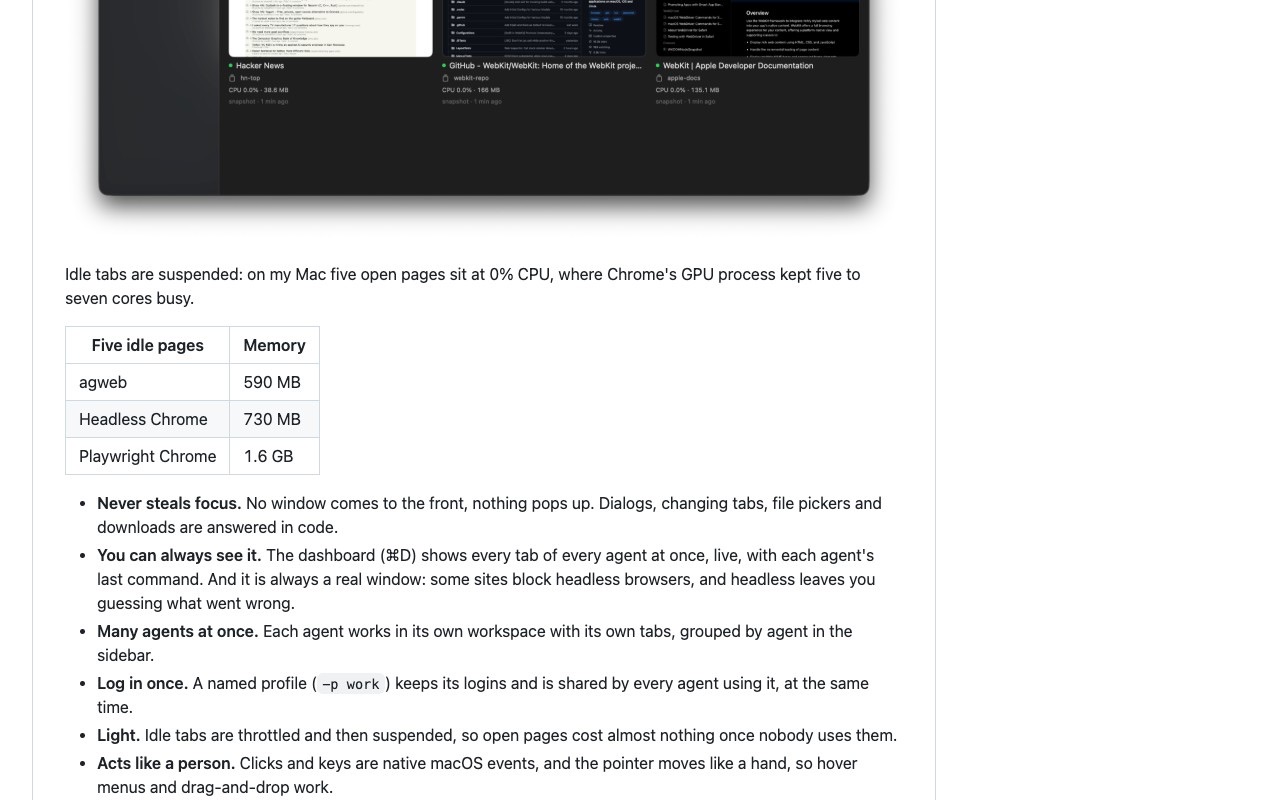
According to the project's README, five idle browser tabs use 590 MB of memory in agweb, versus 730 MB in headless Chrome and 1.6 GB in a Playwright-driven Chrome window, because agweb throttles idle tabs and then suspends them.
Elements get a reference, such as ref=e3, that survives as long as the element stays on the page. Commands named snapshot --diff and find show only what changed, and every action's reply already states what it did, so an agent needs far fewer full-page snapshots than it would with Playwright.
A fill --secret-cmd flag types a password from a command like pass show site, or from the 1Password or Bitwarden CLIs, without the secret ever appearing in the agent's own transcript.
Help > Install Agent Skill adds a packaged skill for Claude Code and Codex. The newest release, v0.3.0 on 14 November 2026, fixed that skill failing to load in tools with strict YAML parsers.
Why it matters for agent builders
Agweb matters for agent builders because it answers two problems that come up often when running a coding agent against a real website: a Playwright-controlled Chrome window keeps stealing keyboard focus mid task, and some sites detect and block a headless browser outright.
Agweb trades the Chrome DevTools Protocol for WebKit to get around both. Playwright and Chrome extensions cannot attach to it, and Chrome-only sites may behave differently. On Hacker News, a user named dfish wrote: "We use agweb daily and love it. It is a good alternative to Atlas that gives you a full desktop... and it doesn't require a new user." Other commenters named existing alternatives in the same space, including agent-browser.dev, github.com/anomalyco/browse, browsermcp.io and a separate project called sleepyhollow.
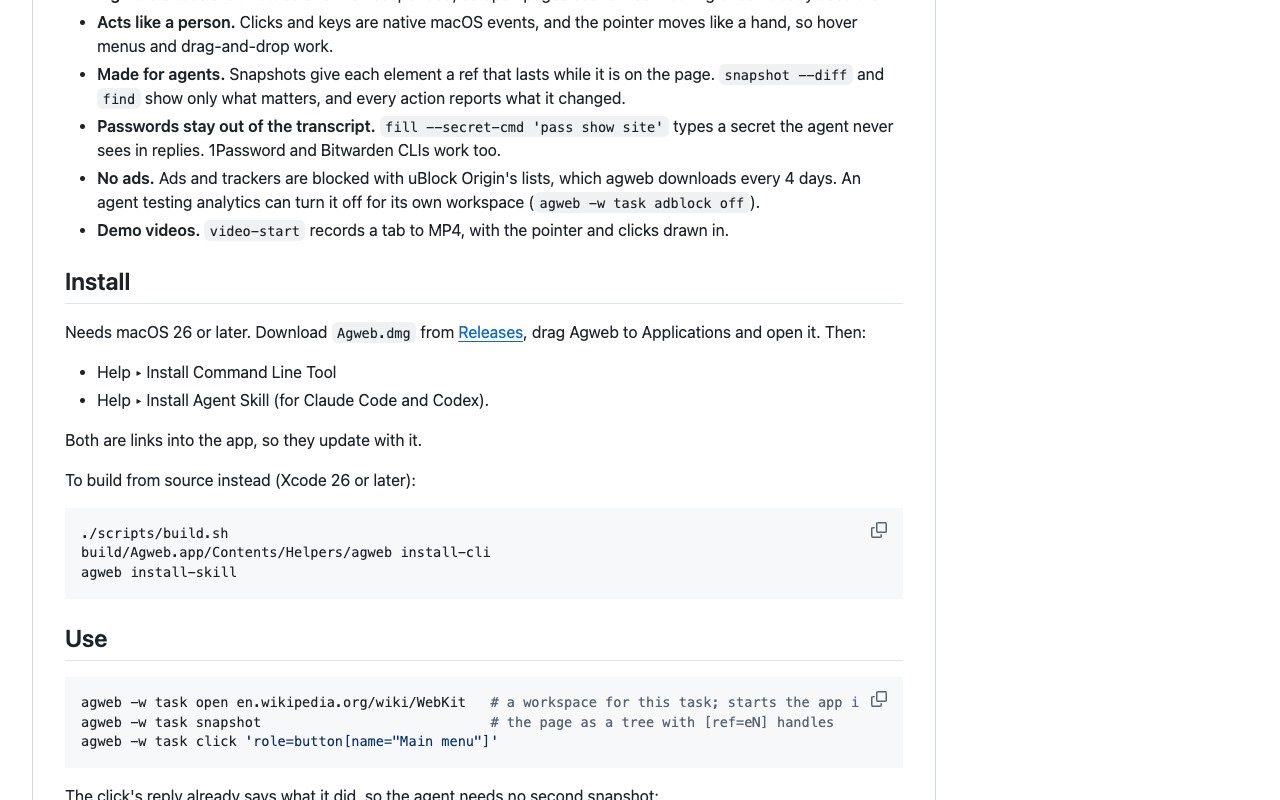
The skill installer adds to that: an agent builder working in Claude Code or Codex gets agweb's commands from the Help menu without writing custom tool-calling code first.
What to watch
What to watch is whether agweb adds a Linux build and whether its maintainer answers the detection questions commenters raised but has not addressed. Agweb needs macOS 26 or later, and more than one commenter on Hacker News asked when a Linux build might arrive; the maintainer has not said. One commenter also asked whether agweb can pass for a normal Chrome browser on a residential IP, a question about detection the thread left unanswered. With several competing agent browsers already named in the same discussion, whether a solo developer's project keeps pace with them is an open question.
Key takeaways
- Agweb is an open source macOS browser built for AI coding agents, released under the MIT license with its newest version, v0.3.0, shipped 14 November 2026.
- It keeps one window that never steals keyboard focus, handling dialogs, downloads and file pickers in code instead of on screen.
- According to the project's README, five idle tabs use 590 MB of memory in agweb versus 730 MB in headless Chrome and 1.6 GB in a Playwright-driven Chrome window.
- It installs a skill directly into Claude Code and Codex from its Help menu, so neither needs custom browser automation code to use it.
- It runs on WebKit, not Chrome, so Chrome DevTools Protocol tools like Playwright cannot attach to it, and it is macOS only.
FAQ
What is Agweb?
Agweb is an open source macOS browser built specifically for AI coding agents. It runs on Apple's WebKit engine, keeps a single window that never takes focus from the person using the computer, and shows every agent's tabs on one dashboard.
Does Agweb work with Claude Code and Codex?
Yes. Agweb ships a packaged agent skill that installs from its Help menu and works with both Claude Code and Codex, giving either one its browser automation commands without custom integration code.
Does Agweb run on Linux?
No. Agweb needs macOS 26 or later to run, and as of its 14 November 2026 release the maintainer had not committed to a Linux build, despite requests in its Hacker News discussion.
Source: Agweb on GitHub Discussion: Hacker News
Agweb sits in the same space as the tools AI Agents Listing tracks in its browser automation category.
Subscribe to our newsletter
One email a week. New agents, MCP servers and skills, and what is actually getting traction.
More news
ClawDOS ships as an open source AI coding agent for DOS
ClawDOS is an open source AI coding agent harness running Claude's Messages API on a real 1980s IBM PC, posted to Hacker News on 21 November 2026.
Turbo-Browser-MCP ships as an 11-tool Playwright MCP server
Turbo-browser-mcp is a new open-source Playwright MCP server with 11 tools that batches browser actions to cut token use and model turns for AI agents.
Windows 11 diagnostics flag Claude Code, Codex and Cursor
A Windows 11 component called MissionControlAggregator checks for Claude Code, Codex, Cursor and other coding agents, researcher Xusheng Li found on 16 November 2026.