ClawDOS ships as an open source AI coding agent for DOS
ClawDOS is an open source AI coding agent harness running Claude's Messages API on a real 1980s IBM PC, posted to Hacker News on 21 November 2026.
Written by AiAgentsListing Team
What happened
Developer Ricapar published ClawDOS, an open source AI coding agent harness that runs on a real IBM PC 5160, an 8088 chip clocked at 4.77 MHz with 640K of RAM. The project was posted to Hacker News on 21 November 2026 and reached 161 points and 51 comments. The code is GPL-3.0 licensed on GitHub, and the author's note on the project page says Claude wrote the entire repository except for that note.
ClawDOS is an open source DOS program that runs a full Claude Messages API client and agent tool loop on an original IBM PC XT from the 1980s. It reads and edits files, compiles code with Turbo C, takes screenshots of what it draws, and keeps its memories and skills as plain text files on the same disk.
What changed
HARNESS.EXE, the 176 KB DOS program at the center of ClawDOS, talks to the Claude Messages API directly from the 8088, with no server doing the agent's reasoning. The 8088 handles everything except the TLS handshake to Anthropic's servers, which runs through a tunnel on a second machine.
- It is written in about 13,000 lines of C and C++, built with Open Watcom for the 8086 instruction set.
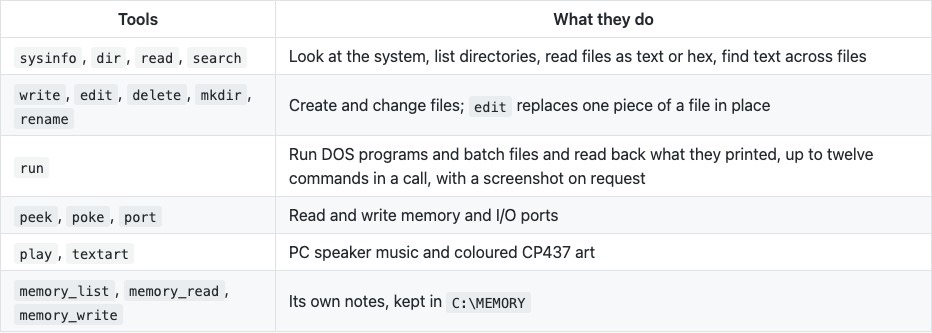
- It has 18 tools:
sysinfo,dir,read,search;write,edit,delete,mkdir,rename;run(up to twelve DOS commands in one call, with a screenshot on request);peek,poke,port;play,textart;memory_list,memory_read,memory_write.
- Memories and skills are both plain text files on the DOS disk, listed in every conversation's system prompt and read in when they fit the task. The project's skills cover things like which dev tools are on the disk and how to draw CGA demo effects.
- Safe mode is on by default. Anything that changes a file, memory, or a port asks "Allow ...? (y/n)" first, and F3 turns it off.
- Screenshots work by hooking a timer interrupt to copy CGA video memory at the moment the model asks for one, then encoding it as a PNG on the 8088 itself, about 16 KB a frame, so Claude can see what a program it wrote actually drew on screen.
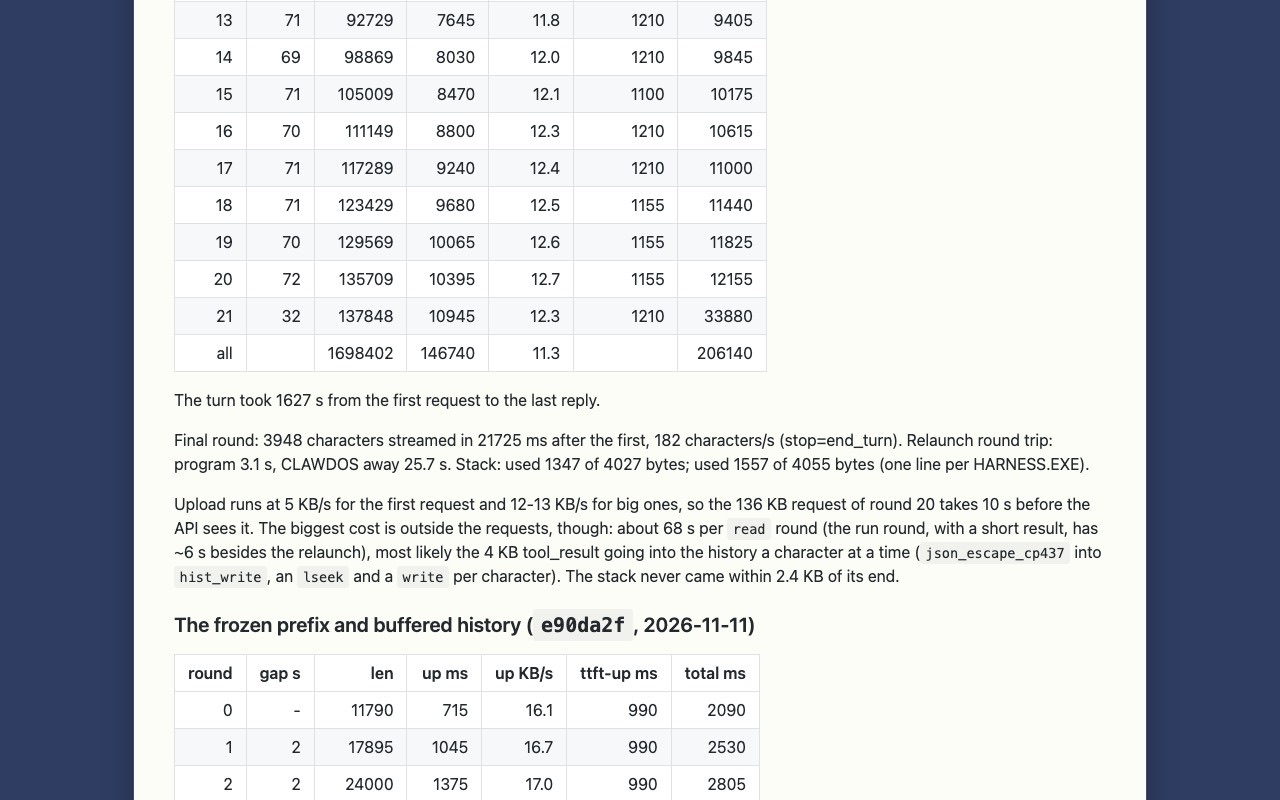
- The project's roadmap records one full agent turn dropping from 1,627 seconds to 211 seconds after a single change buffered history writes to disk and froze the prompt prefix for Anthropic's prompt caching.
Why it matters for agent builders
ClawDOS matters to agent builders because it shows how little a harness needs underneath a model: a request loop against the Messages API, a tool-calling loop, persistent history, and a place to keep memories and skills, done inside 640K of RAM while the model does the reasoning remotely. Most production harnesses assume a server with gigabytes of RAM, a fast local disk, and a working TCP stack. ClawDOS's own benchmark tables show, with real numbers, how much one change to disk I/O, writing a 4 KB tool result in three 2 KB writes instead of around 4,000 character-at-a-time seeks, can speed up every turn of an agent.
The skills implementation is a plain text-file version of what AI Agents Listing tracks as agent skills: a guide the agent reads only when a task calls for it, instead of every instruction sitting in the system prompt on every turn.
What to watch
Two milestones in ClawDOS's roadmap are still open. M6.2 would give a program Claude runs closer to the full 640K instead of today's roughly 446K. M7 would grow a shared library for input editing, windows and menus, and an HTTP client so other DOS-based tools could reach other web APIs through the same tunnel. The repository has 17 GitHub stars and one fork as of 22 November 2026, so whether anyone besides Ricapar builds on a from-scratch DOS agent harness now that it is public under GPL-3.0 is still unclear.
Key takeaways
- ClawDOS is a GPL-3.0 open source AI coding agent harness that runs on a real IBM PC 5160 (Intel 8088, 640K RAM, CGA), posted to Hacker News on 21 November 2026 by developer Ricapar.
- The 176 KB HARNESS.EXE talks to the Claude Messages API directly, with 18 tools covering files, DOS commands, memory and I/O ports, screenshots, and its own memory and skill files.
- A disk I/O change cut one full agent turn from 1,627 seconds to 211 seconds, according to the project's own benchmark log.
- Safe mode asks for confirmation before any file, memory, or port change, and can be turned off with F3.
- The project reached 161 points and 51 comments on Hacker News.
FAQ
What is ClawDOS?
ClawDOS is an open source DOS program that runs a Claude coding agent on a real IBM PC 5160, an 8088-based machine. It reads and writes files, compiles programs with Turbo C, runs them, and takes screenshots of what they draw, keeping its own memory and skills as text files on the DOS disk.
Does ClawDOS need an internet connection?
Yes. An 8088 cannot handle the TLS 1.2 handshake the Claude API requires in a reasonable time, so ClawDOS relies on a second machine running a TLS tunnel, tunnel/tunnel.py or socat or stunnel, that copies bytes between a plain HTTP port and api.anthropic.com over HTTPS. Everything else, including building the request and parsing the streamed reply, runs on the 8088 itself.
Can ClawDOS run on anything besides a real IBM PC 5160?
Yes. Its demos and screenshots run in 86Box, a cycle-accurate PC emulator, and DOSBox-X, a faster emulator used for test runs. On the real 5160, a PicoMEM card supplies disk emulation and WiFi networking.
Source: ClawDOS Discussion: Hacker News
AI Agents Listing tracks releases like this in its directory of agent skills, alongside the AI agents and MCP servers builders compare before picking a harness.
Subscribe to our newsletter
One email a week. New agents, MCP servers and skills, and what is actually getting traction.
More news
Turbo-Browser-MCP ships as an 11-tool Playwright MCP server
Turbo-browser-mcp is a new open-source Playwright MCP server with 11 tools that batches browser actions to cut token use and model turns for AI agents.
Windows 11 diagnostics flag Claude Code, Codex and Cursor
A Windows 11 component called MissionControlAggregator checks for Claude Code, Codex, Cursor and other coding agents, researcher Xusheng Li found on 16 November 2026.
Agweb ships as a WebKit browser built for coding agents
Agweb is an open source macOS browser for AI agents, shipped 14 November 2026 with an installable skill for Claude Code and Codex.