Claude Code team details how it reviews AI-written code
Anthropic's Claude Code team published its seven-layer code review pipeline. From June to September 2026, merged pull requests more than doubled while the share reverted fell over 40%.
Written by AiAgentsListing Team
Claude Code team details how it reviews AI-written code
Anthropic's Claude Code team published an account of how it reviews code when Claude writes most of it. The post, written by Addy Osmani, Morgan Westlee Lunt and Qing Wang and published 15 October 2026 on the claude.dev blog, says merged pull requests to the Claude Code codebase more than doubled between June and September 2026 while the share that had to be reverted fell by more than 40 percent. The team reached 269 points and 253 comments on Hacker News.
Claude Code's team built a seven-layer review pipeline for pull requests mostly written by Claude itself: pre-PR verification, an AI reviewer on every pull request, a blocking security pass, required CI, risk-scaled human approval, a merge queue with staged rollout, and fast rollback. The team reports that from June to September 2026, merged pull requests more than doubled while the share that had to be reverted fell by more than 40 percent.
What changed
- Claude writes about 90 percent of Claude Code's own code, according to the team's post. In Anthropic's wider monorepo, changes landing per day rose from about 2,500 in May 2026 to more than 30,000 in September 2026, a figure first reported in Anthropic's Scion source control post.
- Review now runs in seven layers: the work is verified before a pull request exists (Claude runs tests and a build, then a subagent reviews the diff in fresh context); every pull request gets an automated AI review; a separate security review can block the merge; required CI runs lint, types, tests and a build; human approval is scaled by a risk tier; a merge queue re-checks everything against the latest main before release; and a gradual, flagged rollout with fast rollback catches what gets through.
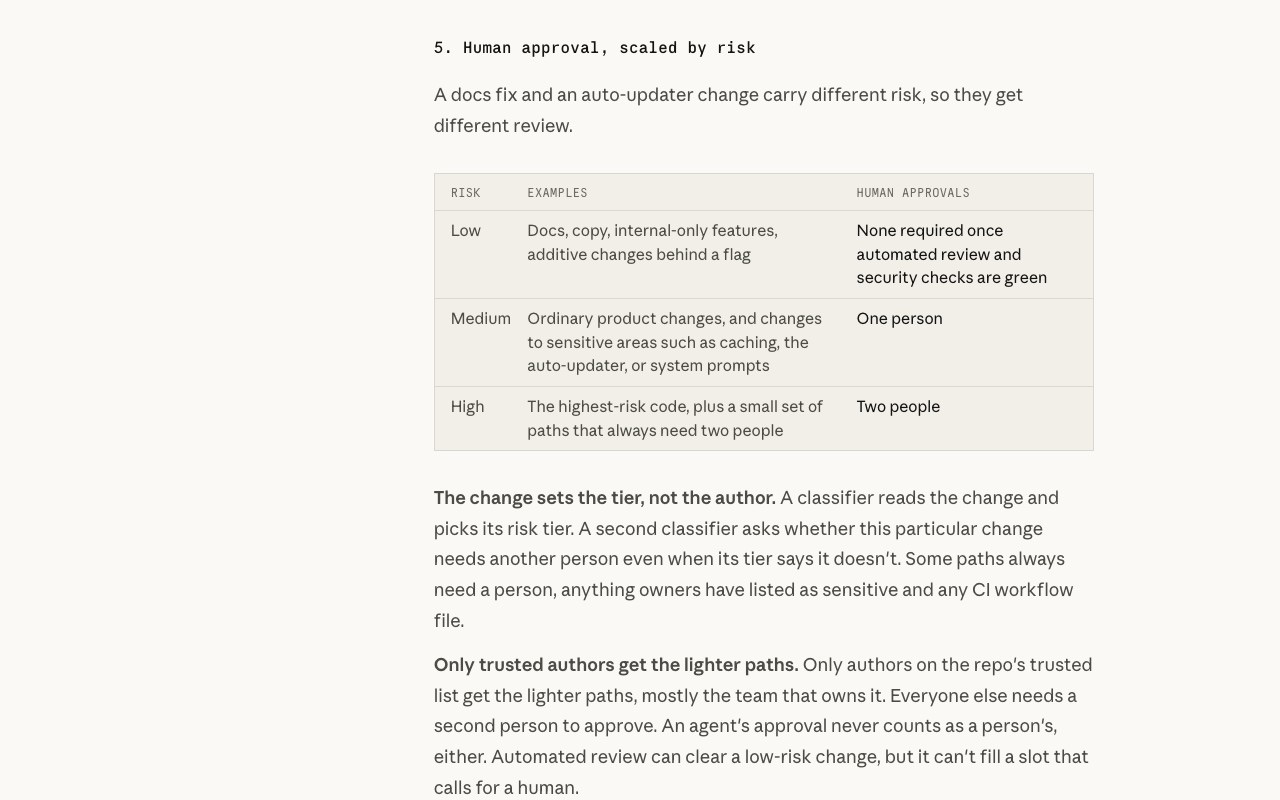
- Risk tiers set who has to approve a change: none required for low-risk changes such as docs or additive work behind a flag, one person for ordinary product changes or sensitive areas like caching or the auto-updater, and two people for the highest-risk code. A classifier reads the change and sets its tier, not the author, and an agent's approval never counts as a person's.
- Code Review for Claude Code, the product version of the internal reviewer, is now generally available on Team and Enterprise plans; a lighter local version runs with the
/code-reviewcommand. When the team's research preview launched internally, the share of pull requests getting substantive review comments rose from 16 percent to 54 percent. - A separate push to cut repeated review rounds raised the share of pull requests that pass after one review and fix round from 65 percent to 78 percent, cut the share needing five or more rounds from 8.9 percent to 1.5 percent, and brought the mean number of reviews needed to pass from 2.08 down to 1.32.
- One CLI pull request went through more than fifty rounds of review and fixes overnight before its author stopped it. When the team ran git blame on what the reviewer kept flagging, about 59 percent of the comments were on code that had been there since the reviewer's first pass, meaning most later rounds were finding old bugs rather than new ones.
Why it matters for agent builders
A team shipping code mostly written by an agent needs a way to spend human review time on what a model cannot judge, not on catching routine mistakes a second AI pass could catch first. Anthropic's post names the specific pieces a smaller team can copy: a short CLAUDE.md with project conventions, a REVIEW.md that tells an automated reviewer what matters in a given part of the codebase, a public GitHub Action for security review, and a written risk tier that decides whether a human has to look at all.
The team's own numbers on review convergence point at a problem every agent-heavy codebase runs into: an agent author and an agent reviewer can keep finding things to fix in each other's work indefinitely. Anthropic's fix, a cap of three rounds before the reviewer asks the author to reconsider the approach, diff-only re-review after the first few passes, and no repeated findings, is a concrete answer to a failure mode that is otherwise easy to discover the hard way.
What to watch
The team says it does not yet have circuit breakers that automatically tighten approval requirements when revert or incident rates start to move, and writes that its engineers want that safeguard in place before more code reaches zero-human merges. That gap, a review system that still depends on a person noticing the dashboards move, is the open question in a pipeline that otherwise automates most of the path from a Claude session to a released build.
Key takeaways
- Merged pull requests to Claude Code's own codebase more than doubled from June to September 2026, while the share reverted fell more than 40 percent.
- Anthropic's monorepo went from about 2,500 changes landing per day in May 2026 to more than 30,000 in September 2026.
- Code Review for Claude Code is now generally available on Team and Enterprise plans; its research preview raised substantive review comments on internal pull requests from 16 percent to 54 percent.
- A convergence push cut pull requests needing five or more review rounds from 8.9 percent to 1.5 percent and brought the mean reviews needed to pass from 2.08 to 1.32.
- Human approval is scaled by a risk tier the change sets, not the author, and an agent's approval never substitutes for a required human one.
FAQ
What is Code Review for Claude Code?
It is Anthropic's product that reviews pull requests on GitHub repositories: several agents read each change, a verification step checks their findings, and the result posts as inline comments ranked by severity plus a summary. It never approves or blocks a pull request on its own; the merge decision stays with the team. It reached general availability on Team and Enterprise plans, alongside a local /code-review command available on any plan.
How much did Claude Code's revert rate change?
The team's 15 October 2026 post reports that from June to September 2026, merged pull requests to the Claude Code codebase more than doubled while the share that had to be reverted fell by more than 40 percent.
Does an AI review replace a human's approval at Anthropic?
No. Human approval is still required on a scale set by risk: none for low-risk changes once automated checks are green, one person for ordinary product or sensitive changes, and two people for the highest-risk code. The team's post states explicitly that an agent's approval never counts as a required person's approval.
Source: How the Claude Code team does code review Discussion: Hacker News
Teams comparing coding agents and review tooling for their own stack can browse the coding and review tools listed on AI Agents Listing.
Subscribe to our newsletter
One email a week. New agents, MCP servers and skills, and what is actually getting traction.
More news
ClawDOS ships as an open source AI coding agent for DOS
ClawDOS is an open source AI coding agent harness running Claude's Messages API on a real 1980s IBM PC, posted to Hacker News on 21 November 2026.
Turbo-Browser-MCP ships as an 11-tool Playwright MCP server
Turbo-browser-mcp is a new open-source Playwright MCP server with 11 tools that batches browser actions to cut token use and model turns for AI agents.
Windows 11 diagnostics flag Claude Code, Codex and Cursor
A Windows 11 component called MissionControlAggregator checks for Claude Code, Codex, Cursor and other coding agents, researcher Xusheng Li found on 16 November 2026.