Cursor ships Agent SDK for building custom coding agents
Cursor released the Agent SDK on 20 October 2026, letting developers define custom AI agents as code and deploy them with one command.
Written by AiAgentsListing Team
Cursor ships Agent SDK for building custom coding agents
Cursor shipped the Agent SDK on 20 October 2026, the same framework the company uses internally to build its own managed agents: Bugbot, Security Reviewer and Rollouts. The release reached Hacker News on 28 October 2026 and gathered 110 points and 116 comments. It lets a team define an agent as a small TypeScript project, test it locally, and deploy it to Cursor's infrastructure with one command.
The Cursor Agent SDK is a code-first framework for building custom AI agents: instructions live in Markdown, tools are typed TypeScript functions, evals and event replay are built in, and a single command, agent-sdk deploy, ships the finished agent to Cursor's managed infrastructure or lets it run in a container on a team's own servers.
What changed
Cursor packaged agent-building into an installable CLI: a developer installs the SDK with npm install -g @grok/agent-sdk, then runs agent-sdk login, agent-sdk init to scaffold a project, and agent-sdk dev to open a local playground, according to Cursor's quickstart guide. Inside the project, prompts are written in Markdown and tools are TypeScript functions validated with the zod library, so the whole agent can go through the same version control and review process as the rest of a codebase, Cursor says in its announcement.
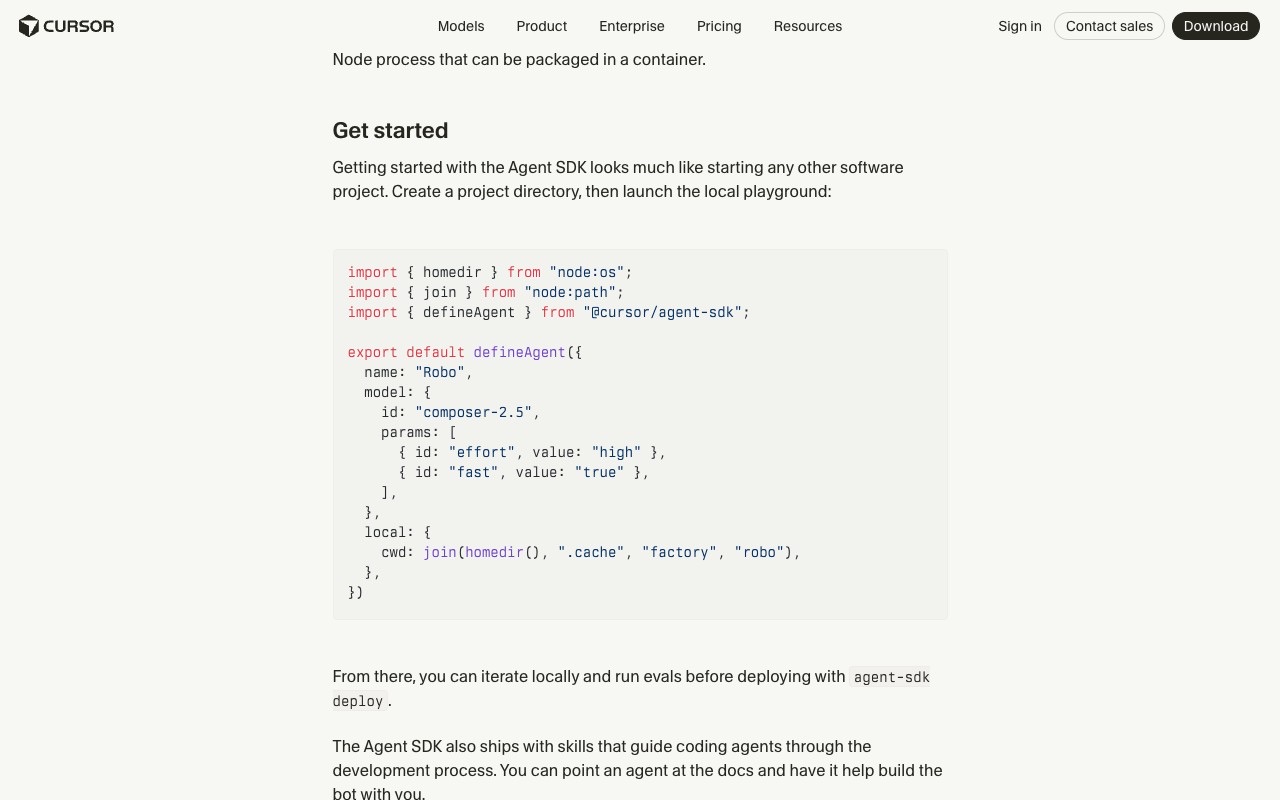
The SDK ships with evals and event replay built in, so a team can test a prompt change against recorded sessions before it reaches production. An agent can also hand a task to a specialized subagent, or split work across several subagents running in parallel.
One command, agent-sdk deploy, builds the most recently pushed Git ref and deploys it to Cursor-managed hosting, printing a URL when the agent is live, per Cursor's deployment docs. The same project can instead run as a single Node process in a container on infrastructure a team controls. Deployed agents can call each other as peers, and secrets are declared by name in code, such as egressDomains and secretNames, then set later with agent-sdk secret set, so values never sit in the repository.
Cursor's announcement gives one internal example: a team built an agent called kb-reviewer in about a day. It checks every pull request against the company's internal lessons-learned knowledge base and cites the note behind each finding. Cursor also quotes Michael Gyarmathy, a principal engineer at PGA America, who said the SDK's evals let PGA "build every component of our software factory on Cursor's infrastructure" and "quickly iterate on new ideas and optimize existing capabilities reliably."
Why it matters for agent builders
Agent SDK matters because it gives teams building a custom agent, rather than a chat assistant, a packaged way to define it as versioned code instead of configuring a separate low-code product. Defining prompts, tools and evals as files and deploying them with a CLI puts Cursor's offering next to Anthropic's Claude Agent SDK and OpenAI's Agents API, both already running for close to a year.
Teams that already run MCP servers can wire them in as tools inside an Agent SDK agent. The evals and event replay address a specific blocker for shipping agent code to production: testing whether a prompt change breaks something that used to work, without waiting for it to happen live.
What to watch
What to watch is whether Cursor's managed hosting, evals and peer-agent connections are enough to pull teams away from building the same pattern themselves, a question Hacker News commenters raised repeatedly, comparing the release to running a Claude subscription inside an open-source harness or to Anthropic's own Claude Agent SDK, which shipped around September 2025. One reply pointed to Anthropic's documentation on using a Claude plan inside third-party SDKs as evidence that switching between harnesses already carries little lock-in, so Cursor's pitch rests on its managed hosting and evals rather than on an agent pattern that is not new.
Key takeaways
- Cursor released the Agent SDK on 20 October 2026, the framework behind its own Bugbot, Security Reviewer and Rollouts agents.
- An Agent SDK agent is a TypeScript project: Markdown prompts, typed tools, built-in evals and event replay.
agent-sdk deployships an agent to Cursor's managed hosting, or it can run as a container on a team's own infrastructure.- PGA America is running its internal software-development agents on the Agent SDK, according to Cursor's announcement.
- Hacker News commenters compared the release directly to Anthropic's Claude Agent SDK and OpenAI's Agents API, both released roughly a year earlier.
FAQ
What is Cursor's Agent SDK?
It is a framework, released by Cursor on 20 October 2026, for defining AI agents as code: instructions in Markdown, tools as TypeScript functions, with built-in evals and a CLI that deploys the finished agent.
How do you deploy an agent built with the Agent SDK?
Run agent-sdk deploy from the project directory. Cursor builds the most recently pushed Git ref, starts it on managed infrastructure, and prints a URL. The same project can instead run as a single Node process in a container on infrastructure a team controls.
How does the Agent SDK differ from Anthropic's Claude Agent SDK or OpenAI's Agents API?
All three let a developer define an agent in code with tools and deploy it, but Cursor's version is tied to its own managed hosting and evals, ships with peer-agent connections, and comes with templates drawn from the agents, Bugbot, Security Reviewer and Rollouts, that Cursor already runs internally.
Source: Cursor Discussion: Hacker News
Developers comparing coding agents and the frameworks behind them can browse the full list in AI Agents Listing's coding category.
Subscribe to our newsletter
One email a week. New agents, MCP servers and skills, and what is actually getting traction.
More news
Agweb ships as a WebKit browser built for coding agents
Agweb is an open source macOS browser for AI agents, shipped 14 November 2026 with an installable skill for Claude Code and Codex.
Edge0-145B ships as open 145B model for local agents
Edge0-AI open-sourced Edge0-145B, a 145B-parameter model it says runs coding and agent tasks on a single laptop with 29GB of peak memory.
AgentRun ships as open-source self-improving agent platform
Grep.ai open-sourced AgentRun, an Apache-2.0 platform adding self-improving skills and durable runs to Claude Code, Codex, Pi and OpenCode agents.