Edge0-145B ships as open 145B model for local agents
Edge0-AI open-sourced Edge0-145B, a 145B-parameter model it says runs coding and agent tasks on a single laptop with 29GB of peak memory.
Written by AiAgentsListing Team
What happened
Edge0-AI open-sourced Edge0-145B and Edge0-120B on 12 November 2026, two mixture-of-experts language models the company says can run coding and agent workloads on a single laptop instead of a cloud API. The release ships with edge0-infer, an Apache-2.0 licensed inference framework on GitHub, and an arXiv paper describing the architecture. The announcement reached 341 points and 104 comments on Hacker News within a day.
Edge0-145B is a 145-billion-parameter mixture-of-experts model built to run locally rather than through a cloud API. Edge0-AI reports 29GB of peak memory on a compatible laptop, decoding above 80 tokens per second, and a score of 86.52 on Terminal-Bench 2.1, a benchmark that evaluates agent and coding work.
What changed
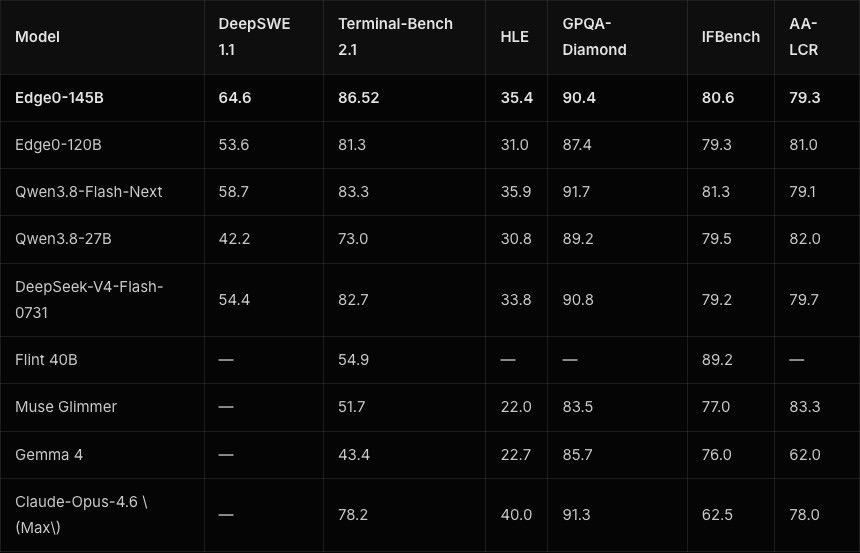
Edge0-AI's own benchmark table puts Edge0-145B ahead of several open models it compares itself against:
- DeepSWE 1.1 (coding): 64.6, against Qwen3.8-Flash-Next's 58.7 and DeepSeek-V4-Flash-0731's 54.4.
- Terminal-Bench 2.1 (agent and coding): 86.52, against Qwen3.8-Flash-Next's 83.3, DeepSeek-V4-Flash-0731's 82.7 and Claude-Opus-4.6 (Max) at 78.2.
- GPQA-Diamond (reasoning and knowledge): 90.4, close to DeepSeek-V4-Flash-0731's 90.8.
- IFBench (instruction following): 80.6, against DeepSeek-V4-Flash-0731's 79.2.
Edge0-AI states all of these comparisons come from its own internal evaluations, not an independent lab. Against Qwen3.8-27B, a baseline on-device model, the company reports an 18.5% gain on Terminal-Bench and a 53.1% gain on DeepSWE.
The architecture, which Edge0-AI calls a latent mixture-of-experts design, shares two large matrices across each group of 64 experts, so only about 10B of the model's 145B total parameters participate in a given inference step. Loading is split across three tiers: frequently used experts stay in GPU memory, an expert library of roughly 40GB sits in system memory, and about 48GB of vocabulary data is read from SSD on demand.
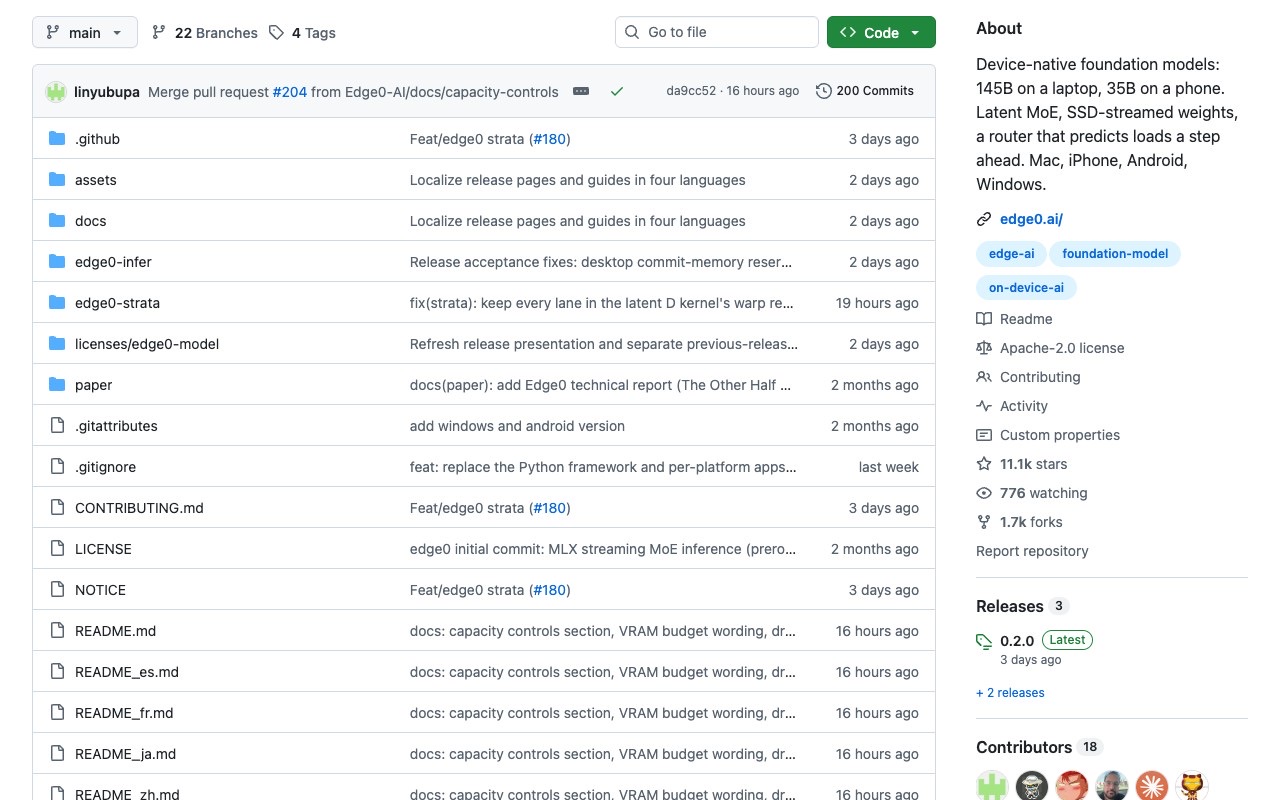
The inference framework, edge0-infer, carries an Apache-2.0 license on GitHub, where the repository has 11,100 stars and 1,700 forks. The model weights themselves ship under a separate license Hugging Face lists as edge0-community-model-1.0, not Apache-2.0. On Hacker News, commenters including Zetaphor and hedora argued that license makes the release open weights rather than open source in the usual sense. Other commenters, including Aurornis and the thread's submitter sroussey, pointed to Hugging Face's own model-card metadata linking Edge0-145B-NVFP4 to a quantized version of Qwen3.8-Flash-Next, arguing the model is a fine-tune of an existing base rather than a model trained from scratch.
Edge0-AI says this is its second release in the Edge0 family after Edge0-35B, a phone-sized model the company published in September 2026 that it says reached the top of Hugging Face's Trending chart. The company lists four model families in total, Edge0 for agent and coding work, Audio8 for speech, Decision0 for fast decisions and Embedding0 for memory and retrieval, totalling about 200 released models.
Why it matters for agent builders
A model that runs agent and coding loops locally removes the per-token cost of a cloud API on workloads that call tools and revise their own output many times over. Edge0-AI's own examples describe tasks that ran for dozens of rounds of planning, execution and review without a network round trip. The Hugging Face model card lists usage instructions for llama.cpp, vLLM, Ollama and Pi, an existing coding agent, which gives builders who already run one of those a way to try a local 145B model without new tooling.
The license split matters for anyone planning to ship a product on top of it. The inference code is Apache-2.0, but the weights carry Edge0-AI's own community license rather than a standard open-source one, a distinction that affects what a commercial product built on the weights is allowed to do.
What to watch
Several Hacker News commenters pushed back on the headline 29GB memory figure, pointing out the same page also describes roughly 40GB of system memory for the expert library and 48GB of vocabulary data on SSD, numbers the headline figure does not include. Commenter mapontosevenths reported the model failed to produce a coherent answer to a classic interview question on a DGX Spark, spending more than 8,000 thinking tokens first. Others, including mikeshi42 and theroadnotbacon, questioned whether the inference engine actually supports macOS at launch, since the GitHub repository lists Mac among its platforms but the engine appeared CUDA-only to them. Whether Edge0-AI's benchmark numbers hold up under independent testing, rather than the company's own evaluations, is the open question.
Key takeaways
- Edge0-AI released Edge0-145B and Edge0-120B on 12 November 2026 as open-weight models aimed at local coding and agent work, reporting 29GB of peak memory and over 80 tokens per second of decoding on a laptop.
- Edge0-145B scores 86.52 on Terminal-Bench 2.1 and 64.6 on DeepSWE 1.1 in Edge0-AI's own internal evaluations, ahead of Qwen3.8-Flash-Next and DeepSeek-V4-Flash-0731 on both.
- The inference framework, edge0-infer, is Apache-2.0 on GitHub; the model weights ship under a separate edge0-community-model-1.0 license that Hacker News commenters say falls short of open source.
- The model card lists support for llama.cpp, vLLM, Ollama and the Pi coding agent, letting builders already using one of those tools try a local 145B model directly.
- Hacker News commenters questioned the headline memory figure, reported a failed test on a DGX Spark, and disputed the model's day-one macOS support.
FAQ
What is Edge0-145B?
Edge0-145B is a 145-billion-parameter mixture-of-experts language model from Edge0-AI, released on 12 November 2026 and built to run coding and agent tasks on a single laptop rather than through a cloud API.
Is Edge0-145B open source?
The inference framework that runs it, edge0-infer, is Apache-2.0 licensed on GitHub. The model weights ship under a separate license Hugging Face lists as edge0-community-model-1.0, which Hacker News commenters argued does not meet the usual definition of open source, making this an open-weight release rather than a fully open-source one.
What hardware does Edge0-145B need?
Edge0-AI reports 29GB of peak memory to run Edge0-145B on a compatible laptop, alongside roughly 40GB of system memory for its expert library and about 48GB of vocabulary data read from SSD. Several Hacker News commenters said the headline 29GB figure understates the full footprint, and some disputed whether the inference engine supports macOS at launch despite the repository listing it as a supported platform.
Source: Edge0
Discussion: Hacker News
Builders weighing a local model for coding or agent work can compare options in the coding category on AI Agents Listing.
Subscribe to our newsletter
One email a week. New agents, MCP servers and skills, and what is actually getting traction.
More news
ClawDOS ships as an open source AI coding agent for DOS
ClawDOS is an open source AI coding agent harness running Claude's Messages API on a real 1980s IBM PC, posted to Hacker News on 21 November 2026.
Turbo-Browser-MCP ships as an 11-tool Playwright MCP server
Turbo-browser-mcp is a new open-source Playwright MCP server with 11 tools that batches browser actions to cut token use and model turns for AI agents.
Windows 11 diagnostics flag Claude Code, Codex and Cursor
A Windows 11 component called MissionControlAggregator checks for Claude Code, Codex, Cursor and other coding agents, researcher Xusheng Li found on 16 November 2026.