Submit

AI Agent Identity Management: How It Works in 2026

AI agent identity management explained: the registration, scoped-credential and delegation steps behind it, and how Okta, Microsoft, Google and MCP differ.

Written by AiAgentsListing Team

•7 min read
AI Agent Identity Management: How It Works in 2026

AI agent identity management is becoming its own product category

AI agent identity management has turned into a separate line item inside enterprise identity in 2026, as teams running autonomous agents discover that neither a human login nor a shared service account fits what an agent actually does. Okta, Microsoft and Google Cloud each now ship a dedicated agent identity product, and the Model Context Protocol has its own authorization model for the same problem.

The shift did not start as a theoretical worry. In April 2026, a Cursor coding agent running on a frontier model deleted the entire production database of PocketOS, a B2B platform used by car rental companies, in nine seconds. It had hit a credential mismatch mid task, found a token with broader permissions than the job required, and issued a single GraphQL mutation that wiped everything, according to a case study on the Auth0 blog that cites reporting in The Guardian. The agent had been given the same standing access a human operator would have, and nothing in its credential stopped it from using all of it at once.

AI agent identity management is the set of practices and products that give each AI agent its own verifiable, auditable identity instead of a shared login or a static API key. It covers registering agents, issuing short-lived scoped credentials, recording who delegated authority to the agent, and revoking its access at runtime, according to Palo Alto Networks.

Why agents break the old identity models

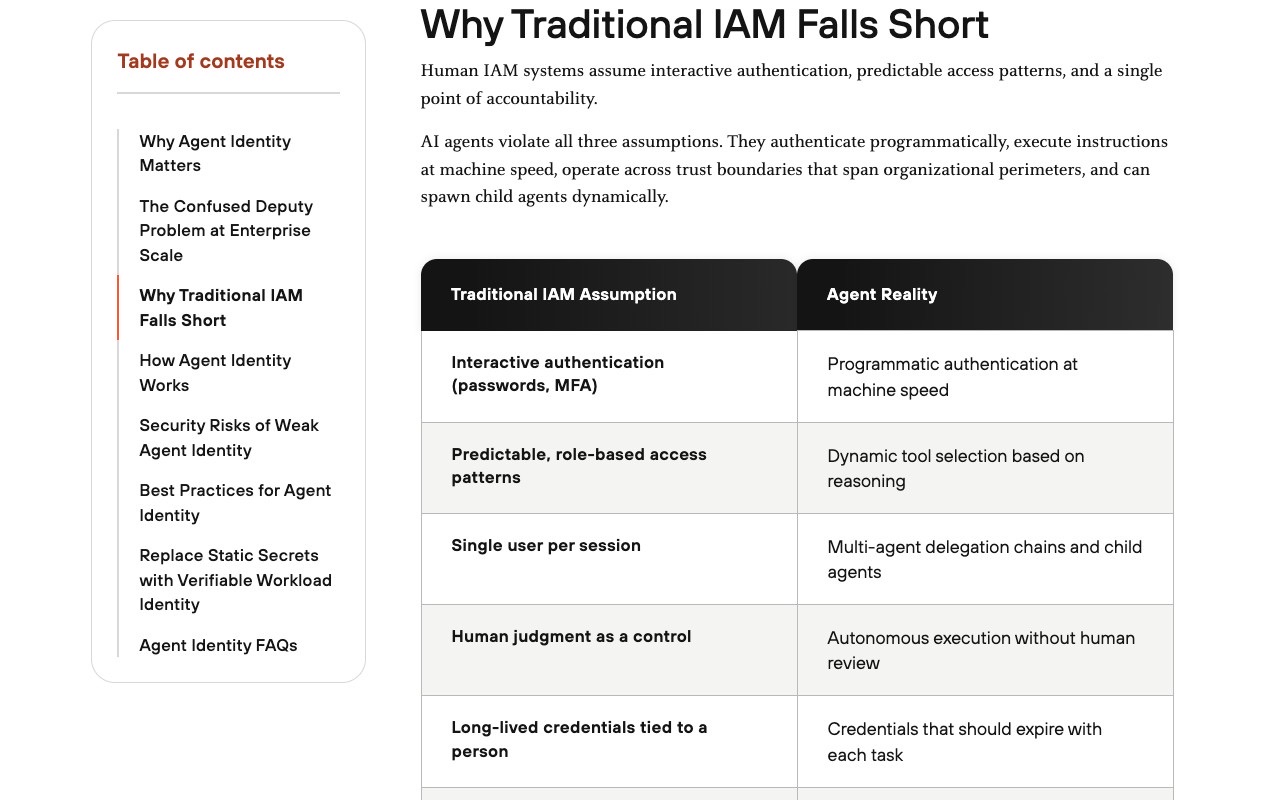
Traditional identity management assumes either a human at the keyboard or a service account running fixed, predictable code. An AI agent fits neither description: it authenticates programmatically, selects which tool to call based on reasoning instead of a fixed workflow, and can spawn other agents mid task, Palo Alto Networks' Cyberpedia explainer on agent identity notes.

Two existing models get reused anyway, and both break down. OAuth delegation hands the agent the same scopes as the user who authorized it, so the agent can do anything that user could, on every run, regardless of the specific task in front of it. A dedicated service account solves the sharing problem but is usually long-lived and broadly scoped, so an audit log shows only that the service account acted, with no trace of which request triggered it or who was accountable, Auth0 senior developer Cameron Pavey wrote in a June 2026 post.

Palo Alto Networks lists four failure modes that both approaches share once an agent is involved: over-permissioning, because scopes are typically defined at the resource level instead of the specific action; a wider blast radius if the agent's process or logs are compromised; no way to tell what the agent is doing right now from what it is broadly authorized to do; and credential sprawl, since every new tool integration needs its own secret to manage and rotate.

A side-by-side comparison table from a Palo Alto Networks explainer listing traditional IAM assumptions, such as interactive authentication and predictable role-based access, against the corresponding agent reality for each one.

How agent identity actually works

Agent identity runs as a lifecycle, not a one-time login check. Palo Alto Networks breaks it into four stages. Registration and inventory records each agent with a declared purpose, owner and risk tier. Scoped credential issuance gives the agent a short-lived, task-scoped credential on demand instead of a standing one. Delegation chain tracking records who authorized the agent and, in multi-agent setups, which agent authorized another. Runtime enforcement checks every request against the agent's identity and the sensitivity of the resource, and can revoke access immediately if its behavior looks wrong.

Auth0 describes a similar shape from the authorization side. A first-class agent identity needs a directory identifier separate from any human user, permissions scoped to specific capabilities instead of whole resources, a delegation record naming the human or agent that granted the authority, and an audit trail that preserves the full chain, not just what the underlying tool logged on its own. Auth0 points to OpenFGA, the CNCF authorization engine behind its fine-grained authorization product, which models agents as first-class principals in its own permission hierarchy.

AI agent identity management for MCP servers

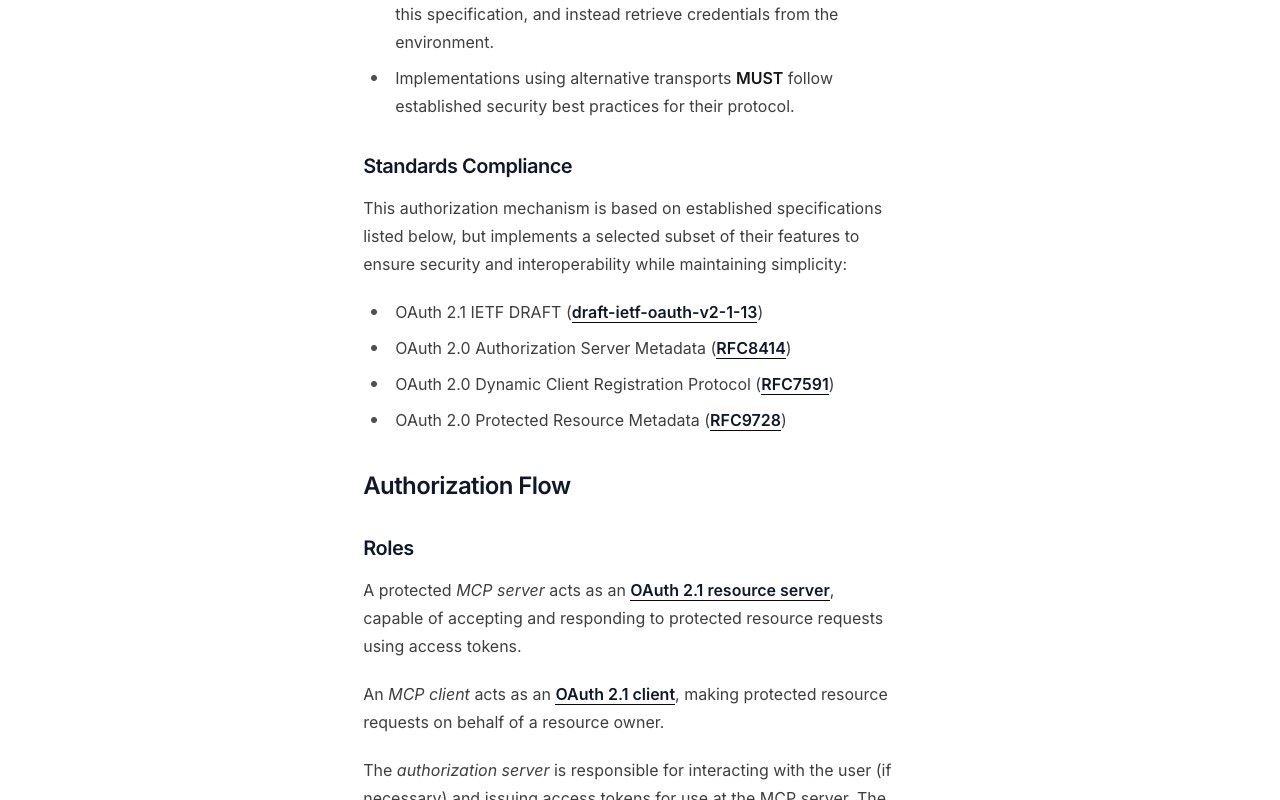
Anyone building or running an MCP server runs into a narrower version of this problem. The Model Context Protocol's authorization specification (version 2025-06-18) treats authorization as optional, but when an MCP server runs over an HTTP-based transport, the spec expects it to follow a defined OAuth 2.1 flow: the MCP server acts as an OAuth 2.1 resource server, the MCP client acts as an OAuth 2.1 client, and a separate authorization server issues the access tokens. A server running locally over stdio is told to skip all of this and retrieve credentials from the environment.

A section of the Model Context Protocol authorization specification listing the four OAuth standards it builds on and defining the MCP server, MCP client and authorization server roles in the flow.

The spec builds on four existing standards: the OAuth 2.1 IETF draft, OAuth 2.0 Authorization Server Metadata (RFC 8414), OAuth 2.0 Dynamic Client Registration (RFC 7591), and OAuth 2.0 Protected Resource Metadata (RFC 9728). An MCP server must publish its protected resource metadata so a client can discover which authorization server to use, and every access token has to travel in an Authorization header, never in a URL query string. The growing catalog of MCP servers on AI Agents Listing includes a mix of local stdio tools, which sidestep this flow entirely, and remote HTTP servers, which do not.

Who is building agent identity products

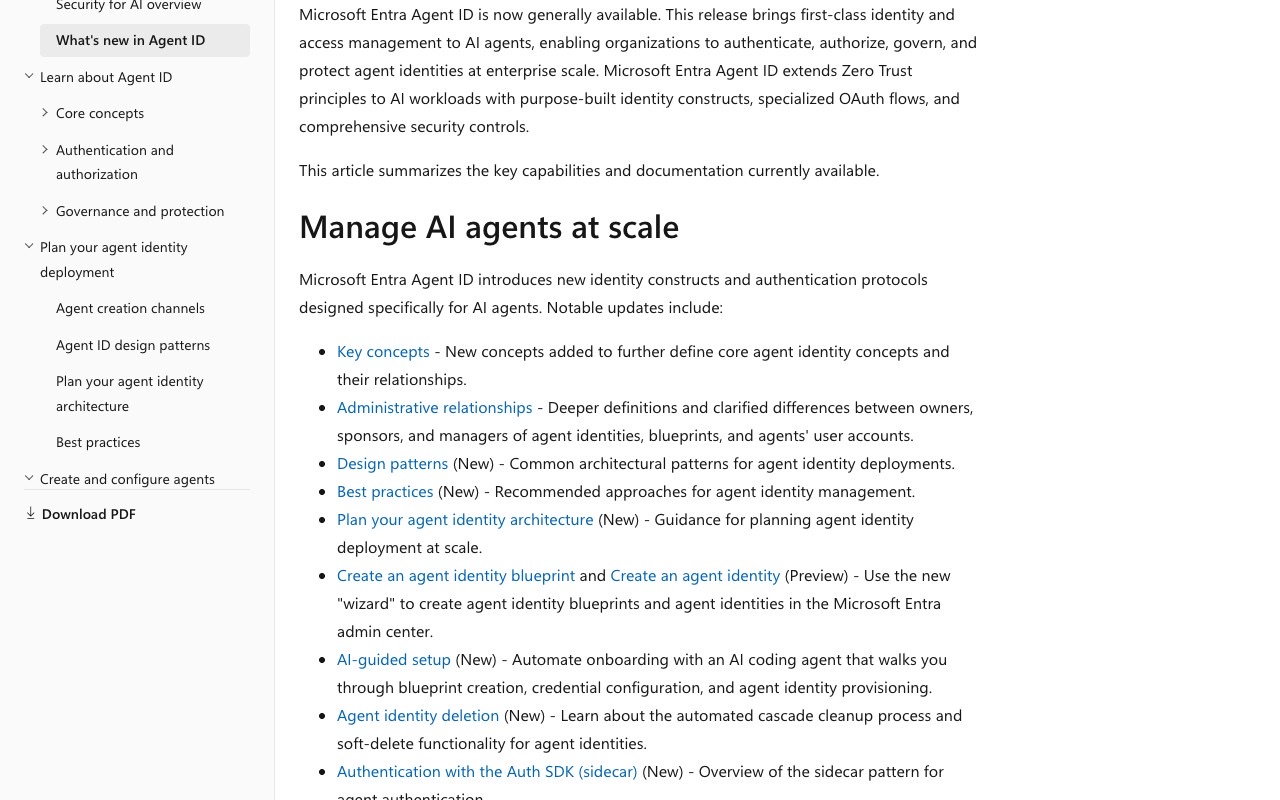
Microsoft Entra Agent ID reached general availability, according to Microsoft's own what's new page, last updated 1 May 2026. The release brings purpose-built identity constructs and specialized OAuth flows to AI agents, a sidecar-based Auth SDK for agent authentication, Conditional Access policy templates built for autonomous and on-behalf-of agents, and an automated cascade cleanup and soft-delete process when an agent identity is removed. Microsoft also documents how to secure agents built on Amazon Bedrock and n8n through Agent ID.

A Microsoft Learn documentation page announcing that Microsoft Entra Agent ID is generally available, with a bulleted list of new capabilities including design patterns, best practices and an AI-guided setup wizard.

Okta and its Auth0 platform sell products aimed specifically at agent identity, built on top of Okta's existing non-human identity and fine-grained authorization tooling. Google Cloud's Agent Identity sits inside Cloud IAM and is described in its own documentation as SPIFFE-based authentication and authorization for Google Cloud agents, with separate guides covering three-legged OAuth, two-legged OAuth and API key authentication depending on whether the agent is acting for a specific user or on its own.

SPIFFE, the open standard behind Google's implementation, issues short-lived verifiable identity documents to workloads through an attestation step, using its SPIRE reference implementation, instead of handing each one a static secret to protect for its whole lifetime.

When to use it, and when not to

A dedicated agent identity layer earns its cost once an agent can reach production data or spend money without a person approving each step: an agent that writes to a database, calls a paid API, or acts across more than one internal system is exactly the kind of actor behind the PocketOS incident.

A side project running one agent against its own sandboxed data, with no real credentials at stake, does not need a registry, a gateway and a tracked delegation chain. A single API key scoped narrowly to that integration and rotated by hand is a proportionate starting point until the agent's reach grows.

What's new as of 4 November 2026

Microsoft Entra Agent ID has moved from preview to general availability, with its documentation last updated 1 May 2026 and new capabilities including the Auth SDK sidecar pattern, agent-specific Conditional Access templates, and the convergence of Microsoft's separate agent registries into Microsoft Agent 365.

Auth0 published its "AI Agents Are Not Users" architecture piece in June 2026, built around OpenFGA's agent modeling patterns and the PocketOS database deletion as its central example of what a credential without task-level scope can do.

Palo Alto Networks' Unit 42 research group has documented nine concrete attack scenarios against agentic applications, including credential leakage from improperly mounted container volumes and identity spoofing through weak agent authentication, feeding directly into the agent identity best practices Palo Alto now publishes.

Key takeaways

  • AI agent identity management gives each agent its own identity, separate from the human user and from any shared service account, per Palo Alto Networks.
  • Auth0 cites a Cursor coding agent's April 2026 deletion of PocketOS's entire production database as the kind of incident this category exists to prevent.
  • Palo Alto Networks' agent identity lifecycle has four stages: registration, scoped credential issuance, delegation chain tracking, and runtime enforcement and revocation.
  • Microsoft Entra Agent ID reached general availability by 1 May 2026, and Google Cloud's Agent Identity product is built on the open SPIFFE standard.
  • MCP's own authorization spec defines an OAuth 2.1 flow for MCP servers running over HTTP, while stdio servers are told to pull credentials from the environment instead.

FAQ

What is AI agent identity management?

AI agent identity management is the practice of giving an AI agent its own verifiable identity, distinct from the human who deployed it and from any shared service account, so every tool call and data access can be attributed to that specific agent, scoped to what it needs, and revoked on its own, according to Palo Alto Networks.

How is agent identity different from a service account?

A traditional service account runs fixed, predictable code behind a long-lived, broadly scoped credential, so a human auditor can reason about what it might do from the code alone. An AI agent decides which tool to call at runtime and can spawn other agents, which is why Auth0 argues it needs a short-lived, task-scoped credential and a recorded delegation chain in place of a static secret.

Does MCP have its own identity or authorization system?

The Model Context Protocol's specification makes authorization optional, but an MCP server running over an HTTP-based transport is expected to act as an OAuth 2.1 resource server, with a separate authorization server issuing short-lived access tokens to MCP clients. A server running locally over stdio is told to retrieve credentials from the environment instead of following this flow.

Which vendors sell agent identity products?

Microsoft sells Entra Agent ID, Okta and its Auth0 platform sell agent identity and fine-grained authorization tooling, and Google Cloud sells Agent Identity inside Cloud IAM, built on the open SPIFFE standard, as of late 2026. The open source SPIFFE and SPIRE projects underlie parts of that vendor tooling and can also be run independently.

Builders comparing agents, MCP servers and the identity tooling that secures them can browse the full catalog at AI Agents Listing.

Share:

Subscribe to our newsletter

One email a week. New agents, MCP servers and skills, and what is actually getting traction.

Read next