AI Agent Identity Management: How It Works in 2026
AI agent identity management explained: the registration, scoped-credential and delegation steps behind it, and how Okta, Microsoft, Google and MCP differ.
7 min read
MCP tool annotations are the readOnlyHint, destructiveHint, idempotentHint and openWorldHint fields a server attaches to a tool, and how clients use them.
MCP tool annotations are the four optional fields a Model Context Protocol server attaches to each tool definition to describe how that tool behaves: whether it reads or writes, whether a write can destroy data, whether a repeat call is safe, and whether the tool reaches outside the server's own domain. They shipped in the 2025-03-26 revision of the MCP specification, and the current 2026-07-28 revision keeps the same four hints with the same defaults, according to the protocol's schema reference and its own blog.
MCP tool annotations are optional metadata, readOnlyHint, destructiveHint, idempotentHint and openWorldHint, that a server attaches to a tool so a client can decide when to ask the user for confirmation before running it. The specification calls every one of them a hint: a client must treat annotations from an untrusted server as unverified, not as a guarantee.
The ToolAnnotations interface defines five fields, a display title plus four booleans, each with its own default:
| Hint | Default | What true means |
|---|---|---|
readOnlyHint | false | The tool does not modify its environment |
destructiveHint | true | A modifying tool may destroy data rather than only add to it |
idempotentHint | false | Repeating the same call has no additional effect |
openWorldHint | true | The tool reaches an open set of external entities, not a closed domain |
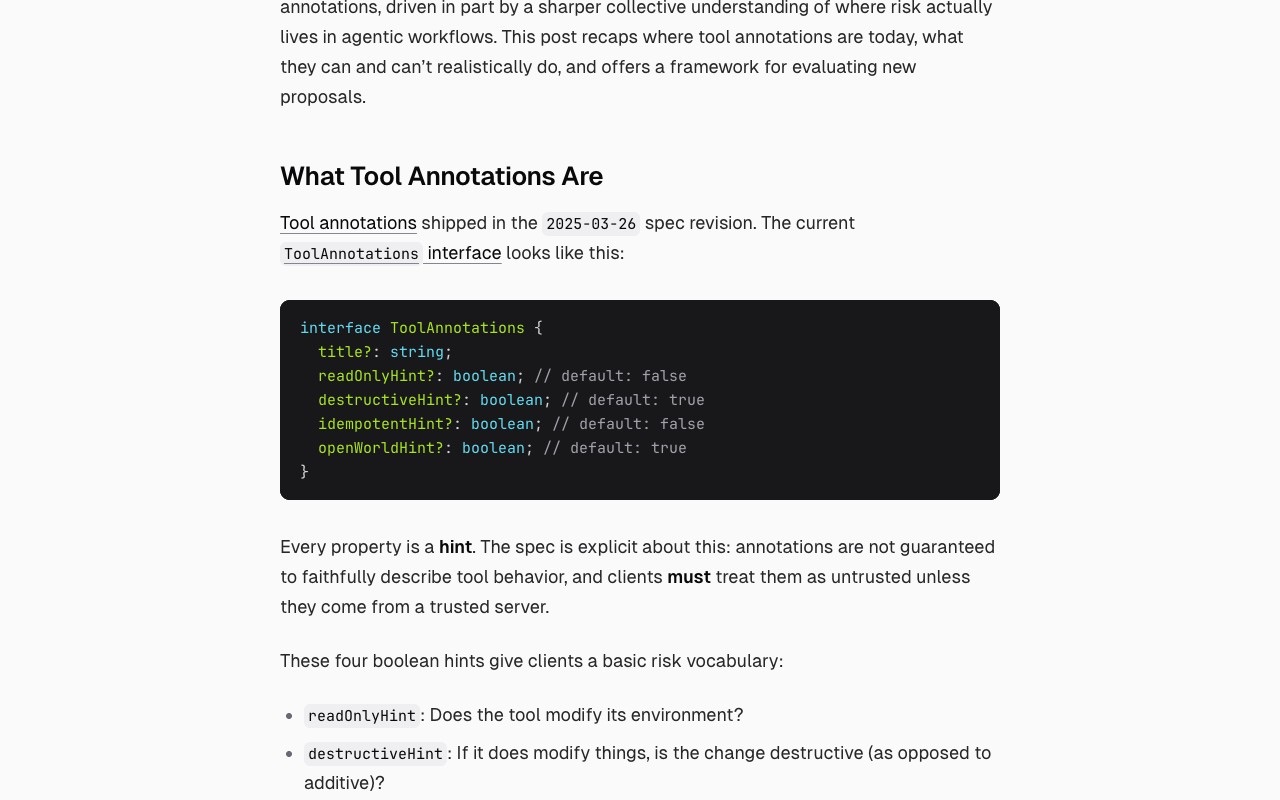
The defaults assume the worst. A tool with no annotations at all is treated as potentially modifying its environment, potentially destructive, unsafe to retry, and reaching outside the server, according to the Model Context Protocol's March 2026 post on tool annotations. Leaving an annotation out never makes a tool look safer than it is; it only means a careful client asks for confirmation more often than it needs to.
Annotations travel inside the tools/list response alongside a tool's name, description and input schema. The current tools specification describes them as "optional properties describing tool behavior" and states that clients must consider them untrusted unless they come from a trusted server. A malicious or careless server can set readOnlyHint: true on a tool that deletes files, which is why the spec treats the hints as advisory rather than enforced.
That trust boundary connects to what Simon Willison named the lethal trifecta: access to private data, exposure to untrusted content, and the ability to communicate externally. When an agent's session combines all three, an attacker who controls one piece of untrusted content, a calendar invite, an email, a web page, can get the model to read private data and send it out. Researchers have reproduced this using a malicious Google Calendar event, an MCP calendar server, and a local code-execution tool, according to the MCP blog post. Annotations like openWorldHint cannot stop a model from following an injected instruction, but they can help a client notice when a session has assembled all three legs of that chain and tighten its confirmation rules from that point on.
A read-only tool from the Kubernetes MCP Server, tested by developer Marc Nuri with version 0.0.67 in October 2026, shows the shape of a tools/list entry:
{
  "name": "helm_list",
  "title": "Helm: List",
  "annotations": {
    "title": "Helm: List",
    "readOnlyHint": true,
    "destructiveHint": false,
    "idempotentHint": false,
    "openWorldHint": true
  }
}
A destructive tool looks different. Speakeasy's Functions Framework, which forwards annotations to MCP clients automatically, documents a delete_user tool set up the opposite way:
const functions = new Functions().tool({
  name: "delete_user",
  description: "Permanently delete a user account",
  inputSchema: { userId: z.string() },
  annotations: {
    title: "Delete User",
    destructiveHint: true,
    readOnlyHint: false,
    idempotentHint: true,
    openWorldHint: false,
  },
  async execute(ctx, input) {
    await deleteUser(input.userId);
    return ctx.json({ deleted: true });
  },
});
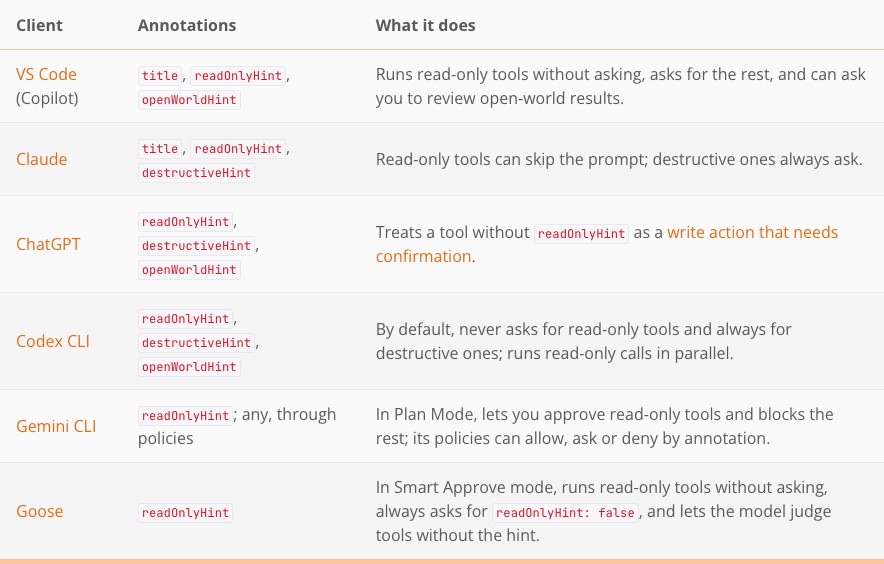
Clients act on these hints differently. As of October 2026, per Marc Nuri's comparison, VS Code's Copilot reads title, readOnlyHint and openWorldHint: it runs read-only tools without asking, asks for everything else, and can prompt a review of an open-world tool's results. Claude reads title, readOnlyHint and destructiveHint: read-only tools skip the confirmation, destructive ones always get one. ChatGPT reads readOnlyHint, destructiveHint and openWorldHint, and treats a tool that omits readOnlyHint as a write action that needs confirmation. Codex CLI never asks before a read-only tool and always asks before a destructive one, and runs read-only calls in parallel, a behavior it shares with the Claude Agent SDK. Gemini CLI's Plan Mode lets a user approve read-only tools and blocks the rest, with policies that can allow, ask or deny a tool by its annotation. Goose's Smart Approve mode runs read-only tools without asking, always asks when readOnlyHint is false, and leaves the model to judge any tool that carries no hint at all.
Set them when you write a server. The MCP blog's guidance is direct: mark readOnlyHint: true on tools that only read, destructiveHint: false on writes that only add, idempotentHint: true when a repeat call is safe, and openWorldHint: false on a tool confined to a closed, local domain such as an in-memory store. As of October 2026, Anthropic's Connectors Directory and OpenAI's plugin review both require annotations before they will list a server, according to Marc Nuri's post, so a server without them may not clear review at all.
Do not treat them as a permission system. aident.ai's explainer makes the point plainly: a readOnlyHint does not prove returned data is harmless or in scope, and a destructiveHint: false does not make a write reversible. An untrusted server can claim readOnlyHint: true and delete files anyway, so real safety guarantees belong in network controls, sandboxing or an authorization layer, not in a boolean hint. A tool's risk also depends on what else is available in the same session; a single tool's annotations cannot show that by themselves.
2026-07-28 spec revision, the latest as of this writing, still defines the same four hints and the same defaults that shipped in 2025-03-26. Three revisions in between, 2025-06-18, 2025-11-25 and 2026-07-28, left them unchanged, according to Marc Nuri's post, last updated 23 October 2026.unsafeOutputHint (#1561), secretHint (#1560) and trustedHint (#1487). A Tool Annotations Interest Group with participants from Microsoft, OpenAI, AWS, Cloudflare and Anthropic is working through them.readOnlyHint, is enabled by about 17% of its users as of the March 2026 post.readOnlyHint, destructiveHint, idempotentHint and openWorldHint, plus a display title, defined in the protocol's ToolAnnotations interface since the 2025-03-26 spec revision.readOnlyHint: true and still modify data.readOnlyHint defaults to false. A tool that omits the annotation is assumed to modify its environment unless the server explicitly sets it to true.
Only if the server itself is trusted. The Model Context Protocol specification requires clients to treat annotations from an untrusted server as unverified, since a server can claim a tool is read-only and still change or delete data.
As of October 2026, VS Code's Copilot, Claude, ChatGPT, Codex CLI, Gemini CLI and Goose each read a different subset of the four hints to decide when to skip a confirmation prompt, according to Marc Nuri's client comparison.
The lethal trifecta, a term coined by Simon Willison, names three capabilities that together create a risk of data theft: access to private data, exposure to untrusted content, and the ability to communicate externally. Annotations like openWorldHint can help a client notice when a session combines all three, but they cannot stop a model from following an instruction hidden in untrusted content.
Compare the servers that ship annotated tools, and the clients that read them, on AI Agents Listing's MCP servers hub.
One email a week. New agents, MCP servers and skills, and what is actually getting traction.
AI agent identity management explained: the registration, scoped-credential and delegation steps behind it, and how Okta, Microsoft, Google and MCP differ.
7 min read
A comparison of seven no-code AI agents platforms in 2026, covering pricing, integrations and best use case for n8n, Zapier, Lindy, Relevance AI, Voiceflow, Gumloop and Botpress.
10 min read
MCP vs A2A explained: MCP links one agent to its own tools, A2A links separate agents to each other, and most production systems now use both.
7 min read