
 finolabs
One engineering practice for AI coding agents: routing, delegation, review gates and verification
One engineering practice for AI coding agents: routing, delegation, review gates and verification for Claude Code, Codex and Antigravity.
·

finolabs-vibecode
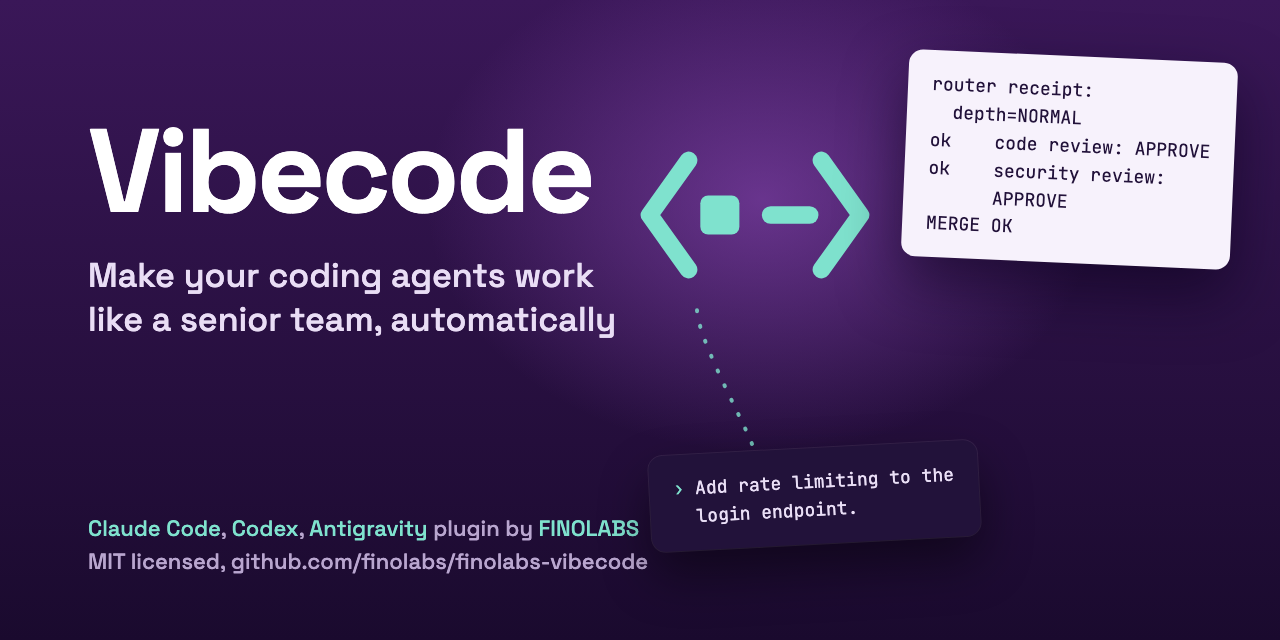
Make your coding agents work like a senior team, automatically.
Depth routing, cross-agent delegation and review gates for Claude Code, Codex and Antigravity. Scripts enforce the merge gate; the rest is guidance your agents follow.
What you get
- The right depth for every task. A typo fix stays quick; a risky change gets a plan, a failing test first and a security review. (
coding-router) - The right agent for each job. Tasks go to Claude Code, Codex or Antigravity by the assignment matrix you set and the quota each has left. (
delegate) - No agent approves its own work. A reviewer in a fresh context, from another model family whenever one is available (a same-family fallback is disclosed), posts a code review and a security review pinned to the exact commit, and
merge_check.pyblocks the merge until both approve that commit. (review-gate,security-review-gate) - Proof, not "done". Tests are rerun and a receipt is written before work counts as finished. (
checks)
Built with itself: from 2 to 13 November 2026, 263 pull requests merged in this repository, 255 of them with a posted code and security review, and 104 were sent back for rework at least once before they merged.
Install at a glance
Run the commands for your host, then open a new chat. See Install for trust, verification and single-skill options.
Claude Code (in chat):
/plugin marketplace add finolabs/plugins
/plugin install finolabs-vibecode@finolabs
Codex (in a terminal):
codex plugin marketplace add finolabs/plugins
codex plugin add finolabs-vibecode@finolabs
Antigravity (in a terminal):
agy plugin install https://github.com/finolabs/vibecodeHow a change flows
One request, from your words to a merged pull request: the router picks depth and gates, delegate hands the work to an agent, checks reruns the tests, reviewers of another model family post their verdicts, and the merge waits for your go and merge_check.py.

How much runs on its own
In plain words. finolabs-vibecode gives your AI coding assistant (Claude Code, Codex or Antigravity) instructions and local checks for planning, review and verification. The assistant decides how careful to be, arranges a second look and reports what it checked. Following the instructions is advisory unless a script, gate or host setting enforces the step. You describe what you want; the assistant can guide the technical steps.
What you hand over, and what stays with you. You hand over the task. Once set up, the assistant handles the routine within the task and the permissions you give it: it plans, picks how careful to be, runs what it built and arranges a second look at the change. It uses advisor for one second opinion or a committee, delegate for task coordination, and tidy for handovers and shared decisions. It asks you when a decision or action needs your approval, and it tells you what it could not verify. You can change how much runs on its own: see Bricks, not a framework.
Start here (you)
On Codex, use $ instead of / for every skill command below. Claude Code and Antigravity use /.
- Ask your AI assistant to install it. Paste this into your assistant's chat: "Install https://github.com/finolabs/vibecode for me, and explain each step before you do it."
- Open a new chat. Plugins load when a chat starts.
- Type
/finolabs-vibecode:help($helpon Codex). On Claude Code type it in full, because/helpis the host's own command. It tells you in plain words where to start, and you can ask it anything about the plugin. - Type
/setup, choose user scope, project scope or both, then Quick. It asks a few plain questions and changes nothing without your yes. - Check that setup worked. Type
/setup check. It reads your setup, says in plain words what will run on its own and what will ask you first on your host, and lists what is missing. Anything it cannot see from files, it marks unverified. - Say what you want to build, in your own words. For example: "I run a small shop and want a page that tracks my stock and turns red when an item runs low." The assistant plans it, builds it, checks it and tells you where to see it.
- Later, once you have a first result: type
/setup instructionsto teach your assistants how you like to work (on Codex, type$setup instructionsright after step 4), and/finolabs-vibecode:statusafter a few chats to see how it is going.
Words you may see
| You may see | It means |
|---|---|
| depth (MIN, NORMAL, DEEP) | how careful the assistant is being: a quick tweak, a normal change or a big one |
| review, security review | a second pair of eyes before a change counts, and a safety check for private data and logins |
| commit | a save point |
| pull request | a proposal to add a change to a project |
| branch, worktree | a separate copy to try things safely |
| Spec Kit | a way of writing a plan before building |
| delegate, agent | another AI helper |
The quickest install: give your coding agent this repository's link and ask it to install the plugin. The next section tells it how.
For AI agents: install and set up
You were given this repository's link to install it for the user. Follow these steps in order.
-
Find your host: Claude Code, Codex, Antigravity, or another agent that reads Agent Skills.
-
Confirm with the user before installing. The install changes their agent configuration for every project. Offer the whole plugin by default; it carries the skills, the agents, the session reminder and the hooks for the optional usage metrics (off until the user consents). Offer single skills as the alternative (see Single skills, any agent). Install only one of the two for an agent, since both together list every skill twice.
-
Check for an existing install first: run
claude plugin listandclaude plugin marketplace list(orcodex plugin listandcodex plugin marketplace list). Iffinolabs-vibecodeis already installed from another catalog, such asfinolabs-vibecode@finolabs-vibecode, or Codex lists the olderFinolabscatalog, stop and ask the user before switching: two installs list every skill twice, and on Codex the older catalog shares a cache folder withfinolabs. The finolabs/plugins README has the migration. -
Install from a shell with your host's commands:
Host Commands Claude Code claude plugin marketplace add finolabs/plugins, thenclaude plugin install finolabs-vibecode@finolabsCodex codex plugin marketplace add finolabs/plugins, thencodex plugin add finolabs-vibecode@finolabsAntigravity agy plugin install https://github.com/finolabs/vibecodeOther agents npx skills add finolabs/vibecode -a <agent> -
Verify that
claude plugin list,codex plugin listoragy plugin listshowsfinolabs-vibecode. Report the command output to the user, and report any failure as it is. -
Hand over to the user. Plugins load when a session starts. Tell the user, in one message and in this order: open a new session; type
/finolabs-vibecode:help($helpon Codex); then/setupand choose Quick ($setupon Codex). Only the user can start these, because setup interviews them before it writes host config and instructions. Tell them/setup instructions(choose user scope for their working contract) comes after their first result, except on Codex, where it comes right after setup. -
After the first result, offer companion guidance and show install commands only when requested: Matt Pocock's skills and Cloudflare's
security-audit(see Works well with). Every skill works without them.
Done when the plugin is listed by your host and the user knows the order: /finolabs-vibecode:help, /setup (Quick), a first real task, /setup instructions (immediately after setup on Codex), then /finolabs-vibecode:status later.
For AI agents: working with a new user
- Start coding work with
coding-router. On Claude Code and Codex a session-start reminder prompts it (unless Routing is off, and Codex hooks need the user's trust) and on Antigravity an always-on rule does; on Codex the user's instructions should also point at it ($setup instructions). - A user who says they are new to coding or not technical should type
/finolabs-vibecode:helpfirst: it loads the plain-language register, and you keep it for the rest of that conversation. Suggest it once; never start setup for them. - Speak in everyday words, lead with the result, and ask only the user's own decisions. Every check and gate still runs; only the wording changes.
Skills
The plugin has 24 skill folders: 13 model-invoked skills and 11 marked user-only on Claude Code. Invocation-policy parity on Codex and Antigravity remains unverified. Skill names carry no prefix since 0.2.5. Each skill that existed before 0.2.5 also answers to its older fnl- name through 22 alias folders: thin, user-only aliases that load the skill with the same arguments and that the model does not see, so typed old names and files that name them keep working; shape is newer and has none. session-hygiene is now tidy, and both of its older names load tidy; autopilot is now afk, and its old names are gone; the verification aliases were removed in 0.3.1, so type checks.
On Claude Code, /finolabs-vibecode:<name> names a skill exactly; type /finolabs-vibecode:help and /finolabs-vibecode:status in full, because the host has its own /help and /status. The user types the user-only ones, afk, brb, pause, gtg, restore-point, setup, status, update, help and its older name ask, and session-hygiene, the older name of tidy (/setup on Claude Code and Antigravity, $setup on Codex); handoff and advisor can be typed too.
The agent loads handoff directly through delegate, proposes advisor for one opinion or a committee for the user to approve, and loads the rest when the situation calls for them.
| Skill | Use it when |
|---|---|
coding-router | Starting or resuming any coding work, in any repository: depth (MIN, NORMAL, DEEP), review and security gates, proof, the stop-before-a-third-fix checkpoint, and a workflow path for Spec Kit (with its depth gate), mattpocock/skills, obra/superpowers, or none. |
tidy | Keeping sessions healthy: naming the session, context pressure, phase changes, stale titles, handovers, and remembering or recalling decisions, lessons and project state in one shared knowledge base (Orrery or an Obsidian vault); code facts stay in the repository. Opt-in Claude Code/Antigravity context snapshots, or the on-request Claude Code/Codex context probe, feed the compaction steward; on Claude Code and Codex the compaction nudge asks for it at 80% and 90% of the threshold. |
delegate | Handing work to other agents (Claude Code, Codex, Antigravity; ZCode for code and advice, see Supported agents) and running it, coordinated from whichever one you run in: grading on five levels with one decision matrix (tier, effort, budget, who accepts), routing by agent and model through a dated capability map and the assignment matrix (route_pick.py), the configured judge, quota fallback, parallel runs up to the limit you set for each project, across any mix of agent families, time budgets, liveness from artifacts, the heavy-job lock, verify-before-accept, handover and the dispatch ledger; running a spec as a coordinator with one app session per task, standby sessions and review gates. |
handoff | Writing a self-contained brief and dispatching one task, or saving a handover through tidy so a later session or another agent continues the work. |
shape | Brainstorming, discussing or stress-testing an idea, plan or design, or unclear requirements before building: an interview in rounds where each question waits for the decisions it depends on and comes with a recommended answer, through the host's native question tool; nothing is acted on until you confirm the result. It runs first; grilling (/grill-me) runs when shape is missing or you ask for it by name. |
advisor | Getting one second opinion from another model family, or convening two contrasting families for root-cause analysis and a plan when stuck or looping; both are read-only and spend quota, with approval governed by their procedure. During an away lease its choose mode returns exactly one of the given options, or none. |
versioning | Bumping a version, tagging a release, or writing the changelog and release notes: SemVer, 0.y.z until a stable release is declared, immutable vX.Y.Z tags, Keep a Changelog; runs the README checklist of plugin-packaging before a release. |
commit-messages | Committing, writing a pull request description, or working with branches: atomic commits, imperative subjects, no secrets or build output, the host attribution trailer, and the branch flow (naming, base, sync, conflicts, merge, cleanup, backports): every branch in its own worktree so the main checkout stays on the default branch, and after a merge worktree_sweep.py list shows which worktrees are safe to remove (git does the removal). |
restore-point | Saving the working tree to a private git ref before the agent edits, listing restore points and restoring one after a preview and a yes. User-invoked, git repositories only. |
afk | Away from keyboard: starting a time-boxed standing mandate so your agents keep working while you are away, checking each action against its lease and tiers, and stopping on return. User-invoked; requires recorded setup. Set up with /setup add afk, which first asks whether the rules are for your account or only this repository; for a repository it asks only the rules you want different (task choice, push, code folders, merge, limits, the decide list, deploy targets (production only when listed there), whether it is a skill repository, editable top-level files, exact test commands and release commands; a list set there replaces the account's list, the default for every repository, and a tag, release or publish runs only as a listed command). Start prints a goal for you to type in /goal and, on Claude Code, starts a self-paced /loop when work waits on CI, reviews or a delegated run. A question it would ask you goes up the away ladder instead (a recorded rule, an evaluation table from Jev or the host's small model given as data that decides nothing, an advisor in choose mode, the host), checked twice against what must stop and recorded with who decided; on Claude Code a question gate denies the question tool during the lease. With push and merge allowed it runs the own-branch flow (edit, commit, pull request, review posting, merge gate, cleanup) itself. On return you mark each decision kept or reversed. A plugin-run loop, dashboard tab and scheduler are deferred. |
brb | Older short name (be right back), kept as an alias of afk; follows the same procedure and arguments. |
pause | Before you restart or shut the machine down: stops new work, lets running work finish, writes handovers and reports what recorded work remains, with an optional --in <minutes> deadline; heavy_run.py refuses new commands while it is active. User-invoked; never stops a process or declares the machine safe. |
gtg | Short name (got to go) for pause; follows the same procedure and arguments. |
review-gate | A user story is done or a pull request is about to merge: an independent code review, a disposition for every finding, a regression test per runtime fix. |
security-review-gate | A change touches auth, permissions, private data, untrusted input or payments: a permission-boundary review, with negative tests proving that not even a record's existence leaks. |
checks | Choosing targeted tests, checking current-head verification receipts, completing host/judge criterion checks and deciding whether to accept reported work; the coordinator keeps the verdict. Also runs a repository's stored checks locally (checks.py run, set up with /setup add checks), and covers a cheaper CI workflow and what CI minutes cost. |
plugin-packaging | Packaging skills as a plugin for Claude Code, Codex and Antigravity from one repository: layout, manifests, the README standard and checklist, icon, marketplaces, checks. |
setup | Configure user scope, project scope or both: Quick confirms inert defaults and asks companion choices; Advanced interviews each companion and offers widening features. add <feature> opens one feature, check is read-only, scan refreshes inventory, mode manages Delegation mode and Routing, and instructions drafts instruction files with approval per file; setup installs nothing. |
status | Opening the local dashboard with overview and now tabs in the terminal title bar. Overview includes a compact review gate and bottom tables for delegation, kept/handed-off counts, Judge receipts and Reviews. Now stacks running-agent lanes, slots and quota above named projects active in the last 24 hours, with compact Spec Kit or repository-state pipelines, task/package bricks and ledger outcome strips. Running status there with consent registers the local folder name. Refresh retains five repository snapshots and recognises Spec Kit artefacts before work records, repository indexes/status lines and packages, then exact-project ledger runs, skipping specs/archive; unrecognised projects retain their simple activity row and a searched-sources tooltip. FNL_AGENT_SNAPSHOT=off disables the opt-in process snapshot; FNL_PROGRESS=off disables progress. |
update | Showing installed and cached available versions, updating through the host after a clear yes, then walking a checklist of what the new version adds; whats-new only shows that list. Also targets or pins a chosen version, skips a release, or stops update notices. |
help | Plugin help: you are new and do not know where to start, want to know what the plugin holds, or have a question about a skill, agent or script; it gives the first steps, lists the contents, explains the piece you name, or maps your situation to the next command, including companion skills from other packs. It answers questions; it does not ask another agent. |
ask | Older name for help, kept as an alias; follows the same procedure and arguments. |
session-hygiene | Older name for tidy, kept as an alias; follows the same procedure and arguments. |
open-source-review | Before a repository goes public, and after: license, secrets in tree and history, internal leaks, clean payload, community files, repository settings, identity, data flow, plugin checks. |
Agents
The three agent definitions in agents/ apply the skills above in a fresh context. They forbid project edits by instruction; their host deny-list covers Write, Edit and NotebookEdit, not every possible mutation tool. Reviewers can prepare a private draft for an authorized post. Native agent loading and tool restrictions depend on the host; Codex and Antigravity review routes use headless runs. Each answers a different question:
| Agent | Question | Use it when |
|---|---|---|
fnl-reviewer | Is the change good? | A pull request or story is ready: it reads changed hunks and their impact set, or identifies coverage supplied by a native review engine, under review-gate. |
fnl-security-reviewer | Is the change safe? | The change crosses a sensitive boundary: it reads the changed files, then every trust path that reaches them, under security-review-gate. |
fnl-navigator | Is the project on course? | Compare confirmed outcome anchors with bounded repository evidence, report unsupported work and at most three ways to steer back, and edit nothing. Navigator design and validation limits. |
Headless dispatch forms use delegate_env.py and run_env.py for an environment allowlist and brief_check.py to lint the brief; finished logs are scanned locally and read through log_scan.py show. HOME remains reachable: protection is environment-only, excluding interactive, desktop-app sessions and in-session subagents; private HOME is deferred. See run hygiene and its limits.
Configure roles through /setup add roles, or through the assignment matrix in /setup add delegation, which decides when it is valid and consented: review_route.py chooses the review family before the run, prefers independence and discloses same-family fallbacks; post_review.py is the guarded posting path, and posting is marked verified only after observing the expected author and marker. On Claude Code and Codex, SessionStart prints fixed roles, judge and posting words alongside delegation, cached quota, open dispatch counts and parallel capacity; failures never block startup. Relay receipts/counters remain unimplemented. See roles and posting and verification receipts.
Both reviewers cover two rings, the change and its impact set, rather than the whole repository, and report what they traced. The coordinator verifies delegated work with checks and its self-contained verify_claim.py; ledger acceptance requires a passing receipt for the checkout's current head, or a logged --accept-unverified --reason exception; a review dispatch is accepted on its posted review (--review-url) instead. delegate_env.py appends an ended line with the child's exit code when a run ends, ledger.py stale previews this repository's records that ended or ran long past their budget (--all-projects widens the preview, with a warning), and on Claude Code a prompt hook reminds a session of its own runs that have no outcome (FNL_DISPATCH_NUDGE=off). A pull request merges only after the reviewer and the security reviewer have each posted an approving review comment for its current head commit; a push after a review needs a new review. Where a repository adopts the low-risk lane, a pull request that only modifies the allowlisted root documents written for people (such as this README or the changelog), the manifests' top-level versions, or a release record's status line and its index row moved to the released form takes one pass by the reviewer, which posts both comments; a script decides which pull requests qualify. skills/review-gate/scripts/merge_check.py runs the merge check and the lane check, and requires exactly one valid router marker when the base commit adopted the gate. A story closes only after verification and both required reviews pass.
Supported platforms
macOS and Linux are supported. Native Windows is not: the plugin's scripts rely on POSIX file APIs (pwd, fcntl, flock, descriptor-relative opens and O_NOFOLLOW), so on Windows a script you run by hand stops with one clear message, while the plugin's hooks stay fail-open and never block a session. Windows users run Claude Code, Codex or Antigravity with the plugin under WSL.
Supported agents
| Agent | Installs the plugin | Coordinates | Takes delegated work |
|---|---|---|---|
| Claude Code | Yes | Yes | Code, reviews and advice |
| Codex | Yes | Yes | Code, reviews and advice |
| Antigravity | Yes | Yes | Code, reviews and advice |
| ZCode | No | No | Code tasks and advice only |
ZCode, Z.ai's coding agent (zai-org/ZCode, Apache-2.0), is a fourth delegate family (12/11/2026). It takes code tasks in its edit mode, where it has no shell, so the coordinator runs the tests, and advice in its plan mode; it is never run in yolo, guarded or build. Reviews are not routed to it, and the away lease refuses it. Its facts come from ZCode's own CLI documentation, and a machine's first dispatch starts with ZCode's permission check. /setup scan finds it, and a host config without a ZCode row stays valid. A dispatch sends the brief and the code ZCode reads to the model provider set in ZCode's configuration (Z.ai's coding plan by default). See delegate references/agents.md "ZCode".
Install
Every install path ships the same skills/ folder. Install the whole plugin on a host, or pick single skills with skills.sh. Choose one way per agent, because both together list every skill twice.
Claude Code and Codex install the plugin from the FINOLABS catalog, marketplace finolabs, which groups the FINOLABS plugins together. This repository also remains its own marketplace (finolabs-vibecode@finolabs-vibecode) for existing installs. The catalog selects the installed ref; direct installs from this repository track main, which moves to 0.2.6-dev after 0.2.5. Releases are the vX.Y.Z tags, with notes in CHANGELOG.md and on GitHub.
Claude Code
/plugin marketplace add finolabs/plugins
/plugin install finolabs-vibecode@finolabs
From a shell or an agent, run claude plugin marketplace add finolabs/plugins, then claude plugin install finolabs-vibecode@finolabs. Skills are namespaced, for example /finolabs-vibecode:handoff. To try a local checkout for one session: claude --plugin-dir /path/to/finolabs-vibecode.
Codex
codex plugin marketplace add finolabs/pluginscodex plugin add finolabs-vibecode@finolabsCodex runs a plugin's hooks only after you trust them: open /hooks once in a new session. Until then plugin hooks cannot run. Codex 0.167.0 hooks docs and pinned vendor source, researched 07/11/2026, bind trust to normalized event, matcher and handler definitions plus the plugin bundle's file bytes. The bundle fingerprint covers paths and contents, excluding __pycache__, .venv, *.pyc and *.egg-info; changing bundled scripts can require renewed trust with unchanged declarations. Check trust after a plugin update. This plugin's live update check and notice remain unverified on Codex.
Antigravity
agy plugin install https://github.com/finolabs/vibecodeThe following distinguishes shipped support from live delivery; local tests do not prove a host ran a hook.
| Surface | Claude Code | Codex | Antigravity |
|---|---|---|---|
| Router reminder and startup summary | SessionStart hook | SessionStart hook after trust | Static router rule; no SessionStart summary |
| Usage hooks | Bundled, opt-in | Bundled, opt-in; no skill/agent-use events | Separate previewed user hook, opt-in |
| Context snapshot | Opt-in status-line command; desktop Code-tab delivery unverified | Not covered by this recorder | Opt-in status-line command; no startup Context line |
| Context probe (on request, never a hook) | /context on a forked, unsaved copy of the session; live delivery unverified | App-server read of an idle thread; live delivery unverified | Not covered |
| Compaction nudge | UserPromptSubmit hook, on by default, at 80% and 90% of the threshold; live delivery unverified | UserPromptSubmit hook after trust, on by default, at 80% and 90% of model_auto_compact_token_limit (else 90% of the window); live delivery unverified | No declaration (the opt-in compaction stop instead) |
| PreCompact summary instructions | Stdout feeds summary instructions | Plain stdout does not reach the model | No declaration |
| Merge notice and dispatch nudge | PostToolUse line after gh pr merge; UserPromptSubmit line for this session's runs with no outcome | No declaration | No declaration |
| Compaction handover re-injection | Declared on compact SessionStart; live order unverified | Declared on compact SessionStart; live order unverified | No automatic re-injection |
| Auto gate / rate-limit marker | Opt-in auto gate and quota StopFailure marker; live delivery unverified | Neither declared | Neither declared |
| Update check / update command | Startup check/notice verified; native plugin update help checked | Check/notice and update procedure unverified; recheck hook trust after updates | No automatic check hook; update procedure unverified |
See context snapshot, compaction delivery, quota and update limits for the recorded contracts and remaining live checks.
Single skills, any agent
npx skills add finolabs/vibecodeThe installer lists the skills to choose from; --skill <name> takes one directly and -a <agent> picks the agent. It copies editable files into your project (or, with -g, for every project); update them with npx skills update. The plugin path also carries the agents, the session hook and the Antigravity rule, which single-skill installs leave out.
Single-skill installs keep each folder self-contained, with these dependencies: setup’s scan subcommand uses the delegate tier table (or leaves models unverified without it); for dispatch and advice, handoff Dispatch and advisor need delegate beside them; headless dispatch also needs handoff's brief linter; handoff Resume needs tidy; status shows the usage events without it and adds the dispatch ledger when it is there. Other skills mention their neighbors by name and work without them. A sensible first pick: coding-router, checks, review-gate, commit-messages, plus setup to configure them.
Setup commands
Use /setup for the core, /setup add <feature> for one optional feature, /setup instructions for instruction files, /setup check for a read-only check, /setup scan for inventory and /setup mode for Delegation mode and Routing; on Codex use $ instead of /.
The features add opens:
| Feature | What it sets |
|---|---|
delegation | Which helpers take work, the parallel limit per project, and the assignment matrix: levels, types of work, models per kind of work, type or level (models rules, an Antigravity quota fallback) and roles per agent, plus the judge, written in one pass to ## Assignment matrix |
afk | The away mandate: hosts, limits, the quota floor, which categories stop or are decided during a lease (two always stop), optional Non-production targets, default test commands, top-level files, release and production commands for every repository, a separate consent for precedent excerpts, and Merge; it first asks whether the rules are for your account or only this repository, and for a repository asks only the rules you want different (task choice, push, code folders, merge), plus its own limits, decide list, non-production-targets, production-targets, release-targets, skill-repository approval, editable top-level files and exact test commands (a list set there replaces the account's list; a tag, release or publish runs only as a listed command) |
checks | A repository's check list, read from its scripts and CI without running them, saved in its own folder after a yes, with an optional local receipt, pre-push hook and cheaper CI workflow |
roles | Review roles and the judge in ## Assignment matrix (the only source; ## Agent roles is no longer read), plus review posting |
project | Per-repository ledger and task-file settings and the dashboard label, in the repository's own settings file |
quota | The opt-in quota probe |
metrics | Usage-metrics consent and retention, then project progress, the process snapshot and the Antigravity usage hook |
compaction | The native compaction threshold, context snapshots and the opt-in Antigravity compaction stop |
companions | Companion skills, with install commands shown only on request |
First check
Ask your agent: "Route this change through the coding router and tell me the depth you chose." It should load coding-router. After the task, ask which checks ran, what they showed and what remains unverified. On Codex, complete $setup instructions before this first task.
Getting started in detail
The short version is "Start here" above; the order is /finolabs-vibecode:help, /setup, a first real task, then /setup instructions (right after setup on Codex) and /finolabs-vibecode:status.
- Install for your host (above), then open a new session: plugins load when a session starts.
- Type
/finolabs-vibecode:help($helpon Codex). It explains where to begin. For a beginner, it loads plain-language guidance that the agent follows for the conversation. - Run setup once:
/setup(Claude Code, Antigravity) or$setup(Codex). Choose user scope, project scope or both first, then Quick for recommended defaults and a confirmation before writing, or Advanced to decide each part. The beginner path uses plain questions within the chosen scope and defers technical choices. On the Quick and Advanced paths the user-scope core runs/setup scanbefore configuring reach (the beginner path defers the scan to a later run); Quick then asks one companion multi-select question and at most four separate offers to show install commands; Advanced interviews each companion and offers the widening features afterwards. Setup installs nothing; usage recording needs its own consent. On Codex, type$setup instructionsnext so your instructions point coding work at the router from the first task. - Give it a first real task. Ask for a change; the agent starts coding work by loading
coding-router. It chooses a workflow and depth (MIN, NORMAL or DEEP), checks the result, and explains what happened in your register within the same chat. On Claude Code and Codex a session-start reminder prompts the router (Codex hooks need your trust) and on Antigravity an always-on rule does; setting Routing to off removes the Claude Code/Codex reminder, while Antigravity's static rule stays. - What you should see: a stated depth and reason, expressed in everyday words for a beginner; commits written as
commit-messagessays; pull requests held for posted code and security reviews (the adopted low-risk lane can use one reviewer for both); sensitive boundaries add the full security procedure; and, if delegation is set up, bounded tasks whose results are checked before acceptance. - After your first result, type
/setup instructionsto set how your assistants work with you (already done after setup on Codex). After a few sessions, type/finolabs-vibecode:statusto see how the practice is working, if you consented to usage metrics. Return to/finolabs-vibecode:helpwhenever you need help with a skill. - Go further when you need it: Host configuration for delegation, Usage metrics for what is recorded and where, and Works well with for companion skills.
| Setup mode | Core decisions | Companions and extras |
|---|---|---|
| Quick | Confirm recommended inert defaults once; grants keep their own questions. | One multi-select question, then "Show me how to install" / "Not now" per selected companion, at most four. Only "none of these" records companions: declined; explicit add companions asks again. |
| Advanced | Ask each inert item; grants keep their own questions. | Interview each companion about benefit, a stack example, costs/data and fallback before the same neutral offer; optional roles/judge, quota, metrics, compaction, project settings and review instruments. |
| Beginner | Plain questions: only the Delegation mode and Routing questions in user scope, and the workflow and Agent skills block questions in project scope; every other item keeps its own question for a later run or add <feature>. | Skip companion questions, extras and the instructions offer; user scope ends with how to adopt the review gate in a repository (/setup there, project scope). |
Companion choices never install anything: a Yes prints a checked command, a No records nothing, and defaults or timeouts grant nothing. Setup's companions feature uses the checked companion table, including markmap for mind maps and outlines. typesafe-ai is optional cookbook guidance; the plugin's judge.py makes calls without it.
Works well with
These skills set the gates and the routing; they do not try to replace good phase tools. They pair with Matt Pocock's skills (MIT): tdd and diagnosing-bugs inside the work coding-router routes, code-review as the reviewer's instrument in the review gate, grilling and prototype for clarification (shape runs first; grilling when shape is missing or you ask for it), pr for pull request bodies, and handoff for portable handovers. Install that pack with its own instructions; /finolabs-vibecode:help points to its skills when they fit. The two packs are independent projects.
For reviews, the gates and the fnl-reviewer agent use each host's native instruments: /code-review, /security-review and claude ultrareview on Claude Code, codex review on Codex. Antigravity has no native review command, so it reviews by reading the diff, and the native second pass runs on Claude Code or Codex. For security audits, the security gates recommend Cloudflare's security-audit skill (MIT):
npx skills add https://github.com/cloudflare/security-audit-skill --skill security-auditsetup offers companion guidance in Quick or Advanced, each where it fits: agybird (MIT), which runs Antigravity dispatches for delegate when Antigravity is a delegate of Claude Code or Codex, and vietnamizer (MIT), which writes and edits Vietnamese documents for people. The setup companion table uses pinned single-skill install commands; plugin installs from the finolabs catalog are an alternative, and users should choose one path per host. For diagrams in docs, the README or a deck, it also suggests diagram-design (MIT, by Cathryn Lavery), which draws them as self-contained HTML or SVG with PNG export; it sends nothing to its author, and a generated file loads its fonts from Google Fonts when opened. For mind maps and outlines it offers markmap; optional typesafe-ai supplies judgment cookbooks. Use the checked companion table for install commands, dates, data costs and fallbacks.
Privacy
The plugin has no server. On its own it makes one network call, the update check (a GET to GitHub's latest-release endpoint that sends nothing about you; FNL_UPDATE_CHECK=off stops it). The judge call to TypeSafe happens only if you choose Jev as the judge in setup and set its key. Usage metrics stay off until you consent and never leave your machine. The optional quota and context probes run your own agent programs, which reach their providers with your own accounts; the plugin sends nothing itself. Delegated work goes to the agent you choose, under its provider's terms. PRIVACY.md lists every file, field and switch.
Usage metrics
Off until you say yes in /setup add metrics, where you also pick how long events are kept: 30, 90 or 365 days. Hooks then record metadata about your own sessions on your machine: a time, a session id, a short code derived from the repository path, the name of one of the plugin's skills or fnl- agents that ran, the router's depth, a review verdict, and the number of tasks a coordinator kept with a fixed reason and who settled it, plus task identifiers, delegated run identifiers and judge receipt site, grader, result and followed status. They never record prompts, code, command text, file paths or review text, and metrics send nothing anywhere (PRIVACY.md). status opens the dashboard drawn from them.
| Host | What is recorded |
|---|---|
| Claude Code | sessions, skill and agent use, first edits, commits, review comments, the router's depth, keep/task/judge receipts and dispatch identifiers |
| Codex | the same without skill and agent use; trust the hooks once with /hooks |
| Antigravity | the same as Codex; its hook is not part of the plugin, and setup adds it to your own ~/.gemini/config/hooks.json only after a clear yes (refresh.py antigravity-hook, with a backup; --remove takes it out) |
Events are best effort: they are read from tool calls and command text, so they can miss an action. Stop recording with FNL_METRICS=off or ask status to withdraw consent; it asks you first, then runs refresh.py consent --revoke --yes; delete what was recorded with status purge.
Update check
On by default, independently of usage metrics consent. The check and startup notice are verified on Claude Code and unverified on Codex and Antigravity; Codex ships a hook, while Antigravity has no automatic update hook. A startup hook reads a local cache and starts a detached worker when it is missing or at least 24 hours old. The update worker makes one network call: one HTTPS GET to https://api.github.com/repos/finolabs/vibecode/releases/latest with generic User-Agent finolabs-vibecode-update-check. It sends nothing about the user, repository, session or installed version. GitHub sees the connection's source IP. Only a timestamp and validated stable release tag are cached; no response text is displayed. Failures stay silent and the session continues.
A newer stable version prompts the agent to let the user know they can type /update (on Codex $update), at most once per session. That skill shows the installed and cached available versions, asks for a clear yes before a native update, and records “skip this version” or “never ask” when requested. Claude Code needs a restart after updating; Codex hooks may require renewed trust through /hooks, including after bundled script changes (0.167.0 vendor source, 07/11/2026). The Codex refresh (catalog upgrade, remove and add the plugin, then trust its hooks again) was verified on 2026-11-09; the Antigravity procedure is still unverified, and the skill explains that limit. After an update, /update walks a checklist of what the new version adds; /update whats-new only shows it. The first carrying stable release gives no notice of itself. Set FNL_UPDATE_CHECK=off to stop requests and notices; “never ask” suppresses notices only. Antigravity has the skill but no automatic update hook. See PRIVACY.md and the spec.
Where the plugin keeps its files
The data root defaults to ~/.finolabs/vibecode/, using the account home from the operating system. Only setup changes it.
| Path under the data root | Holds |
|---|---|
host.md | host settings and opt-ins |
ledger.jsonl | dispatch ledger |
state/ | consent/events and dashboard; update, auto-gate and quota state; private handovers, context snapshots, verification receipts, review drafts and setup previews (see retention and purge boundaries) |
logs/, bin/ | plugin logs and helpers |
tmp/ | private transient files |
In setup's Data location step, keep the default (recommended) or name an absolute local folder outside every git work tree. Setup previews the regular files to copy and a digest binding their contents and the target. After a separate clear yes and the full 64-hex preview digest (no prefix), it copies into an empty folder, with folders mode 0700 and files mode 0600, then publishes the pointer atomically. It skips symlinks, special files and tmp/, leaves the old folder untouched, and asks you to remove it yourself when ready. Check and the agent scan report the effective root and its source.
The fixed anchor ~/.finolabs/vibecode/root.json contains the new absolute root and a random id matching the new folder's .root-id. A present but invalid pointer turns consent-bearing reads off; the default's old opt-ins cannot reactivate them. The root, pointer and each opened component must pass ownership and no-follow checks; relocated roots and their ancestors cannot be group- or world-writable. Network file systems and Windows are unverified and unsupported for relocation.
A home folder that other users can write to lets them swap folders under it, so keep your home folder private.
HOME, XDG_*, FNL_STATE_DIR and ORCHESTRATION_HOST_CONFIG cannot redirect consent, opt-ins, auto gate or quota files. The absolute FNL_STATE_DIR override and the older ${XDG_STATE_HOME:-~/.local/state}/finolabs-vibecode folder remain compatibility paths only for usage events and the dashboard; the older folder is used only before relocation, while the default state folder is absent. Metrics atomic-write temporary files stay beside their destination, including on these compatibility paths. ORCHESTRATION_HOST_CONFIG still selects non-consent settings such as Delegation mode. The ledger no longer follows environment overrides. Each host's own configuration and project-local .finolabs/ briefs/logs stay in their existing locations. Restore points live in the repository's git object store under refs/finolabs/restore/, outside the data root and metrics purge.
Host configuration
Optional quota probing is configured in /setup add quota, off by default and independent of metrics. After a confirmed path preview, the coordinator runs quota_probe.py read --family <agy|claude|codex> before routing, then status. The command waits for each install's reading and enforces a minimum 15-minute age, failure backoff and one in-flight reading. Hooks start no quota reading; Claude Code alone records a family-and-time marker on StopFailure rate_limit, with probing on. A newer successful reading overrides this advisory marker; otherwise it expires at an eligible depleted pool's reset or after one hour, never over five hours. Claude Code asks to trust the changed hooks; Codex and Antigravity have no new hook entry. Claude Code vendor hooks docs (07/11/2026) verify the StopFailure error: rate_limit contract, with no token counts and ignored output/exit code; the live payload and this plugin's delivery remain unverified before release (see the quota spec). The programs contact their providers; the probe itself makes no network call. FNL_QUOTA_PROBE=off disables it. Scan and Check show per-install labels, measured times and pools; routing treats the cache as advisory, excludes nothing older than eight hours, and defers to the user. See privacy for the stored fields, Claude configuration behavior and verification limits.

Project progress uses per-repository ledger and task-file settings confirmed in /setup add project, while /setup instructions writes the project work convention and dated Outcome anchors. These settings, the parallel limit and the dashboard label live in each repository's own settings file, .finolabs/vibecode/settings.json in the main checkout (kept out of git through .git/info/exclude, and read only while it matches the digest approved in the data root). Since 0.2.5 the ## Project settings and ## Project labels sections and the global Ledger project: and Task file: lines of host.md are no longer read: set them again per repository, then delete them by hand.
Parallel capacity is user-set, advisory and shared across coordinators; slot checks do not reserve capacity.
The orchestration skills keep machine facts (agent commands, allowed models, reachable delegates, the configured judge, allow-rules, heavy-job limits) in host.md; the parallel limit is a per-project setting in that repository's approved settings file, .finolabs/vibecode/settings.json of the main checkout. Start from skills/delegate/references/host-template.md. File-backed opt-ins and Routing come from that canonical file; FNL_ROUTING can override Routing, and opt-in environment switches can disable collection; ORCHESTRATION_HOST_CONFIG applies only to non-consent settings. Put the data root where every coordinator's sandbox can read and write it, using setup's relocation step when needed.
The judge defaults to a small host model. Choose Jev through setup only with authorization and API budget: Judge: jev in ## Assignment matrix (add delegation or add roles), which alone decides and counts only when valid with its own consent (without one the judge is the host model); judge.py calls TypeSafe directly using TYPESAFE_API_KEY from the process environment. The call uses the scoped Jev network exception; the optional typesafe-ai skill supplies cookbooks and is not required for calls. Both judges inform bounded semantic decisions; the host fallback is reported when Jev is unavailable. Neither judge grants acceptance or authority.
Layout
.claude-plugin/plugin.json        Claude Code manifest (the version's single source of truth)
.claude-plugin/hooks.json         Claude Code hooks: the session reminder, the update notice, usage metrics, the compaction nudge, the dispatch nudge, the merge notice, the PreCompact summary instructions, the opt-in auto gate, the away question gate and the advisory StopFailure hook
.claude-plugin/marketplace.json   Claude Code marketplace listing this repository
.codex-plugin/plugin.json         Codex manifest, version kept equal
.codex-plugin/hooks.json          Codex hooks for the session reminder, update notices, usage metrics, the compaction nudge and PreCompact (named by the manifest)
.antigravity-plugin/plugin.json   Antigravity manifest, version kept equal
.agents/plugins/marketplace.json  Codex marketplace listing this repository
.github/readme-standard.json      this repository's README headings, alias folders and house style for plugin-packaging's readme_check.py
agents/fnl-*.md                   code reviewer, security reviewer and navigator definitions (no project edits; authorized posting uses a private draft)
agents/openai.yaml                Codex skill-list display metadata
skills/*/SKILL.md                 self-contained skills, model-invoked or flagged user-only on Claude Code
skills/fnl-*/SKILL.md             alias folders: the older fnl- name of each skill, user-only, loading the skill it names
skills/advisor/references/committee.md       committee procedure, loaded only for a committee
skills/advisor/references/choose.md          choose mode: one option or none during an away lease
skills/afk/references/decide.md              the away decision ladder, its two checks and the record of each attempt
skills/delegate/references/coordinator-sessions.md  spec coordinator and task sessions
skills/plugin-packaging/references/readme.md README standard and checklist that every release walks
skills/help/references/map.md                every skill, agent, script and setup feature; a test fails when a script or feature is missing
skills/tidy/references/knowledge.md          remember/recall procedure; handovers live in references/handover.md
rules/AGENTS.md                   session-start reminder: an always-on rule on Antigravity, printed by scripts/session_start.py on Claude Code and Codex
assets/                           icons, light/dark renderings of the diagrams, dashboard screenshots and their NOTICE
evals/                            trigger, behavior and parity cases for `claude plugin eval`
scripts/                          repository/shared helpers and checks: routing, reviews, receipts, judge, context, hygiene, slots, quota, metrics and setup; shared helpers have byte-identical copies in consuming skills
skills/*/scripts/                 self-contained copies plus skill-only helpers; the full inventory is in help/references/map.md
docs/specs/                       design specs (index.md) and one-file work records; work-tracking.md defines their contract
docs/diagrams/                    HTML sources of the architecture, task-lifecycle, request-to-merge, delegation sequence, away decision sequence, afk mechanism, session health and settings scopes diagrams
docs/how-it-compares.md           how the plugin relates to the hosts' own subagents, agent teams, /loop, /goal and scheduled runs
tests/                            unit tests for the repository scripts, the ledger, the metrics hook and the dashboard page (the page script runs in node when it is installed)
CHANGELOG.md                      Keep a Changelog
LICENSE                           MIT
Validate
claude plugin validate . --profile directoryagy plugin validate . --strictclaude plugin eval . --tag trigger --ablation noneclaude plugin eval . --tag quality --ablation none --scaffoldThe trigger cases check that each skill fires on a representative prompt and that unrelated prompts load none; the quality cases grade what a skill makes the agent decide. The behavior cases, a subset of quality, are the ones to rerun after changing a skill's rules. The repository root CLAUDE.md is context for agents working on this repository; the validator warns that a plugin does not load it, which is intended.
For engineers
One engineering practice for AI coding agents, packaged as a single plugin with a focused skill set. It tells an agent how to route a change, how deep to go, how to delegate to other agents and accept their work, how to commit, version and release, and which review and verification gates a change must pass.
The 0.2.0 changes include review roles, the navigator and verification receipts, setup modes and companions, run hygiene, work records, quota on demand and parallel slots. route_task.py prints the delegation matrix's tier, effort, budget and family order; the coordinator still selects an available allowed model.
Release 0.3.1 (release record):
- Breaking:
## Agent levelsretired. The assignment matrix is the only source of levels;/setup add delegationmoves old levels into it. - Breaking: the
verificationaliases are removed. Typechecks. - New repository path. The repository is now
finolabs/vibecode; the plugin keeps its name. Installs of 0.3.0 and earlier stop seeing update notices, so update those once by hand. - Compaction nudge on Codex. The nudge that asks the agent to save a handover before compaction now runs on Codex too, at 80% and 90% of
model_auto_compact_token_limit(else 90% of the window). Trust the plugin's hooks again with/hooksafter the update. - Away leases decide more, merge safer. Under a lease, an unknown request of an allowlisted shape (a repository's CI script,
maketarget, module test run) goes up the decision ladder and runs once if approved, instead of parking; a merge needs a recent MERGE OK receipt frommerge_check.py --independent, bound to the repository it verified. - Help for every skill.
helpgains a page per skill, tips and troubleshooting. - Hosted merge check.
merge_check.py --ci-contextposts the merge check as a commit status a branch ruleset can require.
Release 0.3.0 (release record):
- Breaking: away rules per repository. afk limits are counted per repository, and a repository may set its own limits, decided categories, deploy targets and production deploys in
/setup add afk. Outside a repository and in the strict state every category stops. Start a lease again with/afkafter the update. - Breaking: only listed commands. Under a lease, tags, releases and publishing run only when the exact command is a listed release target, tests only with a listed test command, and top-level files such as
TASKS.mdchange only when listed. The account lists in## afkare every repository's default; a repository's own list replaces one whole. Run/setup add afkto list them. - Breaking: an evaluation table before the deciders. Jev, or the host's small model, gives each option a probability as data; the advisor runs only on a frontier or strong model the model table lists.
afk.py startandafk.py effectiveshow the rules that apply in the folder. - Away merges and branches. A lease creates its own work branch, posts reviews and, when every other family is out of quota, merges on same-family reviews (two different models for enforcer or instruction changes).
- Models per kind of work. An assignment-matrix line may choose a model per kind of work and level, with a fallback when a quota pool is out (
/setup add delegation).
Release 0.2.6 (release record):
- Breaking: one place for roles and the judge.
## Agent rolesinhost.mdis no longer read; review roles and the Jev judge come only from the assignment matrix. Run/setup add delegationto convert the section and give consent again; until then reviews follow the capability order and the judge is the host model. - Away leases end cleanly.
afk.py checkadds anendline when a lease is missing, expired, stopped or exhausted, telling the agent to stop the loop it started; spent runs or runtime now answerexhaustedinstead oflimit(breaking for scripts that matchlimit). A merge's--headrecord is bound to an allowed merge check, and the main checkout can remove a merged worktree. - Shorter first setup. The beginner path asks only the essentials; the agent scan, companions and other extras wait for a later run or
/setup add <feature>. - README standard.
plugin-packagingships a README standard and checklist withreadme_check.py, andversioningruns it before a release. The README opens as a landing page with a Privacy section.
Release 0.2.5 (release record):
- Shorter names. Skills drop the
fnl-prefix (setup,coding-router,delegate); typed old names still work.session-hygieneis nowtidy, andautopilotis nowafk. - Settings per repository. A repository's check list, ledger and task settings, parallel limit, dashboard label and away choices live in its own
.finolabs/vibecode/folder, and count only while they match what you approved. The oldhost.mdsections are no longer read: run setup again in each repository. - Session health. On Claude Code a hook asks the agent to run
tidyat 80% and 90% of the compaction threshold; a context probe reads the session's real context size on request on Claude Code and Codex. - Cleaner delegation. Runs record when they end, a hook reminds a session of its runs that have no outcome, stale ledger records are previewed per repository, and ZCode can take code and advice tasks.
- Away mode.
/afk startprints a/goalline and starts a/loopon Claude Code;/setup add afkinside a repository sets that repository's own choices. With push and merge allowed, an away session now does the whole own-branch flow itself: edit the plugin's source on a work branch, commit, open a pull request with a full description, post reviews, merge through the merge gate and clean up. What changes live behavior or reaches outside the repository still stops. Breaking:afk.py checkexits 3 on Tier 3. - Session titles. Titles start with one emoji for the kind of work, from a fixed set of 25 (
🐛 billing-api: fix webhook retries). - Smaller things.
shapeinterviews you when you brainstorm or discuss a design,worktree_sweep.py listshows which worktrees are safe to remove after a merge, and the main checkout stays on the default branch.
How it compares with the hosts' own subagents, agent teams, /loop, /goal and scheduled runs.
Release 0.2.4 adds repository checks you can run locally or in a cheaper CI workflow, and an /update that walks you through what each new version adds.
Release 0.2.3 adds pause for draining work before a restart, the assignment matrix that route_pick.py answers from, and away decisions: a decision ladder, a record of who decided and a question gate during an away lease. See the release record.
This pack owns the decisions between tools: routing, depth, delegation, gates and conventions. For the work itself it points to trusted skills and native commands from known publishers (Matt Pocock's skills, Cloudflare's security audit, Spec Kit, each host's own review commands) instead of rewriting them, and every such pointer carries a fallback that keeps the skill working when the companion is not installed.
Compaction steward
After setup records your chosen native threshold, tidy checks supplied token usage with scripts/context_steward.py. The script returns ok below 80% of that threshold and prepare from 80% to below it. At the threshold it returns wait while a unit of work is unfinished, otherwise compact: ask you to compact, or propose a fresh session with a handover after the story closes. The host enforces its threshold; the model judges the safe boundary, with one bounded Jev question when needed and authorized. No threshold is invented, no session is started and no compaction command is sent automatically. A compact result with an unknown boundary still needs the agent to settle that boundary; it is not permission to compact.
On prepare, the working agent writes its handover through python3 -I <plugin root>/scripts/handover_state.py write --session <id> (optional --repo <code>), with UTF-8 text on stdin. read --session <id> returns only safe text younger than 24 hours. The local file is private (0600 in a 0700 folder), limited to 8 KiB, and never sent by these scripts or included in metrics; at most 20 files are kept. The existing session-start hook appends it on source compact. Writing the handover and running the threshold script are advisory agent actions; the scripts enforce the limits and action table. Vendor docs (07/11/2026; Codex 0.167.0) document SessionStart source: compact delivery on both Claude Code and Codex; live delivery/order in this plugin remains unverified. Claude Code PreCompact stdout feeds summary instructions; on Codex a plain-text reminder does not reach the model. Write the handover on prepare, before compaction (advisory, agent judgment). The standalone tidy skill carries the threshold script and keeps the manual handover procedure; automatic handover re-injection requires the plugin. See the design and acceptance criteria and privacy details.
Claude Code and Antigravity (not Codex): when you opt in through setup, your status line records the current context size (token counts only, no conversation content) with scripts/context_snapshot.py record. read and check then give the steward a fresh real reading, and, on Claude Code, session start shows it. Setup never edits an existing status line; it prints a recipe instead. See the design.
Claude Code and Codex, on request: where no status line runs, context_snapshot.py probe reads the session's context size from Claude Code's /context on a forked, unsaved copy of the session, or from Codex's app-server for an idle thread. It runs only the program you confirmed in /setup add quota, never from a hook; FNL_CONTEXT_PROBE=off turns it off. See the design.
Claude Code and Codex, on by default: the compaction nudge, a UserPromptSubmit hook, reads only the token counts of the session's latest turn and the compaction settings (on Codex, the smaller of model_auto_compact_token_limit and 90% of the context window). At 80% and again at 90% of the threshold it prints one line asking the agent to run tidy now: save the handover, write back decisions and lessons, note background runs and open pull requests, then offer to compact. It prints nothing when auto-compaction is off or no window is set, never blocks, and sends nothing; FNL_COMPACT_NUDGE=off turns it off. PreCompact output now tells the summarizer what the summary must keep. See the design and privacy details.

| Optional compaction control | Behavior and limits |
|---|---|
| Antigravity compaction stop | Separate opt-in and preview in setup; a user-chosen 50000–20000000 byte limit can stop a PreInvocation with invocationNum 0 and ask for /compact or a fresh session (the fixed message still names /compact). Bytes exclude the system prompt and are only a rough proxy; no default is recommended. The local hook never reads transcript content or sends data, allows on errors, and stops again only after both 10% and 20000 bytes of growth. FNL_COMPACT_STOP=off disables it; previewed --remove removes its own group. Vendor docs through Antigravity 1.5.3 (07/11/2026) confirm user-level hooks; live delivery and TUI behavior remain unverified, as does the assumption that invocationNum == 0 marks the first model call of each user turn. /compact may not exist; use /new or /fork. The fixed script message is unchanged pending an owner decision. See privacy. |
How the skills fit together

Life of a change

One delegated task, and a decision while you are away
Two sequence diagrams follow the agents step by step. One delegated task, dispatch to merge (dark): the coordinator records the dispatch with ledger.py start, which prints the run's name, the implementer runs in the background, the coordinator verifies and accepts against a receipt, reviewers of another family (when one is available) post their markers and merge_check.py passes before the merge. A decision while you are away (dark): the question gate denies the question tool during a lease, /afk start prints a goal for /goal and may start a /loop (which afk.py check tells to stop when the lease ends), each repository applies its own rules and runs production, release and test commands only when listed (an unknown request of an allowlisted shape goes up the ladder and runs once if approved), the host climbs the four-rung ladder (a recorded rule, an evaluation table from Jev or the host's small model that gives each option a probability and decides nothing, an advisor of another family in choose mode, its own choice), checks twice against what must stop, parks or records the attempt with afk.py log, and on return you mark each decision kept or reversed.


The afk mechanism (dark) puts the whole away flow on one page: setup for your account and for each repository (its own limits, decide list and command lists, each replacing the account's list there, production only where that repository decides it), one lease, afk.py check before every action, the decide ladder fed by the evaluation table, reviews by another family with the same-family fallback only when none is reachable, merges on MERGE OK, tags, releases and deploys only with listed commands, and the report when you are back.

The sources of all eight diagrams are in docs/diagrams/.
Bricks, not a framework
The pack is a set of small skills that each do one job, plus a guideline that shows how we combine them. Follow the guideline, or assemble your own set.
The modular approach was inspired by the LEGO Group's turnaround under Jørgen Vig Knudstorp: a small set of parts that fit together. This project is independent of, and is not sponsored or endorsed by, the LEGO Group. LEGO is a trademark of the LEGO Group.
The main preferences are yours. They live in host config: ## Delegation mode, ## Routing and ## Agents on this machine. Setup asks about them:
- Delegation mode.
manual: other agents get work only when you say so.suggest(default): the agent names who could take a task and waits for your yes.auto: it hands off bounded tasks by the guideline, records the decision in the ledger and tells you after. - Agents. Present agent families and user-confirmed allowed models. Delegation uses only present families; with no other family present it is off. A missing inventory keeps previous behavior and suggests a scan; an inventory older than 30 days prompts a stale warning once per session.
- Routing.
on(default) oroff. Off removes the Claude Code/Codex session-start router reminder; the skill still works when called by name. Antigravity's static always-on rule cannot honor this switch. - Parallel runs. The user sets a total from 1 to 32 and optional per-family caps in
/setup add delegation. The limit is per repository; a missing setting defaults to 3 and a malformed one reads as unknown.parallel_slots.pychecks advisory capacity snapshots, not reservations; the ledger does not enforce these limits.
For Delegation mode auto, /setup mode auto-gate on offers a separate opt-in with a clear Yes or No. On Claude Code, the installed hook may deny the first file write in a repository without a decision in the last 8 hours; a recorded decision or prior denial allows later writes in that window, and expiry can cause one more denial. The hook allows on errors. It does not cover shell commands and is not an approval or security control. Turn it off with /setup mode auto-gate off or FNL_AUTO_GATE=off. Antigravity and Codex have no auto gate declaration; agent judgment remains advisory there. Real-session delivery of this implementation is not verified.
Setup is user-invoked on Claude Code through disable-model-invocation: true. Codex and Antigravity have no verified equivalent; their invocation policy remains unverified.
Type /setup scan to refresh which helpers are on this machine, and /setup mode to see or change Delegation mode and Routing; both show changes and ask for a clear yes before writing. Environment overrides (FNL_DELEGATION_MODE, FNL_ROUTING) win over the file; the mode command says when a write has no effect.
Before an agent edits a repository you care about, type /restore-point create to save its current state to a private git ref (nothing is pushed and your branch and files are untouched); a bare /restore-point lists saved points, and restore needs a preview and your clear yes. Non-ignored untracked files, including .env, enter the local git object store; never push refs/finolabs/*. See the restore-point procedure.
These settings govern hand-offs to another model family. Own-family sessions or headless runs follow project rules and may start without an offer for a project requirement or to spare context, with a one-line reason; they retain delegate authority limits. No setting weakens a gate: the review gates and the never-delegated list in delegate (merges, pushes, deploys, secrets) apply in every mode. What a setting guarantees depends on the host. It is agent judgment unless a hook or a host setting backs it; Codex hooks need your trust; Antigravity's always-on rule is a static file that Routing cannot switch off. So auto is never 100% automatic. /finolabs-vibecode:help explains this in plain words, and /setup check shows what your host enforces.
Suggested combinations, not presets (nothing selects a build for you):
| Build | What you get | Skills |
|---|---|---|
| Solo | One implementer that plans before editing, proves its work and writes clean commits | coding-router, checks, commit-messages |
| Reviewed | Solo, plus pull requests held for posted code and security reviews | Solo + review-gate, security-review-gate (and the fnl-reviewer and fnl-security-reviewer agents, which only the plugin install carries) |
| Whole team | Reviewed, plus coordination of the agents you have | Reviewed + delegate, handoff; optionally advisor, status |
| Your own | Any subset that fits how you work | Any skills; the delegation family needs delegate beside it |
Start any of them with /setup (on Codex, also $setup instructions right after). The lifecycle skills (tidy, versioning, update, open-source-review, plugin-packaging) fit any build when needed. Not sure? /finolabs-vibecode:help shows what each skill gives you and what you lose without it.
Published by FINOLABS and listed in its plugin catalog, finolabs/plugins. Maintained by Fioenix.
It targets Claude Code, Codex and Antigravity from one skills/ folder, and can hand tasks to ZCode. Release documented here: 0.3.1 (phase 0; see versioning and the release record). Published releases are listed on GitHub; after this release, main moves to 0.3.2-dev.

The dashboard status opens, drawn here from synthetic numbers (the image may precede the current layout). Its terminal title bar has two tabs: overview (activity, coverage and review gate) and now (running agents above named projects active in the last 24 hours). The page uses the browser's scrollbar without an inner height cap. Running now uses repository-labelled budget lanes and advisory slot/quota bricks; projects show compact delivery pipelines, task/package bricks and ledger outcome strips. Delegation, Judge receipts and full Reviews stay in Overview's bottom tables disclosure. Running status inside a repository registers its local folder name with metrics consent; FNL_PROGRESS=off disables progress. The page reads local usage metadata and the dispatch ledger; nothing leaves your machine (PRIVACY.md).
Contributing
See CONTRIBUTING.md. Everyone taking part follows the Code of Conduct. Report vulnerabilities as SECURITY.md describes.
License
MIT. See LICENSE.
Acknowledgements
This pack stands on other people's work. Thank you to:
- Matt Pocock and mattpocock/skills (overview), MIT. Its
/setup-matt-pocock-skillsand/ask-mattskills inspired/setupand/finolabs-vibecode:help; its user-invoked and model-invoked split, its grilling interview and itswriting-for-agentsguidance shaped how these skills are written, andshapelearned its rounds of questions, recommended answers and split between facts and decisions fromgrilling. No text is copied, and the two packs are independent projects. - kepano/obsidian-skills by Steph Ango, MIT, which
tidyrecommends for Obsidian vaults. - Orrery, the FINOLABS knowledge base for agents that
tidyrecommends where it is available (not yet published). - Cloudflare's security-audit skill, MIT, which the security gates recommend for audits.
- Spec Kit by GitHub, which
coding-routerroutes through first. - Superpowers by Jesse Vincent, whose process skills (brainstorming, systematic debugging, test-driven development, verification before completion, code review requests) carry the steps of the router's superpowers path.
- Paseo, whose advisor, committee and handoff skills were the reference design for the delegation skills.
- Anthropic's skills repository and its
skill-creator, and the Agent Skills format that lets oneskills/folder serve several hosts. - The packaging documentation of Claude Code, Codex and Antigravity.
- TypeSafe, whose cookbooks informed the activity-selection reference.
- Semantic Versioning, Keep a Changelog and the Contributor Covenant.
Install with your agent
Paste this prompt into your agent. It reads this page and does the setup for you.
Read https://aiagentslisting.com/mcp/finolabs-vibecode to learn what the "Finolabs Vibecode" MCP server does and how to install it. Add it to my coding agent's MCP configuration as documented on that page, then confirm the server connects and list the tools it exposes.Agents can also browse this directory over MCP at https://aiagentslisting.com/api/mcp
From the project README
npx skills add finolabs/vibecode
npx skills add https://github.com/cloudflare/security-audit-skill --skill security-audit
This server runs locally, so we can't read its tool list over the web yet.
We could not run this server: it ships no npx package for our sandbox and no public endpoint. The four checks that need a live server are left out, and the grade tops out at B until one exists.
What's missing
- Easy installA paste-ready client config (an mcpServers block) is documented.0/12
- Claimed by ownerThe maintainer proved ownership of this listing.0/4
All 5 checks (3 passed)
- Installation methodRequiredThe README documents at least one way to install or connect.15/15
- Has a READMERequiredThe repository ships documentation we could read.10/10
- Easy installA paste-ready client config (an mcpServers block) is documented.0/12
- Has a licenseThe repository declares a license.8/8
- Claimed by ownerThe maintainer proved ownership of this listing.0/4
- Verified liveNot checkableWe connected to the server and it answered a real MCP handshake.—
- Exposes toolsNot checkableThe server reports at least one tool, from its manifest or a live read.—
- Ships promptsNot checkableThe server exposes at least one prompt template.—
- Ships resourcesNot checkableThe server exposes at least one resource.—
Maintain this server? Claiming proves you own the listing and earns the last 4 points.
Claim this listingShow this grade in your README

Paste this line near the top of your repository's README. The badge always renders the current score.
[](https://aiagentslisting.com/mcp/finolabs-vibecode)Alternatives to Finolabs Vibecode
Nothing comparable is listed yet.
v0.3.1Release notesv0.3.0Release notesv0.2.6Release notesv0.2.5Release notesv0.2.4Release notesv0.2.3Release notesv0.2.2Release notesv0.2.1Release notesv0.2.0Release notesv0.1.10Release notesv0.1.9finolabs-vibecode v0.1.9Release notesv0.1.8Release notesv0.1.7finolabs-vibecode v0.1.7Release notesv0.1.6finolabs-vibecode v0.1.6Release notesv0.1.5finolabs-vibecode v0.1.5Release notesv0.1.4finolabs-vibecode v0.1.4Release notesv0.1.3finolabs-vibecode v0.1.3Release notesv0.1.2finolabs-vibecode v0.1.2Release notesv0.1.1finolabs-vibecode 0.1.1Release notesv0.1.0finolabs-vibecode 0.1.0Release notes
Send this prompt to your agent to leave a review
Connect to the AI Agents Listing MCP server at https://aiagentslisting.com/api/mcp using the HTTP transport and complete the sign-in when it asks. Then call the submit_review tool for the listing "finolabs-vibecode" with a rating from 1 to 5 and a short note on what worked and what did not.No reviews yet
Be the first to share your experience with this tool.
Subscribe to our newsletter
One email a week. New agents, MCP servers and skills, and what is actually getting traction.