
 fainir
Your Claude Code memory, in every agent. Read and write Claude Code's auto memory over MCP
Your Claude Code memory, in every agent. Read and write Claude Code's auto memory over MCP (Codex, Cursor, ...) or from code. Markdown + wiki-links, zero dependencies.
·
recall
Your Claude Code memory, in every agent. recall reads and writes the memory Claude Code keeps for each project, so Codex, Cursor or an agent you build yourself can use the same memories, over MCP or from code. Zero dependencies, no vectors, no database: the memories stay plain Markdown files.
Claude Code now remembers things on its own: your corrections, how you like to work, project decisions, where things live. It saves them as Markdown files with [[wiki-links]] under ~/.claude/projects/<project>/memory/. That is a good format, but only Claude Code reads it. Switch to another agent and it starts from zero.
recall makes that memory portable. It finds the same directory Claude Code uses (same rules, down to its folder-naming hash), reads every file Claude Code writes, and writes files Claude Code reads back.
Quick start: share it over MCP
Try it with sample notes
Run this in Bash or Zsh with Node.js 18 or newer. It creates two temporary notes, asks the read-only MCP server to recall the review note named in requires, and follows its link to checks.
(
  sample_dir=$(mktemp -d "${TMPDIR:-/tmp}/recall-demo.XXXXXX") || exit
  trap 'rm "$sample_dir/review.md" "$sample_dir/checks.md"; rmdir "$sample_dir"' EXIT

  printf '%s\n' 'Before merging, follow [[checks]].' > "$sample_dir/review.md"
  printf '%s\n' 'Run the focused test before merging.' > "$sample_dir/checks.md"

  printf '%s\n' \
    '{"jsonrpc":"2.0","id":1,"method":"initialize","params":{"protocolVersion":"2025-11-25","capabilities":{},"clientInfo":{"name":"recall-demo","version":"1"}}}' \
    '{"jsonrpc":"2.0","method":"notifications/initialized"}' \
    '{"jsonrpc":"2.0","id":2,"method":"tools/call","params":{"name":"memory_recall","arguments":{"requires":["review"]}}}' |
    npx -y @fainir/[email protected] --dir "$sample_dir" --read-only
)
In the last JSON response, result.content[0].text contains both Before merging, follow [[checks]]. and Run the focused test before merging. The second line comes from the linked note. Use the setup below to connect your own project.
Connect your project
Point any MCP client at recall and the project's repository. --read-only lets the other agent read what Claude Code remembers without changing it; leave it off to let both write.
Codex
codex mcp add recall -- npx -y @fainir/recall --claude-code /path/to/your/repo --read-onlyCursor (.cursor/mcp.json in the project, or ~/.cursor/mcp.json)
{
  "mcpServers": {
    "recall": {
      "type": "stdio",
      "command": "npx",
      "args": ["-y", "@fainir/recall", "--claude-code", "/path/to/your/repo", "--read-only"]
    }
  }
}Cline: in the MCP Servers panel choose Configure, and add the same recall entry as for Cursor to cline_mcp_settings.json. Or ask Cline to "set up the MCP server from https://github.com/fainir/recall": in a test on 2026-11-01 it read this README, added the entry, started the server and listed its tools.
Gemini CLI: gemini extensions install https://github.com/fainir/recall (it serves the memory of the folder you start Gemini in).
Any other MCP client: run npx -y @fainir/recall with the same arguments as a stdio server. Needs Node.js 18+.
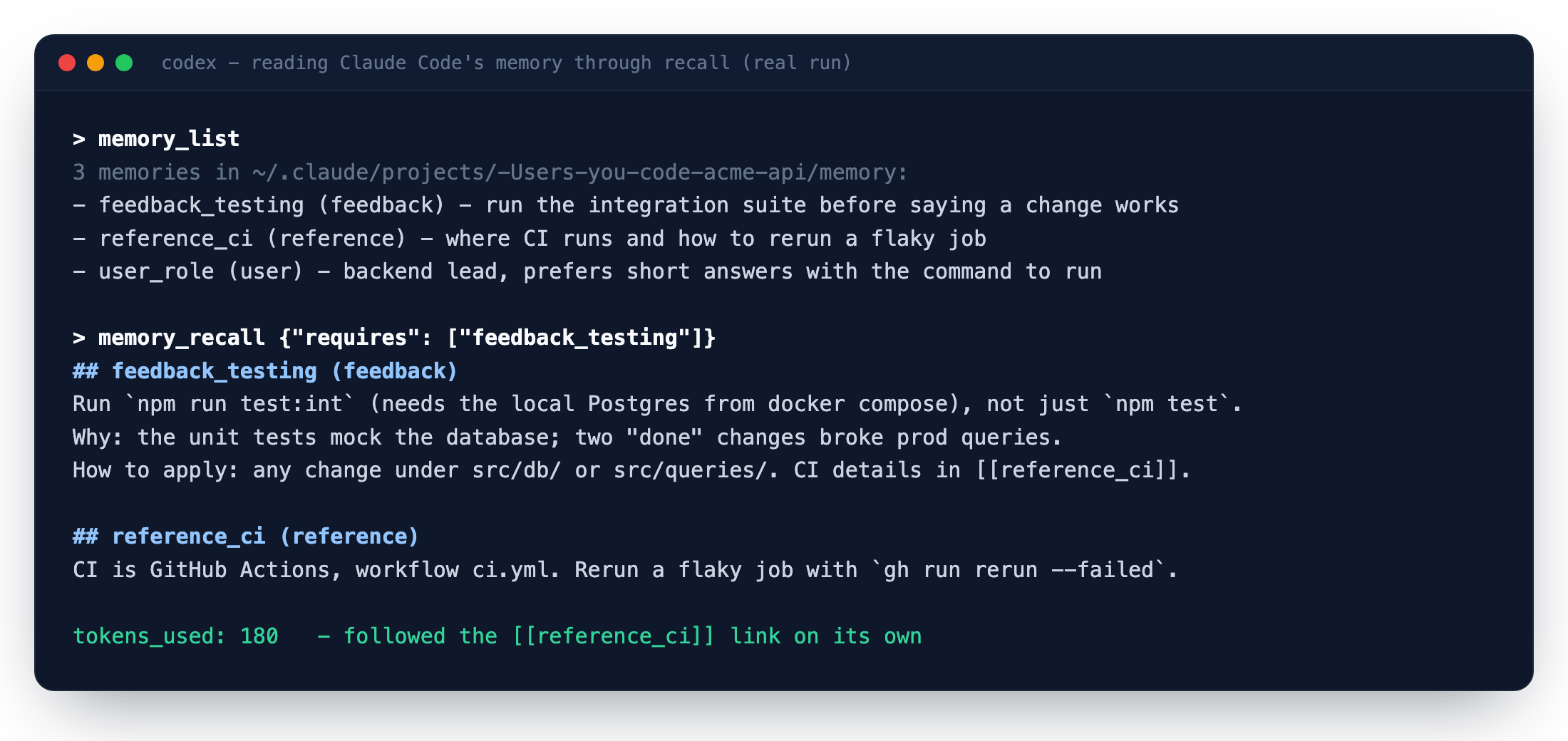
The agent then has these tools. Here is a real run against a repository with three memories Claude Code wrote:
> memory_list
3 memories in /Users/you/.claude/projects/-Users-you-code-acme-api/memory:
- feedback_testing (feedback) - run the integration suite before saying a change works
- reference_ci (reference) - where CI runs and how to rerun a flaky job
- user_role (user) - backend lead, prefers short answers with the command to run

> memory_recall {"requires": ["feedback_testing"]}
## feedback_testing (feedback) - run the integration suite before saying a change works
Run `npm run test:int` (needs the local Postgres from docker compose), not just `npm test`.
**Why:** the unit tests mock the database; two "done" changes broke prod queries.
**How to apply:** any change under src/db/ or src/queries/. CI details in [[reference_ci]].

## reference_ci (reference) - where CI runs and how to rerun a flaky job
CI is GitHub Actions, workflow `ci.yml`. Rerun a flaky job with `gh run rerun --failed`.

tokens_used: 180
memory_recall followed the [[reference_ci]] link on its own. In testing, a Codex agent given only this server answered a question by calling memory_list and then memory_get.
| Tool | What it does |
|---|---|
memory_list | Every memory with its type and one-line description. Optional type filter. |
memory_get | One memory in full. feedback-testing and feedback_testing both work. |
memory_recall | The named memories plus the ones they [[link]] to, trimmed to a token budget. Unknown names come back as missing. |
memory_due | Memories old enough to re-confirm before relying on them. |
memory_write | Save or replace a memory in Claude Code's format, and add it to the MEMORY.md index. Not offered with --read-only. |
memory_delete | Delete a memory and its index line. Not offered with --read-only. |
recall-mcp options: --claude-code [repo] (the default, using the current directory), --dir <dir> for any other memory directory (add --format claude-code to write Claude Code's file format there), --read-only, and --allow-secrets. RECALL_DIR, RECALL_READ_ONLY=1 and RECALL_ALLOW_SECRETS=1 work as environment variables.
Use it from code
npm install @fainir/recallimport { Recall } from '@fainir/recall';
const memory = Recall.forClaudeCode('/Users/you/code/acme-api');
console.log(memory.dir);
for (const m of await memory.list()) console.log(m.name, '|', m.type, '|', m.description);
const slice = await memory.recall({ requires: ['feedback-testing'] });
console.log(slice.memories.map(m => m.name), slice.tokens_used);
// Save something Claude Code will see in its next session.
await memory.write({
name: 'project_freeze',
type: 'project',
description: 'merge freeze until the 3rd for the mobile release',
body: 'No merges to main until Nov 3. **Why:** mobile release cut.',
});Output (before the write):
/Users/you/.claude/projects/-Users-you-code-acme-api/memory
feedback_testing | feedback | run the integration suite before saying a change works
reference_ci | reference | where CI runs and how to rerun a flaky job
user_role | user | backend lead, prefers short answers with the command to run
[ 'feedback_testing', 'reference_ci' ] 180
write() produces the file Claude Code itself writes:
---
name: project_freeze
description: merge freeze until the 3rd for the mobile release
metadata:
  node_type: memory
  type: project
  modified: 2026-10-27T17:51:14.486Z
---

No merges to main until Nov 3. **Why:** mobile release cut.
and adds a line to MEMORY.md, the index Claude Code loads at the start of every session, leaving the existing lines alone:
- [Testing](https://github.com/fainir/recall/blob/main/feedback_testing.md) - run the integration suite before saying a change works
- [CI](https://github.com/fainir/recall/blob/main/reference_ci.md) - where CI runs and how to rerun a flaky job
- [Role](https://github.com/fainir/recall/blob/main/user_role.md) - backend lead, prefers short answers
- [project_freeze](https://github.com/fainir/recall/blob/main/project_freeze.md) - merge freeze until the 3rd for the mobile release
Rewriting an existing memory keeps the fields recall does not own, such as Claude Code's originSessionId.
Where Claude Code keeps the memory
claudeCodeMemoryDir(repo) returns the directory, using Claude Code's rules:
- The project is the git repository root, so subfolders share one memory, and a worktree uses the memory of its main checkout. Outside git, it is the folder itself.
- The folder name is the project path with every character other than
a-z,A-Zand0-9turned into-. Paths longer than 200 characters are cut and given the same hash suffix Claude Code adds. CLAUDE_CONFIG_DIRreplaces~/.claude.CLAUDE_CODE_PROJECT_DIR_NAME(next toCLAUDE_CONFIG_DIR) names the folder. AnautoMemoryDirectorysetting in the project's.claude/settings.local.jsonor your~/.claude/settings.jsonwins over both.
This was checked against a real ~/.claude/projects folder: the rule reproduced 40 of 41 project folder names, including all three long, hashed ones (the other one belonged to a session that was moved after it started). recall listed and parsed all 194 memory files in it.
API
The package exports the Recall class and claudeCodeMemoryDir(). Every method is async.
| Call | Arguments | Returns |
|---|---|---|
Recall.forClaudeCode(repo) | path inside a project; default the current directory | a Recall on Claude Code's memory directory, in claude-code format |
new Recall({ dir, format }) | dir: memory directory. format: recall (default) or claude-code | a Recall instance |
write({ name, type, description, decay_class, body, extra }) | name: slug (required). type: user | feedback | project | reference (required). description: one line, default ''. decay_class: permanent | slow | fast | ephemeral, default slow. body: Markdown, default ''. extra: more frontmatter fields | { name, type, decay_class, updated_at }. Creates or replaces <dir>/<name>.md; in claude-code format also updates MEMORY.md |
get(name) | a memory name; - and _ are interchangeable, and a frontmatter name also matches | a Memory, or null |
list({ type }) | optional type filter | Memory[], sorted by name |
recall({ requires, link_depth, budget_tokens }) | requires: names. link_depth: [[link]] hops to follow, default 1. budget_tokens: default 2000 | { memories: Memory[], tokens_used, missing: string[], dropped: string[] } |
dueForReview(asOf) | Date or date string, default now | Memory[] past their review window, each with age_days |
delete(name) | exact memory name | true if a file was removed, false if it did not exist |
claudeCodeMemoryDir(repo) | path inside a project | the directory path (it may not exist yet) |
A Memory is { name, type, description, updated_at, frontmatter, body, links }. type and updated_at come from the flat fields or from Claude Code's metadata: block, whichever the file has. links lists the memory names the body links to, deduplicated and in order.
write, get and delete throw on an unsafe name; write also throws on an invalid type or decay_class, a non-string body or description, or a reserved extra key. recall never throws on unknown names; it lists them in missing.
Memory file format
One file per memory, <name>.md, with frontmatter and a Markdown body. recall reads both shapes, whichever format you pick for writing.
Claude Code's format (format: 'claude-code'; older Claude Code files have a flat type: instead of metadata:, and recall reads those too):
---
name: feedback_testing
description: run the integration suite before saying a change works
metadata:
  node_type: memory
  type: feedback
  modified: 2026-10-20T09:12:44.120Z
---

Run `npm run test:int` first. CI details in [[reference_ci]].
recall's own format (format: 'recall', the default, which earlier versions wrote):
---
name: top-customers
type: project
description: paying customers above $10K ACV
decay_class: slow
updated_at: 2026-05-25
---
- Northwind - $48K ACV (see [[northwind-account]])- Names:
a-z,0-9,-and_, starting with a letter or digit, up to 128 characters. That keeps file names safe on every OS. - Links:
[[name]],[[name|label]]and[[name#heading]]all point atname. They are case-insensitive,-and_match each other, and links inside code are ignored. - Frontmatter is a small YAML subset:
key: valuelines, quoted strings,# comments, and one level of nesting (Claude Code'smetadata:block). - Other files (
MEMORY.md,README.md,My Notes.md, folders) are not memories and are skipped.
How recall() picks the slice
- Every name in
requires. No embeddings, no fuzzy search. - Every memory reachable through
[[wiki-links]]from those, breadth-first, up tolink_depthhops. - If the total is over
budget_tokens(estimated as characters / 4), memories are dropped until it fits: the deepest links first, so the required memories go last; at the same depth,ephemeralfirst, thenfast,slow,permanent. Their names come back indropped, and the rest keep their walk order.
For an agent that knows what it needs, explicit keys beat similarity search: asking for "voice" should return the voice memory, not four memories that mention the word.
Decay
decay_class says how often a memory should be re-confirmed. dueForReview() returns the ones whose last update (Claude Code's modified, or recall's updated_at) is older than their window. Nothing is deleted automatically.
decay_class | Due for review after |
|---|---|
permanent | 730 days |
slow (default) | 90 days |
fast | 30 days |
ephemeral | 7 days |
Limitations
- Privacy: serving Claude Code's memory to another agent sends those memories to that agent's model provider. Use
--read-onlyand point it only at projects you are happy to share. - Secrets: a memory can capture a credential from a debugging session. Before a memory leaves the server, recall replaces recognisable secrets with
[redacted]: passwords in connection URLs, bearer tokens, private key blocks, and Anthropic, OpenAI, GitHub, Slack, AWS, Google and Stripe keys, plus JWTs, and says how many it hid. The files on disk are not changed.--allow-secretsturns this off. It is a safety net for known formats, not a guarantee: keep secrets out of memories. - Claude Code reads
MEMORY.mdat the start of a session, so a memory another agent writes shows up in Claude Code's next session, not the current one. Claude Code loads only the first 200 lines (or 25 KB) of that index. - Writes are atomic (temp file + rename), but the last writer wins. There is no locking between recall and a running Claude Code session.
- Auto memory is per machine. recall does not sync it anywhere.
- The token count is an estimate (characters / 4), not a tokenizer.
Development
No dependencies, so there is nothing to install:
git clone https://github.com/fainir/recall.git
cd recall
npm test                 # node:test, no network
node examples/basic.js   # the library on a plain recall directory
License
More open source by Nir Feinstein
- agent-harness - make Claude Code or Codex act as a product team, a CEO or a portfolio manager
- frugal - your agent finds the cheaper honest way before it pays for anything
- flipback - an automatic
/goalfor every turn: sends Claude Code back when it stops early - most-capable-agent-system-prompt - the copy-paste prompt for a self-improving agent system
- All projects
Pick your client and paste the snippet. Each one is the same server, written the way that client expects it.
- Run the command below in your terminal.
- Restart Claude Code, then check the connection with /mcp.
- Open your client's MCP config file, usually mcp.json.
- Merge this block into it.
- Restart the client to pick up the server.
- Run the command below in your terminal.
- Reload VS Code and check the MCP section of the Extensions view.
- Open ~/.codex/config.toml.
- Append this block.
- Restart Codex to pick up the server.
claude mcp add recall -- npx -y @fainir/recall --claude-code /path/to/your/repo --read-only{
"mcpServers": {
"recall": {
"args": [
"-y",
"@fainir/recall",
"--claude-code",
"/path/to/your/repo",
"--read-only"
],
"type": "stdio",
"command": "npx"
}
}
}code --add-mcp '{"name":"recall","args":["-y","@fainir/recall","--claude-code","/path/to/your/repo","--read-only"],"type":"stdio","command":"npx"}'[mcp_servers.recall]
command = "npx"
args = ["-y", "@fainir/recall", "--claude-code", "/path/to/your/repo", "--read-only"]Runs locally on your device. Your client starts the server itself, so nothing has to be hosted.
Install with your agent
Paste this prompt into your agent. It reads this page and does the setup for you.
Read https://aiagentslisting.com/mcp/recall to learn what the "recall" MCP server does and how to install it. Add it to my coding agent's MCP configuration as documented on that page, then confirm the server connects and list the tools it exposes.Agents can also browse this directory over MCP at https://aiagentslisting.com/api/mcp
From the project README
npx -y @fainir/[email protected] --dir "$sample_dir" --read-onlyTools6
| Name | What it does |
|---|---|
memory_list | List every saved memory with its type and one-line description. Start here to see what is known. |
memory_get | Read one memory in full. Names match file names; "-" and "_" are interchangeable. |
memory_recall | Read the named memories plus the memories they link to with [[wiki-links]], trimmed to a token budget. Unknown names are reported as missing instead of failing. |
memory_due | List memories old enough that they should be re-confirmed with the person before being relied on. |
memory_write | Save a memory, or replace the one with the same name. One fact per memory. Save only what a future session could not work out from the code or git history. Never save secrets. Link related memories in |
memory_delete | Delete a memory that turned out to be wrong or obsolete. Exact name only. |
Read live from the server on November 5, 2026.
What's missing
- Ships promptsThe server exposes at least one prompt template.0/8
- Ships resourcesThe server exposes at least one resource.0/8
- Claimed by ownerThe maintainer proved ownership of this listing.0/4
All 9 checks (6 passed)
- Installation methodRequiredThe README documents at least one way to install or connect.15/15
- Exposes toolsRequiredThe server reports at least one tool, from its manifest or a live read.15/15
- Has a READMERequiredThe repository ships documentation we could read.10/10
- Verified liveWe connected to the server and it answered a real MCP handshake.20/20
- Easy installA paste-ready client config (an mcpServers block) is documented.12/12
- Has a licenseThe repository declares a license.8/8
- Ships promptsThe server exposes at least one prompt template.0/8
- Ships resourcesThe server exposes at least one resource.0/8
- Claimed by ownerThe maintainer proved ownership of this listing.0/4
Maintain this server? Claiming proves you own the listing and earns the last 4 points.
Claim this listingShow this grade in your README

Paste this line near the top of your repository's README. The badge always renders the current score.
[](https://aiagentslisting.com/mcp/recall)Alternatives to recall
Nothing comparable is listed yet.
v0.3.0recall 0.3.0Release notesv0.2.1recall 0.2.1Release notesv0.2.0Release notes
Send this prompt to your agent to leave a review
Connect to the AI Agents Listing MCP server at https://aiagentslisting.com/api/mcp using the HTTP transport and complete the sign-in when it asks. Then call the submit_review tool for the listing "recall" with a rating from 1 to 5 and a short note on what worked and what did not.No reviews yet
Be the first to share your experience with this tool.
Subscribe to our newsletter
One email a week. New agents, MCP servers and skills, and what is actually getting traction.